

Egypt’s CPI rises 0.2% in August as food, housing costs climb

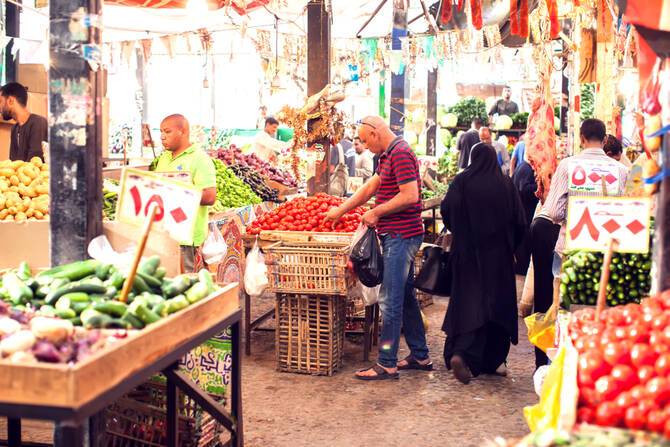
The headline consumer price index reached 257.1 points, up from 256.6 in July, according to the latest data from the Central Agency for Public Mobilization and Statistics, or CAPMAS. Shutterstock
Short Url
Updated 10 September 2025
Follow

Egypt’s CPI rises 0.2% in August as food, housing costs climb

JEDDAH: Egypt’s consumer prices rose 0.2 percent in August, reversing July’s drop, as higher food, tobacco, housing and healthcare costs outweighed declines in meat, fruits and sugar. 

The headline consumer price index reached 257.1 points, up from 256.6 in July, according to the latest data from the Central Agency for Public Mobilization and Statistics, or CAPMAS. 

Annual inflation slowed to 11.2 percent from 13.1 percent a month earlier. 

The rise in Egypt’s CPI comes amid ongoing efforts to stabilize the economy following a series of external shocks, including regional conflicts and Red Sea trade disruptions, according to a July report by the International Monetary Fund.  

It noted that while inflation has eased since September 2023, it remains a key policy challenge due to its heavy impact on purchasing power. 

Food and beverages rose 0.1 percent on the month, led by dairy, cheese and eggs up 0.8 percent, mineral water and juices up 0.8 percent, and oils, fats, coffee and grains each up 0.1 percent.  

Prices declined for meat and poultry by 1.3 percent, fish and seafood by 0.5 percent, fruits by 0.5 percent and sugar by 0.4 percent. 

Outside food, tobacco climbed 1 percent on higher cigarette prices, while clothing and footwear gained 0.9 percent. Housing, water, electricity, gas and fuel advanced 0.5 percent, driven by a 0.9 percent increase in actual rents.  

Household equipment and maintenance rose 1 percent, supported by appliances up 1.4 percent and maintenance goods up 1.1 percent. 

Healthcare increased 0.8 percent on the back of hospital services rising 2.8 percent, while transport slipped 0.3 percent as services declined 0.8 percent. Restaurants and hotels gained 0.4 percent, and miscellaneous goods and services added 0.4 percent. 

On an annual basis, healthcare costs surged 34.2 percent, housing rose 20.1 percent, tobacco 24.6 percent and transport 21.4 percent. Food and beverages increased 1.3 percent, underscoring divergent price pressures across Egypt’s consumption basket.  

With external financing stabilized through IMF support and ongoing reforms, Egyptian authorities are aiming to balance fiscal consolidation with measures to shield vulnerable groups from inflation shocks. 


Saudi Arabia, WEF launch initiative to reshape global travel landscape

Updated 11 November 2025
Follow

Saudi Arabia, WEF launch initiative to reshape global travel landscape

  • ‘Beyond Tourism’ is global framework advancing sustainability, inclusivity, and resilience in the sector

RIYADH: Saudi Arabia has partnered with the World Economic Forum to launch the “Beyond Tourism” initiative, a global framework designed to drive a more sustainable, inclusive, and resilient future for the travel and tourism sector.

Announcing the initiative on his X account, Saudi Minister of Tourism Ahmed Al-Khateeb said he was “thrilled to announce the launch,” noting that it is “dedicated to shaping the future of travel and tourism and is built around 10 core principles.”

Al-Khateeb emphasized that Beyond Tourism underscores the sector’s vital role as “a bridge between cultures, a means to empower communities, and a source of opportunities for future generations.”

The initiative comes as the global travel and tourism industry undergoes a major structural shift — moving away from fragmented, business-as-usual models toward integrated, ecosystem-based strategies.

According to the World Economic Forum, the sector is projected to reach 30 billion tourist visits and contribute $16 trillion to global gross domestic product by 2034. Yet, it continues to face complex challenges including rising tension between visitors and residents, environmental pressures, workforce shortages, and exposure to geopolitical and climate disruptions.

“The global travel and tourism sector is entering a period of profound transformation, moving decisively from a fragmented, business-as-usual operating model to a holistic, ecosystem-based paradigm,” the WEF said in a statement.

The forum noted that past reliance on siloed policies — a weakness underscored during the COVID-19 pandemic — has proven insufficient to address today’s global challenges.

Its proposed ecosystem approach focuses on five key enablers: infrastructure, finance, technology and innovation, people and skills, and policy and governance. The model aims to convert systemic challenges into opportunities for inclusive and sustainable growth.

Several destinations have already demonstrated the benefits of this approach. Countries such as Portugal, New Zealand, Costa Rica, Singapore, and Indonesia have leveraged it to improve conservation outcomes, diversify economies, and strengthen sustainable tourism development.

By promoting global cooperation among governments, private-sector leaders, and local communities, the Beyond Tourism initiative seeks to unlock the full potential of the industry while safeguarding cultural and natural heritage for generations to come.