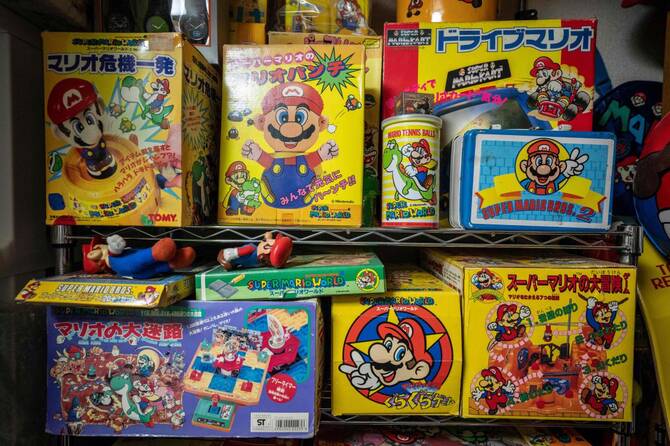
PARIS: Surrounded by thousands of objects bearing the likeness of Nintendo’s moustachioed plumber, 40-year-old Kikai reflects that his “life would be totally different without Mario” who also marks four decades this week.
The colorful “Super Mario Bros.,” released for Nintendo’s home consoles in Japan on September 13, 1985, was a landmark of early video gaming.
Players controlled the eponymous character as he ran and hopped his way from left to right through a colorful world of platforms, pipes and scowling enemies — all set to the jaunty eight-bit music that has stuck in minds for decades.
“My father bought me the game, and I’ve been playing for as long as I can remember,” Kikai told AFP in his office lined with somewhere between 20 and 30 thousand Mario-related objects, from plastic figurines to plush toys and carpets.
Created by legendary game designer Shigeru Miyamoto, Mario has obsessed several generations of fans like Kikai.
The character’s first appearance came in 1981 arcade game “Donkey Kong,” when he was known simply as “Jumpman.”
Mario’s christening came in 1983 with the “Mario Bros.” arcade cabinet, but his true rise to fame was with “Super Mario Bros.” on Nintendo’s Famicom console (known as the NES in Europe), which has sold more than 40 million copies.
“It was a lucky accident, because at the start there was no plan for this character to become a video gaming icon,” said Alexis Bross, the French co-author of the book “Mario Generations.”
The plumber’s look was initially chosen to conserve scarce computing resources and make him stand out on screen, with bright blue overalls and a cap that saved on animating hair.
Miyamoto created Mario as “a completely functional character under very strict technical constraints” governing the few pixels making up his image, Bross noted.
But as the games endured through the years, their star became a “generation-spanning” and even “reassuring” presence, he added.
“He’s a regular man, not unlike us, who has no special powers at the outset and stays a bit frozen in time.”
Beyond Mario’s mainline adventures, spinoff games have dropped him, his buddies like brother Luigi and his rivals like dragon Bowser into “Mario Golf,” “Mario Tennis” and the vastly popular “Mario Kart.”
Graphics have evolved from 2D to 3D as the games’ reach has spread to many hundreds of millions of players worldwide.
But the original pixelated look has long inspired artists making their own riffs on the character.
Lyon-based street artist In The Woup, who declined to give his real name, has been mashing Mario up with other characters like Gandalf from “The Lord of the Rings” or “Star Wars” antagonist Darth Vader in guerilla mosaics dotting cities around the world for years.
“Bringing things from my games console out on the street means bringing immaterial things out into real life. I thought that was pretty crazy,” the 39-year-old said, a Mario mask securely concealing his face to keep up his anonymity.
Many of today’s children and teens have turned toward more recent heavyweight gaming titles such as Fortnite and Roblox.
But Mario still enjoys a high “parental nostalgia” quotient, with those now heading into middle age still buying the games and playing together with their offspring, said Rhys Elliott of analytics firm Alinea.
Nintendo has looked to evolve along with its audience, recently launching a range of baby clothing and accessories in Japan.
Mario also graces goods from luxury watches to Lego, as well as being the star of theme parks in both Japan and the US.
And in 2023, the plucky plumber made a successful leap to the big screen after a 1993 flop that was one of the first ever game-to-movie adaptations.
The more recent film brought in over $1.3 billion, with a sequel in the works for next year.
With gender relations in a different light today than 40 years ago, Mario’s objective in-game is no longer securing a kiss from a grateful rescued princess.
Nintendo’s princesses are more likely these days to star in their own titles, as the company “adapts to new audiences, following little by little developments in society,” author Bross said.
Even now, fans are eagerly awaiting a new Mario-led 3D adventure following the blockbuster release of the Nintendo Switch 2 console this June.
Bross hopes to see “a totally new idea that will be a new milestone in the history of videogames.”

40 years of ‘Mario’ games that have grown up with fans
https://arab.news/cx9na
40 years of ‘Mario’ games that have grown up with fans
- Surrounded by thousands of objects bearing the likeness of Nintendo’s moustachioed plumber, 40-year-old Kikai reflects that his “life would be totally different without Mario”
‘Right to enjoy culture’: Prisoner sues Australian state for ban on Vegemite
- Andre McKechnie, serving a life sentence for murder, takes his battle for the salty, sticky, brown byproduct of brewing beer to the Supreme Court of Victoria
MELBOURNE, Australia: A prisoner is challenging an Australian state’s ban on prisoners eating Vegemite, claiming in a court suit that withholding the polarizing yeast-based spread that most of the nation revers as an unfairly maligned culinary icon breaches his human right to “enjoy his culture as an Australian.”
Andre McKechnie, 54, serving a life sentence for murder, took his battle for the salty, sticky, brown byproduct of brewing beer to the Supreme Court of Victoria, according to documents the court registry released to The Associated Press on Tuesday.
While more than 80 percent of Australian households are estimated to have a jar of Vegemite in their pantries, inmates in all 12 prisons in Victoria are going without as the national favorite for smearing thinly across breakfast toast is considered contraband.
McKecknie is suing Victoria’s Department of Justice and Community Safety and the agency that manages the prisons, Corrections Victoria. The case is scheduled for trial next year.
Prisoner argues Vegemite ban breaches Charter of Human Rights and Responsibilities
McKechnie is seeking a court declaration that the defendants denied him his right under the Charter of Human Rights and Responsibilities Act to “enjoy his culture as an Australian.”
The Act guarantees “All persons with a particular cultural, religious, racial or linguistic background” the right to “enjoy their culture, to declare and practice their religion and to use their language.”
He also wants a declaration that the defendants breached the Corrections Act by “failing to provide food adequate to maintain” McKechnie’s “well-being.”
He wants the court to order the decision to ban Vegemite to be “remade in accordance with the law.”
Vegemite has been banned from Victorian prisons since 2006, with Corrections Victoria saying it “interferes with narcotic detection dogs.”
Inmates used to smear packages of illicit drugs with Vegemite in the hope that the odor would distract the dogs from the contraband.
Vegemite also contains yeast, which is banned from Victorian prisons because of its “potential to be used in the production of alcohol,” the contraband list says.
The Australian favorite since 1923 considered an acquired taste
Manufactured in Australia since 1923 as an alternative to Britain’s Marmite, Vegemite was long marketed as a source of vitamin B for growing children.
The spread is beloved by a majority of Australians, but typically considered an acquired taste at best by those who weren’t raised on it.
The last US president to visit Australia, Barack Obama, once said: “It’s horrible.”
Australian band Men at Work aroused international curiosity about the yeast-based spread when they mentioned a “Vegemite sandwich” in their 1980s hit “Down Under.”
The band’s lead singer Colin Hay once accused American critics of laying Vegemite on too thick, blaming a “more is more” US culture.
It’s a favorite on breakfast toast and in cheese sandwiches, with most fans agreeing it’s best applied sparingly. Australian travelers bemoan Vegemite’s scarcity overseas.
The Australian government intervened in April when Canadian officials temporarily prevented a Toronto-based cafe from selling Vegemite in jars and on toast in a dispute media branded as “Vegemite-gate.” Canadians relented and allowed the product to be sold despite its failure to comply with local regulations dealing with food packaging and vitamin fortification.
The Department of Justice and Community Safety and Corrections Victoria declined to comment on Tuesday. Government agencies generally maintain it is not appropriate to comment on issues that are before the courts.
Queensland prisons also ban Vegemite, but Australia’s most populous state, New South Wales, does not. Other Australian jurisdictions have yet to tell AP on Tuesday where they stand on the spread.
Victims of crime brand Vegemite lawsuit frivolous and offensive
Victims of crime advocate and lawyer John Herron said it was a frivolous lawsuit and was offensive to victims’ families.
“As victims, we don’t have any rights. We have limited if any support. It’s always about the perpetrator, and this just reinforces that,” said Herron, whose daughter Courtney Herron, was beaten to death in a Melbourne park in 2019. Her killer was found not guilty of murder by reason of mental impairment.
“It’s not a case of Vegemite or Nutella or whatever it may be. It’s an extra perk that is rubbing our faces in the tragedy that we’ve suffered,” Herron added.
McKechnie is currently held at maximum-security Port Phillip Prison. He was 23 years old when he stabbed to death wealthy Gold Coast property developer Otto Kuhne in Queensland state in 1994.
He was sentenced to life for murder and transferred a decade later from the Queensland to the Victorian prison system.
He wrote last year that he spent eight years out on parole in Victoria before he decided that the system “had done more damage than good” and opted to return to prison.
McKechnie’s lawyers didn’t respond to a request for comment on Tuesday.