

Flood-hit India, Pakistan face rising basmati prices amid crop losses

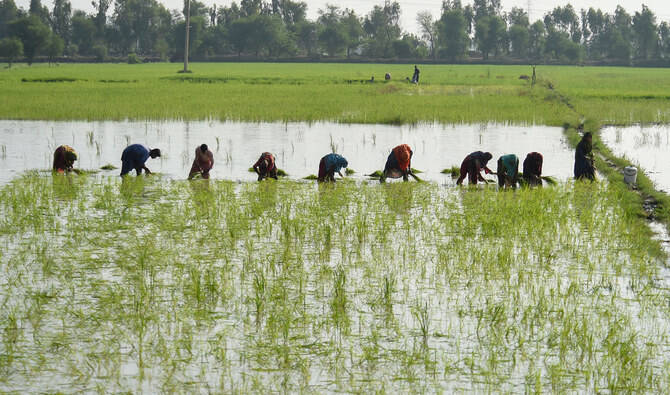
In this picture, taken on September 2, 2022, farmers plant paddy saplings in a field in flood-hit Sukkur, Sindh province. (Photo courtesy: AFP)
Short Url
Updated 08 September 2025
Follow

Flood-hit India, Pakistan face rising basmati prices amid crop losses

  • India’s northern states of Punjab and Haryana contribute over 80 percent, while Pakistan’s Punjab province accounts for over 90 percent of the total basmati rice production
  • Heavy rainfall in late August and earlier this month caused the Ravi, Chenab, Sutlej, and Beas rivers to overflow, flooding these regions in the two countries

MUMBAI/KARACHI: Heavy rains and widespread flooding in basmati rice-growing regions of India and Pakistan have raised concerns over output of the premium staple, driving prices higher as supplies are expected to fall.

India and Pakistan exclusively grow aromatic basmati rice, which sells for nearly twice the price of regular varieties and is primarily imported by Britain, the Middle East, and the United States.

Floods have severely affected the basmati rice crop, but with waters now receding, losses are expected to remain limited provided there is no additional rainfall, said Nitin Gupta, senior vice president at Olam Agri India.

India’s northern states of Punjab and Haryana contribute over 80 percent of the country’s total basmati rice production, while Pakistan’s Punjab province accounts for more than 90 percent of its output.

Heavy rainfall in late August and earlier this month caused the Ravi, Chenab, Sutlej, and Beas rivers to overflow, flooding these regions.

Initial assessments indicate that crops such as paddy, cotton, and pulses on nearly one million hectares were affected in Punjab and Haryana, said an Indian government official.

In Pakistan’s Punjab province rice, sugarcane, corn, vegetables, and cotton on thousands of hectares were submerged earlier this month.

The floods have hit farmers hard, just as crops such as basmati rice and cotton were nearing harvest, said Ibrahim Shafiq, export manager at Latif Rice Mills Pvt Ltd.

In India and Pakistan, paddy seedlings are usually transplanted in June–July, with harvesting starting in late September.

The industry was expecting a bumper crop, but the damage is likely to reduce supplies and push basmati rice prices higher, Shafiq said.

“Conservative estimates put the damage at 20 percent of basmati rice grown in Pakistan...This would definitely drive up the price for basmati rice in local markets as well as international markets,” Shafiq said.

Traders have raised prices by $50 per ton over the past week, and they could rise further if supply shortages remain significant by the end of the harvest, said Gupta of Olam.

However, some industry officials, including Karachi-based Chela Ram Kewlani, say the current price rise is temporarily fueled by reports of crop damage and is expected to ease once supplies from the new season’s harvest arrive.


Gun attack kills policeman, civilian during polio drive in northwest Pakistan

Updated 4 sec ago
Follow

Gun attack kills policeman, civilian during polio drive in northwest Pakistan

  • Pakistani authorities have temporarily suspended vaccination activities in Bajaur district
  • The campaign that started this week aims to vaccinate over 45 million children in Pakistan

PESHAWAR: A gun attack on a polio vaccination team in Pakistan’s northwestern Bajaur district killed a police constable and a civilian on Tuesday, prompting authorities to suspend vaccination activities in the area, officials said.

The attack took place in a small settlement of Bajaur’s Salarzai tehsil, near the Afghan border, where militants have targeted health workers and security personnel involved in polio campaigns in the past despite police escorts assigned to protect vaccination teams.

Pakistan and neighboring Afghanistan are the only two countries where polio remains endemic, and vaccination drives have frequently been disrupted by militant violence, misinformation and vaccine hesitancy.

Authorities routinely deploy police and paramilitary forces to guard polio teams, but attacks have continued in recent years.

“The incident occurred at approximately 12:20 p.m. in Village Tangi Loei Khel, UC Khar 2, when unidentified individuals opened fire on Constable Sajjad, killing him on the spot,” said Shadab Younas, a media officer at the Peshawar Emergency Operations Center.

A civilian bystander, Fazal Rahim, was also hit by gunfire and later died of his injuries after being taken to Khar Hospital, Younas continued, adding that the polio team itself was unharmed.

Global polio tracking data show that 30 of the 39 confirmed wild poliovirus type 1 cases worldwide in 2025 were reported in Pakistan, with the remainder in Afghanistan. Pakistan recorded 74 polio cases in 2024, a sharp rise from six cases in 2023 and just one in 2021, underscoring the fragility of eradication efforts.

Prime Minister Shehbaz Sharif condemned the attack and directed authorities to swiftly identify and bring the perpetrators to justice, according to a statement from his office.

He said the assault on those serving the nation’s polio eradication effort was “deeply regrettable” and reaffirmed that the campaign would continue with full resolve until the disease is eliminated.

The National Emergency Operations Center (NEOC) said the nationwide polio campaign was continuing for a second day, reporting that more than 13.3 million children were vaccinated across the country on the first day of the drive.

The campaign, which started on Dec. 15 and will continue until Dec. 21, aims to administer oral polio drops to more than 45 million children across the country.

Health officials urged parents and communities to cooperate with vaccination teams and ensure children under five receive the drops.

Pakistan and Afghanistan are conducting the polio campaign simultaneously, the NEOC said.