Nepal lifts ban on social media platforms after protests where police killed 19 people

1 / 2
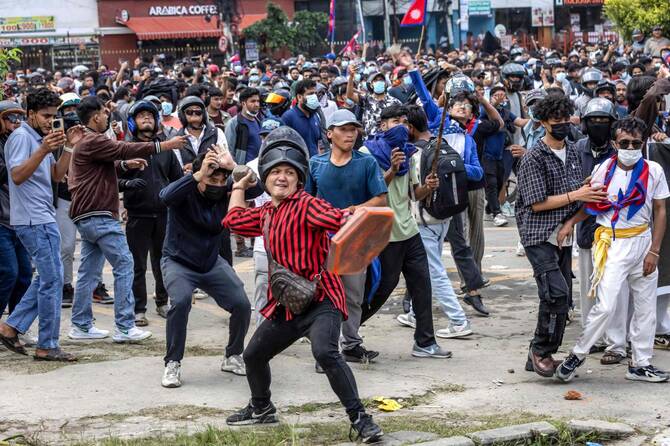
An aerial view shows demonstrators gathered outside Nepal's Parliament (top) during a protest in Kathmandu on September 8, 2025, condemning social media prohibitions and corruption by the government. (AFP)
2 / 2
Demonstrators clash with riot police personnel during a protest outside the Parliament in Kathmandu on September 8, 2025, condemning social media prohibitions and corruption by the government. (AFP)
Short Url
Updated 09 September 2025
Follow

Nepal lifts ban on social media platforms after protests where police killed 19 people

  • The Home Minister Ramesh Lekhak also resigned late Monday at an emergency Cabinet meeting called by Prime Minister Khadga Prasad Oli

KATMANDU: Nepal’s government lifted ban on social media platforms Tuesday a day after violent street protests that left at least 19 people killed.
Some of the world’s largest platforms, including Facebook, X and YouTube were blocked last week, followed by a massive protest rally in the capital Kathmandu on Monday.
Police in Nepal’s capital of Kathmandu opened fire Monday on demonstrators protesting a government attempt to regulate social media.
The Home Minister Ramesh Lekhak also resigned late Monday at an emergency Cabinet meeting called by Prime Minister Khadga Prasad Oli.
Rallies swept the streets around the Parliament building, which was surrounded by tens of thousands of people angry at authorities who said the companies had failed to register and submit to government oversight.
The gunfire unfolded as the government pursues a broader attempt to regulate social media with a bill aimed at ensuring the platforms are “properly managed, responsible and accountable.” The proposal has been widely criticized as a tool for censorship and for punishing government opponents who voice their protests online.
About two dozen social networks that are widely used in Nepal were repeatedly given notices to register their companies officially in the Himalayan nation, the government said. Those that failed to register have been blocked since last week.
Neither Google, which owns YouTube, nor Meta, the parent company of Facebook, Instagram and WhatsApp, responded to requests for comment from The Associated Press. Elon Musk’s X platform did not respond either.
The video-sharing app TikTok, Viber and three other platforms have registered and operated without interruption.
The government imposed a curfew around Parliament, the government secretariat, the presidential house and key parts of the city and in two other cities of Nepal.
Seven of those killed and scores of the wounded were received at the National Trauma Center, the country’s main hospital in the heart of Kathmandu.
“Many of them are in serious condition and appear to have been shot in the head and chest,” said Dr. Badri Risa. Families waited anxiously outside for news of their relatives while people lined up to donate blood.
“Stop the ban on social media. Stop corruption, not social media,” the crowds outside Parliament chanted, waving the red and blue national flags. Monday’s rally was called the protest of Gen Z, which generally refers to people born between 1995 and 2010.
The government’s proposed bill includes asking the companies to appoint a liaison office or a point of contact in the country. Rights groups have called it an attempt by the government to curb freedom of expression and fundamental rights.
Nepal in 2023 banned TikTok for disrupting “social harmony, goodwill and diffusing indecent materials.” The ban was lifted last year after TikTok’s executives pledged to comply with local laws, including a ban of pornographic sites that was passed in 2018.


Trump sues the BBC for defamation over editing of January 6 speech, seeks up to $10 billion in damages

Updated 16 December 2025
Follow

Trump sues the BBC for defamation over editing of January 6 speech, seeks up to $10 billion in damages

  • A BBC spokesperson told Reuters earlier on Monday that it had “no further contact from President Trump’s lawyers at this point
  • The BBC is funded through a mandatory license fee on all TV viewers, which UK lawyers say could make any payout to Trump politically fraught

WASHING: President Donald Trump sued the BBC on Monday for defamation over edited clips of a speech that made it appear he directed supporters to storm the US Capitol, opening an international front in his fight against media coverage he deems untrue or unfair. Trump accused Britain’s publicly owned broadcaster of defaming him by splicing together parts of a January 6, 2021 speech, including one section where he told supporters to march on the Capitol and another where he said “fight like hell.” It omitted a section in which he called for peaceful protest.
Trump’s lawsuit alleges the BBC defamed him and violated a Florida law that bars deceptive and unfair trade practices. He is seeking $5 billion in damages for each of the lawsuit’s two counts. The BBC has apologized to Trump, admitted an error of judgment and acknowledged that the edit gave the mistaken impression that he had made a direct call for violent action. But it has said there is no legal basis to sue.
Trump, in his lawsuit filed Monday in Miami federal court, said the BBC despite its apology “has made no showing of actual remorse for its wrongdoing nor meaningful institutional changes to prevent future journalistic abuses.”
The BBC is funded through a mandatory license fee on all TV viewers, which UK lawyers say could make any payout to Trump politically fraught.
A spokesman for Trump’s legal team said in a statement the BBC “has a long pattern of deceiving its audience in coverage of President Trump, all in service of its own leftist political agenda.”
A BBC spokesperson told Reuters earlier on Monday that it had “no further contact from President Trump’s lawyers at this point. Our position remains the same.” The broadcaster did not immediately respond to a request for comment after the lawsuit was filed.

CRISIS LED TO RESIGNATIONS
Facing one of the biggest crises in its 103-year history, the BBC has said it has no plans to rebroadcast the documentary on any of its platforms.
The dispute over the clip, featured on the BBC’s “Panorama” documentary show shortly before the 2024 presidential election, sparked a public relations crisis for the broadcaster, leading to the resignations of its two most senior officials.
Trump’s lawyers say the BBC caused him overwhelming reputational and financial harm.
The documentary drew scrutiny after the leak of a BBC memo by an external standards adviser that raised concerns about how it was edited, part of a wider investigation of political bias at the publicly funded broadcaster.
The documentary was not broadcast in the United States.
Trump may have sued in the US because defamation claims in Britain must be brought within a year of publication, a window that has closed for the “Panorama” episode.
To overcome the US Constitution’s legal protections for free speech and the press, Trump will need to prove not only that the edit was false and defamatory but also that the BBC knowingly misled viewers or acted recklessly.
The broadcaster could argue that the documentary was substantially true and its editing decisions did not create a false impression, legal experts said. It could also claim the program did not damage Trump’s reputation.
Other media have settled with Trump, including CBS and ABC when Trump sued them following his comeback win in the November 2024 election.
Trump has filed lawsuits against the New York Times, the Wall Street Journal and a newspaper in Iowa, all three of which have denied wrongdoing. The attack on the US Capitol in January 2021 was aimed at blocking Congress from certifying Joe Biden’s presidential win over Trump in the 2020 US election.