

Saudi Arabia leads Pakistan’s August worker remittances as inflows hit $3.1 billion

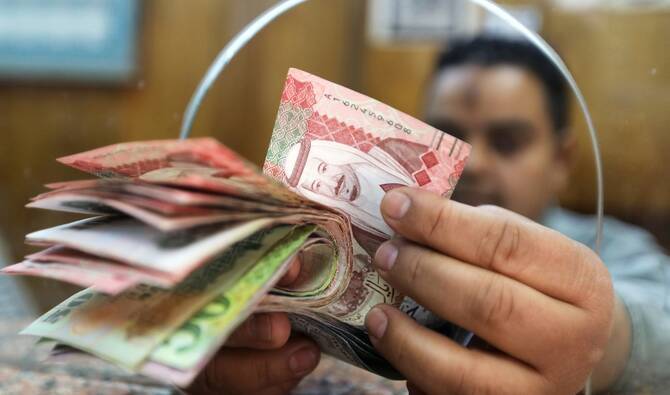
An employee counts Saudi Riyals bills at a money exchange office in central Cairo, Egypt, March 20, 2019. (REUTERS/ file)
Short Url
Updated 08 September 2025
Follow

Saudi Arabia leads Pakistan’s August worker remittances as inflows hit $3.1 billion

  • Remittances rose 6.6 percent year-on-year in August, with cumulative inflows for FY 2025–26 at $6.4 billion
  • Inflows from Gulf nations, led by Saudi Arabia and UAE, remain vital for Pakistan’s balance of payments

KARACHI: Saudi Arabia remained the leading source of remittances to Pakistan in August 2025, sending $736.7 million of the $3.1 billion total received during the month, the State Bank of Pakistan said on Monday. 

Remittances are a key pillar of Pakistan’s external finances, providing hard currency that supports household consumption, helps narrow the current-account gap and bolsters foreign exchange reserves. The steady pipeline from Gulf economies, led by Saudi Arabia and the UAE, has remained crucial for Pakistan’s balance of payments.

Pakistan has received a cumulative $6.4 billion in workers’ remittances during the first two months of fiscal year 2025–26 (July-August), marking a 7.0 percent increase from $5.9 billion in the same period last year.

“Workers’ remittances recorded an inflow of $ 3.1 billion during August 2025,” the central bank said. “In terms of growth, remittances increased by 6.6 percent on year-on-year basis.”

The bulk of these inflows originated from Saudi Arabia ($736.7 million), followed by the UAE ($642.9 million), the UK ($463.4 million) and the US ($267.3 million).

Pakistan received a record $38.3 billion in workers’ remittances during the last fiscal year, reporting an increase of about $8 billion over a 12-month period — exceedng the country’s ongoing $7 billion International Monetary Fund (IMF) loan program.

According to the State Bank of Pakistan, Saudi Arabia led all contributors during FY25, with remittances totaling $9.34 billion, followed by the United Arab Emirates at $7.83 billion, the United Kingdom at $5.99 billion and the United States at $3.72 billion.

Remittances from Gulf Cooperation Council (GCC) countries excluding Saudi Arabia and the UAE totaled $3.71 billion, while EU countries contributed $3.53 billion.

Economists say remittances function as a stabilizer for Pakistan’s economy, helping millions of households manage expenses while giving policymakers breathing room during periods of tight external financing conditions. With traditional sources in the Middle East still accounting for the bulk of transfers, the trajectory of regional labor demand remains central to Pakistan’s outlook on remittance flows.


Tolerance for ‘cross-border terrorism’ has reached its limit, Pakistan warns Afghanistan after airstrikes

Updated 7 sec ago
Follow

Tolerance for ‘cross-border terrorism’ has reached its limit, Pakistan warns Afghanistan after airstrikes

  • Pakistan says carried out intelligence-based airstrikes in border regions with Afghanistan on Saturday, killing 80 militants
  • Afghan authorities dismiss allegations, saying Pakistan killed and injured dozens of civilians, vowing an “appropriate” response 

ISLAMABAD: President Asif Ali Zardari has warned Kabul in a recent statement that Islamabad’s tolerance for “cross-border terrorism” has reached its limit after Pakistan carried out airstrikes in Afghanistan to target alleged militant camps. 

A Pakistani security official said Islamabad carried out intelligence-based airstrikes on Saturday and destroyed seven centers of the Pakistani Taliban or the TTP militant group in the three Afghan provinces of Nangarhar, Paktika and Khost. The official said more than 80 militants were killed in the attacks. An earlier statement from Pakistan’s information ministry said the targets included a camp of a Daesh regional affiliate, the Islamic State Khorasan Province (ISKP), which claimed a suicide bombing at an Islamabad Shia mosque that killed 32 people this month.

Saturday’s airstrikes followed a series of attacks inside Pakistan amid a surge in militancy. Authorities say the attacks, particularly in the northwestern Khyber Pakhtunkhwa (KP) province bordering Afghanistan and the Pakistani capital of Islamabad, were carried out by the TTP and allied groups that Islamabad alleges are operating from sanctuaries in Afghanistan. Kabul denies this and urges Pakistan to concentrate on its security issues without blaming Afghanistan.

In a post on X on Sunday, Afghan government spokesperson Zabihullah Mujahid said Pakistani forces had violated Afghanistan’s territory and killed and wounded dozens of civilians in Nangarhar and Paktika. The Afghan Taliban’s claims of civilian casualties could not be independently verified. Pakistan did not immediately comment on the allegation. 
In a statement issued by his office on Sunday night, Zardari said Pakistan’s recent actions in Afghanistan are rooted in its “inherent right” to defend its people against “terrorism” from across the border. 

 “Tolerance for cross-border terrorism has reached its limit,” Zardari said. 

The Pakistani president reiterated Islamabad’s stance that it is concerning that de facto authorities in Kabul continue to allow “terrorist elements” to operate from Afghan soil in violation of their commitments under the Doha Accord, an agreement signed between both sides in October after fierce border clashes last year, Kabul pledged that Afghanistan’s soil would not be used against any country for militant activities.

The president said it was regrettable that despite warnings and repeated engagement from Islamabad, Afghan authorities failed to take action against militants. 

“He said Pakistan exercised restraint for a considerable period and confined its response to terrorist hideouts located near the border areas,” the president’s office said.

“However, he warned that Pakistan is fully aware of where the planners, facilitators and patrons of violence are based. If bloodshed continues inside Pakistan, those responsible will not remain beyond reach.”

Zardari reaffirmed Pakistan seeks peace, stability and cooperative relations with its neighbors. However, the Pakistani president said peace “cannot rest on denial, duplicity or inaction against terrorism.”

“The protection of Pakistani lives remains paramount and non-negotiable,” he added. 

Afghanistan’s Ministry of National Defense said on Sunday that Pakistan’s airstrikes were in breach of international law and Islamic principles.

It warned that an “appropriate and measured response” will be given in a “suitable time.”

Saturday’s airstrikes and subsequent allegations marks one of the most direct confrontations between Islamabad and Kabul in recent months. It risks further straining already fragile ties along the volatile border between the two neighbors.