


KARACHI: Pakistani officials warned on Sunday of “extremely high” river floods as heavy monsoon rains and water releases from Indian dams swelled rivers in Punjab, with the peak expected to hit the Indus in Sindh on Sept. 9.
Heavy monsoon rains and excess water released by Indian dams have caused Punjab’s rivers to swell, triggering floods in the province since late August. At least 56 people have been killed, more than 4,100 villages impacted and over 4.1 million people have been affected, according to the Provincial Disaster Management Authority (PDMA) Director-General Irfan Ali Kathia.
Rains, deluges, landslides and similar incidents have claimed 910 lives nationwide since late June, when the monsoon began in Pakistan. The floodwaters in Chenab, Ravi and Sutlej rivers have now been moving downstream and will reach their peak in the Indus river in the southern Sindh province by Sept. 9, where authorities have evacuated at least 128,000 people.
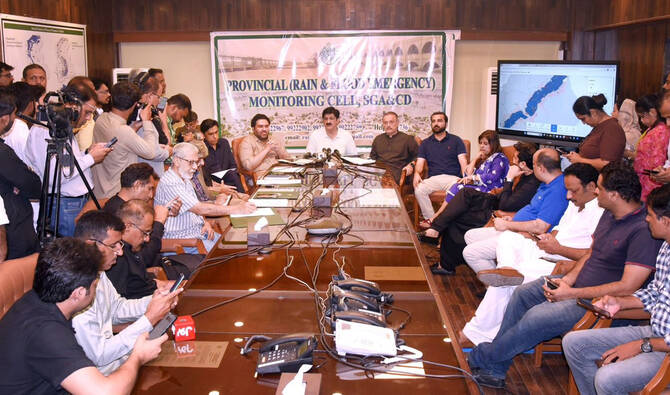
On Sunday, Sindh CM Murad Ali Shah said district commissioners have been asking residents of riverine areas to vacate their homes and move to safer locations as the flood peak is likely to displace more than 320,000 people, adding that provincial ministers are present on both right and left banks of the Indus to directly supervise evacuations.
“In preparation, evacuation of vulnerable riverine populations has been accelerated,” Shah said in a statement, adding that most evacuees had chosen not to stay at relief camps.
“So far, over 40,000 patients have been provided medical aid, while 900,000 livestock have been vaccinated.”
The provincial government is constructing bridges on the Indus highway to facilitate movement of people, according to the chief minister. All relief and health care camps have been geo-tagged, with boats, supplies and staff in place.
“Our preparations are complete. The rain in Sindh is manageable... But we remain cautious,” he said. “At this time, the real need for support is in Punjab. Our health minister has already offered medical assistance to them.”
Punjab is home to half of the country’s 240 million people and accounts for much of its wheat and rice production, with initial estimates suggesting 1.3 million acres of agricultural land have been inundated in the province amid flooding of the Chenab, Ravi and Sutlej rivers.
Pakistan’s National Disaster Management Authority (NDMA) has warned a 10th spell of monsoon season is likely to trigger heavy rains in Punjab and other parts of the country till Sept. 9.
“Due to rains in upper regions, there is a risk of unusual increases in river flows,” Punjab Relief Commissioner Nabeel Javed was quoted as saying by the PDMA.
“By Sept.9, there is a risk of extremely high flooding in rivers Ravi, Sutlej, and Chenab.”
He said all departments of the provincial government are on alert, and all available resources are being utilized to protect the lives and property of citizens.
PUNJAB RIVERS SWELL
The PDMA shared that flooding in Punjab’s rivers was still continuing, adding that Sutlej at Ganda Singh Wala village is experiencing an “extremely high flood level” with a water flow of 311,000 cusecs. At Sulemanki, it said the Sutlej river is facing a high flood level with a water flow of 138,000 cusecs.
At Marala, Chenab has recorded a water level of 84,000 cusecs while at Trimmu Headworks, the water flow has reached 543,000 cusecs, which was categorized as a high flood level.
The PDMA said that Ravi at Jassar location was at a “low” flood level, with its flow recorded at 56,000 cusecs. At Shahdara, the water was recorded at a high flood level of 93,000 cusecs.
“At Balloki Headworks, River Ravi is at an extremely high flood level with a water flow of 148,000 cusecs,” the PDMA said.
Over 4.1 million people have been impacted by the floods in Punjab since late August and authorities have set up more than 400 temporary relief camps, according to PDMA chief Irfan Ali Kathia.
“Around 500 medical camps have served approximately 175,000 individuals,” Kathia said. “Rescue operations in Multan, Muzaffargarh and Rajanpur continue vigorously.”
He said a total of over 2,073,048 people have been rescued, while 1,522,452 animals have been shifted to safer locations across the province.
Pakistan, which ranks among the world’s most climate-vulnerable nations, has experienced increasingly erratic, frequent weather events, including heat waves, untimely rains, storms, cyclones and droughts, in recent years, which scientists have blamed on human-driven climate change.
In May, at least 32 people were killed in severe storms in the South Asian country.


