

Pakistan offers tropical fruits, grains to China as it signs over $4 billion in agri MoUs

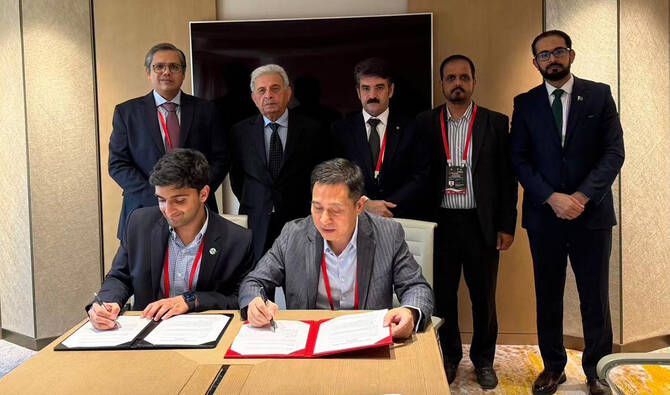
Pakistan’s Federal Minister for National Food Security and Research, Rana Tanveer Hussain (second left-standing), witnessing the signing of agricultural MoUs worth over $4 billion during the Pakistan-China B2B Investment Confrence in Bejing, China, on September 6, 2025. (PID)
Short Url
Updated 06 September 2025
Follow

Pakistan offers tropical fruits, grains to China as it signs over $4 billion in agri MoUs

  • Agriculture minister met over a dozen Chinese firms at B2B event during Sharif’s Beijing visit
  • Pakistan eyes China’s $215 billion annual agricultural import market to boost export-led growth

KARACHI: Pakistan has offered to supply tropical fruits, vegetable and cereal crops to China as it signed more than two dozen agriculture-sector memorandums of understanding worth over $4 billion, its national food security ministry said on Saturday.

The MoUs were finalized at a business-to-business (B2B) investment conference held in Beijing on Sept. 4, coinciding with Prime Minister Shehbaz Sharif’s visit to attend the Shanghai Cooperation Organization summit.

The country’s food security minister, Rana Tanveer Hussain, held meetings with leading agri-industry companies on the sidelines of the conference, inviting Chinese investment in areas like mechanization, seed development, smart farming and precision agriculture to enhance productivity and strengthen Pakistan’s food security.

“Highlighting China’s $215 billion annual agricultural import market, Mr.Hussain said Pakistan can play a significant role in supplying tropical and temperate fruits, vegetables and cereal crops,” the ministry said in a statement.

“He stressed that Pakistan, as China’s closest neighbor and a ‘brotherly country,’ offers geographical proximity and competitive pricing advantages compared to imports from Brazil and other Western countries,” it added.

Pakistan is already receiving agricultural assistance from China after Sharif’s visit last year, when Beijing launched a program to train 1,000 Pakistani agricultural graduates in three phases.

The first batch of about 300 students completed training in Shaanxi province in July, focusing on advanced farming practices, while a second group of 300 departed for China in August.

The initiative aims to equip Pakistan with innovative techniques such as precision agriculture, biotechnology mechanization and modern irrigation systems.

The latest MoUs also come as part of broader Pakistan-China economic cooperation.

Islamabad is planning to float Panda Bonds in the Chinese capital market to boost finances. The national food security ministry’s initiative reflects the government’s continued effort to tap into one of the region’s largest markets as the country pivots toward export-led growth.


Pakistan bulk cargo terminal signs deal to ship copper-gold output from Reko Diq

Updated 6 sec ago
Follow

Pakistan bulk cargo terminal signs deal to ship copper-gold output from Reko Diq

  • Pakistan International Bulk Terminal says the deal positions it as the primary logistics gateway for Reko Diq’s mineral output
  • A top Barrick Mining official says the agreement marks a ‘step forward,’ with exports from the project expected to begin in 2028

ISLAMABAD: A bulk cargo terminal operating at Pakistan’s Port Qasim has signed an agreement to handle and export copper-gold commodities from Reko Diq, including minerals, metals and other natural earth resources, in a move expected to support multibillion-dollar mineral exports from the country, the company said on Monday.

The terminal operator, Pakistan International Bulk Terminal Limited (PIBT), said the agreement positions it as the primary export gateway for Reko Diq’s mineral output and strengthens Pakistan’s ambitions to expand its footprint in global commodity markets.

The deal covers logistics, storage and exports for output from the Reko Diq copper-gold project in southwestern Balochistan province, one of the world’s largest undeveloped mineral deposits, with shipments expected to begin from 2028.

“This agreement is a historic milestone for PIBT and Pakistan, enabling exports from one of the world’s most significant mining projects and serving as a cornerstone for national economic growth,” Sharique Azim Siddiqui, CEO of PIBT, said in a statement.

He expressed appreciation to the government, the Special Investment Facilitation Council, the Ministry of Maritime Affairs and the Port Qasim Authority for their “pivotal role.”

Barrick Mining Corporation, which is developing Reko Diq, also welcomed the agreement.

“We’re delighted to have signed this important agreement with PIBT which marks another step forward in ensuring that Reko Diq delivers lasting value to all our stakeholders but particularly the people of Balochistan and Pakistan,” Mark Hill, the company’s top official, said.

PIBT is a fully mechanized multipurpose bulk terminal located at Port Qasim and was developed with a $305 million investment in partnership with the International Finance Corporation.

The terminal currently has an annual handling capacity of 12 million tons of imports and 4 million tons of exports, with further investment planned to upgrade its export systems, the company said.