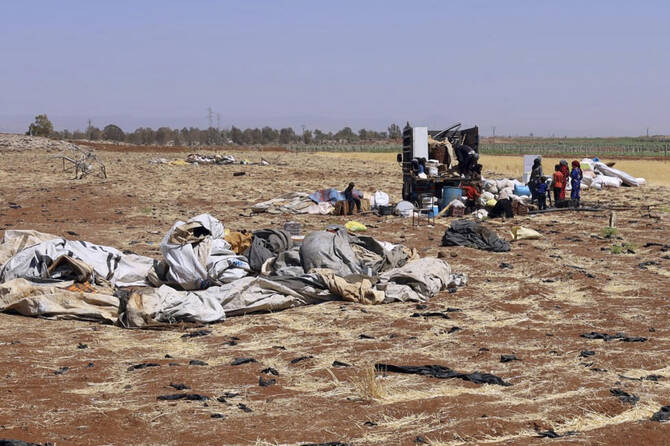
ABTAA, Syria: The classrooms at a school building in Abtaa, in Syria’s southern province of Daraa, have turned into living quarters housing three or four families each. Because of the lack of privacy and close quarters, the woman and children sleep inside, with the men bedding down outside in the courtyard.
The Bedouin families evacuated their villages during sectarian fighting more than a month ago in neighboring Sweida province. Since then, the central government in Damascus has been in a standoff with local Druze authorities in Sweida, while the displaced have been left in a state of limbo.
Munira Al-Hamad, a 56-year-old from the village of Al-Kafr in the Sweida countryside, is staying with her family in the school, which is set to reopen this month. If that happens, she doesn’t know where her family will go.
“We don’t want to live in tents. We want the government to find us houses or someplace fit to live,” she said. “It’s impossible for anyone to return home. Just because you’re Muslim, they’ll see you as the enemy in Sweida.”
Conflict displaces tens of thousands
What began last month with small-scale clashes between local Sunni Muslim Bedouin clans and members of the Druze sect — who are a minority in Syria but the majority in Sweida — escalated into heavy fighting between Bedouins and government fighters on one side and Druze armed groups on the other. Israel intervened on the side of the Druze, launching airstrikes.
Hundreds of civilians, mostly Druze, were killed and Sweida has remained under what residents describe as a siege since then, with limited aid and supplies going in. Amnesty International reported this week that it had documented 46 cases of “Druze men and women deliberately and unlawfully killed,” in some cases by “government and government-affiliated forces in military and security uniforms.”
Although the fighting has subsided, more than 164,000 people remain displaced by the conflict, according to UN figures.
They include Druze internally displaced within Sweida and Bedouins who fled or were evacuated from the province and now see little prospect of going back, raising the prospect of permanent demographic change.
Al-Hamad said her family “remained under siege for 15 days, without bread or anything coming in” before the Syrian Arab Red Crescent evacuated them. Her cousin and a neighbor were attacked by armed men as they fled and had their cars stolen with all the belongings they were transporting, she said.
Jarrah Al-Mohammad, 24, said dozens of residents trekked overnight on foot to escape when the fighting reached their village, Sahwat Balata. Nine people from the area were gunned down by Druze militants, including three children under the age of 15, all of them unarmed, he said. The Associated Press could not independently verify the account.
“No one has gone back. There are houses that they burned and destroyed and stole the furniture,” he said. “We can’t return to Sweida — there’s no longer security between us and the Druze … And we’re the minority in Sweida.”
At a hotel in the Damascus suburb of Sayyida Zeinab that has been converted into a shelter for the displaced, Hamoud Al-Mukhmas and his wife, Munira Al-Sayyad, are mourning their 21- and 23-year-old sons.
They said the two were shot and killed by militants, along with Hamoud’s niece and cousin, while unarmed and trying to flee their home in the town of Shahba.
Al-Sayyad is unhappy in the hotel room, where she has no kitchen to cook for her younger children. The family said food aid is sporadic.
“I need assistance and I need money — we don’t have a house,” Al-Mukhmas said. ”I don’t think we’ll go back — we’d go back and find the Druze living in our houses.”
Few answers from the government
Government officials have insisted that the displacement is temporary, but have not offered any “clarity on for how long people will be displaced, what are the mechanisms or plans or strategies that they have in order to bring them back,” said Haid Haid, a senior research fellow at the Arab Reform Initiative and the Chatham House think tank.
Returning the displaced to their homes will likely require a political solution that appears to be far off, given that the government in Damascus and de facto authorities in Sweida are not even holding direct talks, he said.
Sheikh Hikmat Al-Hijri, a prominent Druze leader in Sweida, is calling for independence for southern Syria — a demand rejected by Damascus — and recently announced the formation of a “national guard” formed from several Druze armed factions.
Government officials declined to comment on their plans for addressing the displacement.
For some, the situation recalls unpleasant memories from Syria’s nearly 14-year civil war, when fighters and civilians opposed to former President Bashar Assad were evacuated from areas retaken from rebels by government forces. The green buses that transported them became for many a symbol of exile and defeat.
Intercommunal tensions now harder to solve
The Bedouins in Sweida, who historically work as livestock herders, consider themselves the original inhabitants of the land before the Druze came in the 18th century, fleeing violence in what is now Lebanon. The two communities have largely coexisted, but there have been periodic tensions and violence.
In 2000, a Bedouin killed a Druze man in a land dispute and government forces intervened, shooting Druze protesters. After a 2018 Daesh group attack on the Druze in Sweida that killed more than 200 people, the Druze accused the Bedouins of helping the militants.
The latest escalation began with a Bedouin tribe in Sweida setting up a checkpoint and attacking and robbing a Druze man, which triggered tit-for-tat attacks and kidnappings. But tensions had been rising before that.
A Bedouin man displaced from Al-Kafr, who spoke on condition of anonymity out of security fears, said that his brother was kidnapped and held for ransom in 2018 by an armed group affiliated with Al-Hijri. On July 12, a day before the clashes started, he said, a group of armed men came to the family’s home and threatened his father, forcing him to sign a paper giving up possession of the house.
The Druze “are not all bad people,” he said. “Some of them supported us kindly, but there are also bad militants.”
He threatened that “if the state does not find a solution after our homes have been occupied, we will take our rights into our own hands.”
Al-Sayyad, the mother of the two young men killed, also took a vengeful tone.
“I want the government to do to these people what they did to my sons,” she said.
Haid said that intercommunal tensions could be resolved with time but have now become secondary to the larger political issues between Damascus and Sweida.
“Unless there is some sort of dialogue in order to overcome those difference, it’s difficult to imagine how the local disputes will be solved,” he said.


![]()

Displaced Bedouin families in limbo as Syrian government and Druze authorities remain at odds
Short Url
https://arab.news/cwm2f
Displaced Bedouin families in limbo as Syrian government and Druze authorities remain at odds
- In Syria’s southern province of Daraa, classrooms have become temporary homes for displaced Bedouin families, who fled sectarian fighting in neighboring Sweida province over a month ago


Latest updates


© 2026 SAUDI RESEARCH & PUBLISHING COMPANY, All Rights Reserved And subject to Terms of Use Agreement.