

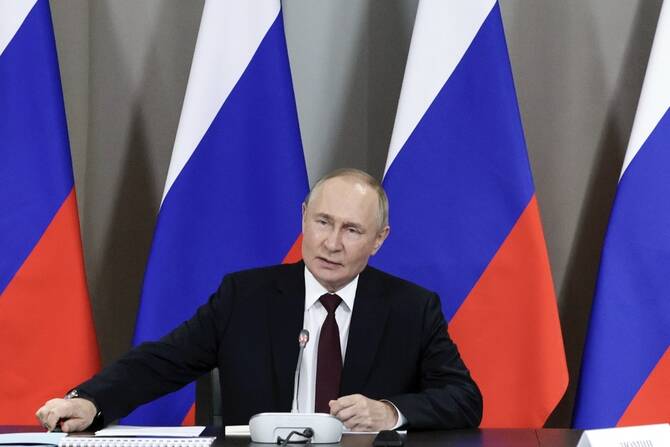
Putin urges Russia’s aerospace industry to develop rocket engines

Putin said Russia remained a leading force in the development of the aerospace industry. (AP)
Short Url
Updated 06 September 2025
Follow

Putin urges Russia’s aerospace industry to develop rocket engines

MOSCOW: President Vladimir Putin urged aerospace industry leaders on Friday to press on with efforts to develop booster rocket engines for space launch vehicles and build on Russia’s longstanding reputation as a leader in space technology.

Putin, who has spent the past week in China and the Russian far eastern port of Vladivostok, flew to the southern Russian city of Samara, where he met industry specialists and toured the Kuznetsov design bureau aircraft engine manufacturing plant.

Quoted by Russian news agencies, Putin said Russia remained a leading force in the development of the aerospace industry.

“It is important to consistently renew production capacity in terms of engines for booster rockets,” the agencies quoted Putin as saying late on Friday.

“And in doing so, we must not only meet our own current and future needs but also move actively on world markets and be successful competitors.”

Putin noted Russian success in developing innovations in terms of producing engines, particularly in the energy sector, despite the imposition of sanctions by Western countries linked to Moscow’s 2022 invasion of Ukraine.

“In conditions of restrictions from sanctions, we succeeded in a short period of time in developing a series of innovative engines for energy,” Putin was quoted as saying. “These are being actively used, including in terms of gas transport infrastructure.”

Putin called it “an extremely important theme,” particularly for the development of Russian gas exports, including the planned Power of Siberia 2 pipeline under discussion in China this week to bring Russian gas to China.

Putin praised the Power of Siberia 2 pipeline as beneficial to both sides. Russia proposed the route years ago, but the plan has gained urgency as it looks to Beijing as a customer to replace Europe, which is trying to reduce Russian energy supplies since the Russian invasion of its smaller neighbor.

Putin also pointed to the development of the PD-26 aircraft engine, saying it would allow for the development of military transports and wide-bodied passenger planes.

“The development of this project will allow for the modernization not only of military transport aircraft, but also opens up prospects for construction of a new generation of wide-bodied civil planes,” he was quoted as saying.


UN says lacks billions of dollars to feed world’s hungry

Updated 3 sec ago
Follow

UN says lacks billions of dollars to feed world’s hungry

  • Up to 318 million people facing severe hunger in 2026
  • UN agencies this year declared famine in Gaza and parts of Sudan
ROME: The UN’s World Food Programme warned Tuesday that funding cuts mean it will struggle to feed even a third of the 318 million people facing severe hunger in 2026.
“Declines in global humanitarian funding are forcing WFP to prioritize food assistance to roughly one third of those in need,” targeting 110 million of the most vulnerable, it said in a statement.
That would cost $13 billion, the agency estimated – but warned that “current funding forecasts indicate WFP may only receive close to half that goal.”
The WFP’s largest donor is the United States which, under President Donald Trump, has cut foreign aid, including to UN agencies. Other big donors, including some European nations, have also shrunk their humanitarian budgets.
The 318 million people facing acute hunger is more than double the figure recorded in 2019, as conflict, extreme weather and economic instability have taken their toll, the WFP said.
UN agencies this year declared famine in Gaza and parts of Sudan, something that WFP executive director Cindy McCain called “completely unacceptable in the 21st century.”
In a foreword to the WFP’s 2026 Global Outlook report, she said the world’s response “remains slow, fragmented and underfunded.”
“Global aid now covers less than half of total needs, with steep reductions in food assistance. Almost all operations have had to cut food and cash, and prioritize which vulnerable group receive help,” she wrote.
“At the same time, attacks on aid workers have surged, revealing a growing disregard for international humanitarian law.”
For those facing hunger in 2026, 41 million people are classified as facing emergency or worse levels.
Last week, both UN food agencies – WFP and the Food and Agriculture Organization (FAO) – warned of 16 “hunger hotspots” around the globe, from Haiti to South Sudan, saying that funding shortfalls were worsening already dire conditions.
In a joint report, the agencies said that they had so far received only $10.5 billion out of a required $29 billion to help those at risk.