



RIYADH: Saudi Arabia has set sustainability goals as part of its long-term vision, embedding green practices into urban development strategies to enhance environmental conditions and improve quality of life.
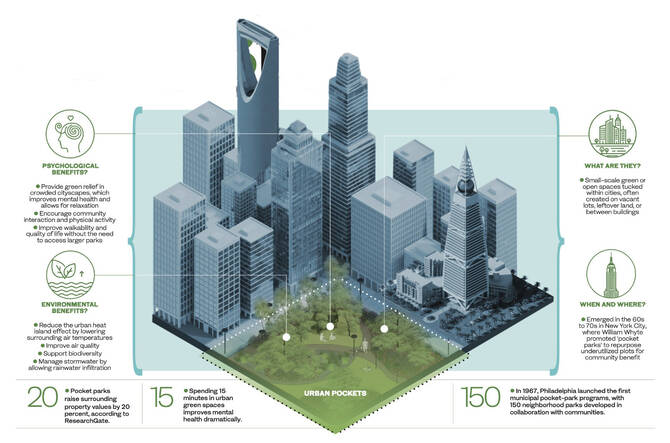
One approach gaining international traction, and increasingly relevant in the Kingdom, is the creation of “urban pockets” — also known as pocket parks.
These small gardens, designed for densely built-up areas, make use of underutilized spaces such as vacant lots between buildings, rooftops, or even courtyards in shopping centers. Several examples already dot Riyadh’s retail landscapes.

King Abdullah Economic City (KAEC) in Rabigh, located along Saudi Arabia's Red Sea Coast, is renowned for its beaches, lush green spaces, and family-friendly attractions. (SPA)
Besides bringing nature and beauty to city life, these modest spaces carry significant environmental benefits. By providing shade and supporting evapotranspiration, they serve as natural cooling systems — a critical function in Saudi Arabia’s climate.
“I see small urban green pockets as essential components of sustainable city planning, especially in Saudi Arabia’s climate,” Mohamed Khattab, a civil engineer promoting urban green space adoption, told Arab News.

Rafha, a governorate in the Northern Borders region, has a continuing program of expanding its green spaces as part of Saudi Vision 2030. (SPA)
The cooling effect of pocket parks is well-documented. A study conducted by Chinese scientists and published by ScienceDirect examined 14 such parks in Shanghai. Using drones to collect canopy and thermal data, the researchers compared temperatures within green pockets to surrounding non-vegetated areas.
They found surface temperatures were nearly 4 C lower, while air temperatures dropped by about 1.2 C. Overall thermal comfort, measured using the Universal Thermal Climate Index, improved by 3.7 C.
Opinion
This section contains relevant reference points, placed in (Opinion field)
For Saudi Arabia, the benefits extend well beyond climate control. Khattab noted that pocket parks also help purify the air. Urban pockets serve many other functions, including improving air quality through absorbing pollutants and releasing oxygen using the vegetation.
These innovations, he added, can help improve the quality of life in Saudi Arabia.

Salam Park, one of of the biggest of Riyadh City's green spaces, is a popular destination in the national capital. (Photo: Royal Commission for Riyadh City)

In Qassim, green spaces have been sprouting up as part of the are just of the region's urban interventions, particularly in the city of Buraidah. (SPA)
Accessible green areas allow people to relax, walk, and socialize, fostering healthier lifestyles and stronger communities. They also enhance the visual and environmental value of neighborhoods, making cities more appealing and inclusive.
Yet integrating pocket parks into dense, fast-developing cities requires foresight. “From a project control perspective, integrating these pockets requires strategic planning, balancing cost, schedule, and stakeholder expectations,” said Khattab.
“But the long-term benefits in terms of public health, environmental resilience, and urban quality of life make them a smart and impactful investment for Saudi cities.”

In Jeddah, efforts are being intensified to adopt a human-centered approach through the 'Bahja' project, one of the city's flagship initiatives aimed at enhancing quality of life by transforming open and underutilized spaces into vibrant urban parks. (SPA)

Hail, in the Kingdom's northwest, has stepped up development of its already expansive green areas, complete with paths for walking and cycling, family facilities and children’s spaces to promote recreation and well-being. to promote recreation and well-being. (SPA)
Urban planners must also ensure inclusivity. “Designers must creatively use available spaces such as rooftops, vertical gardens, and pocket parks between buildings to introduce greenery without disrupting urban flow,” Khattab said.
Parks should be accessible to all, including the elderly and people with disabilities, and connected to pedestrian routes, public transport, and community hubs to maximize use.
DID YOU KNOW?
• Pocket parks have the potential to reduce temperatures in the surrounding area by up to 2 C, making cities and streets more livable.
• Urban pockets carry many psychological benefits, like improving walkability and quality of life without the need to access larger parks.
• They were first launched in the US, with Philadelphia introducing the first municipal pocket-park programs during the 1960s.
As the Kingdom advances toward its sustainable development goals, pocket parks align with broader environmental priorities. They encourage biodiversity, reduce carbon emissions, and promote water-efficient landscaping suited to desert conditions.

Neighborhoods across Madinah have achieved significant progress toward the Sustainable Development Goals (SDGs) under Saudi Vision 2030 targets, according to 2024 urban indicators covering social, economic, housing, transport, and living standards. (SPA)
“From a planning perspective, integrating green pockets into urban infrastructure reflects the shift toward smarter, more resilient cities, which is a core part of Vision 2030,” Khattab said.
“These spaces are not just environmental features. They are strategic tools that help Saudi cities become more inclusive, sustainable, and future-ready, in line with the Kingdom’s long-term development goals.”


