WHO chief urges Israel to stop starvation ‘catastrophe’

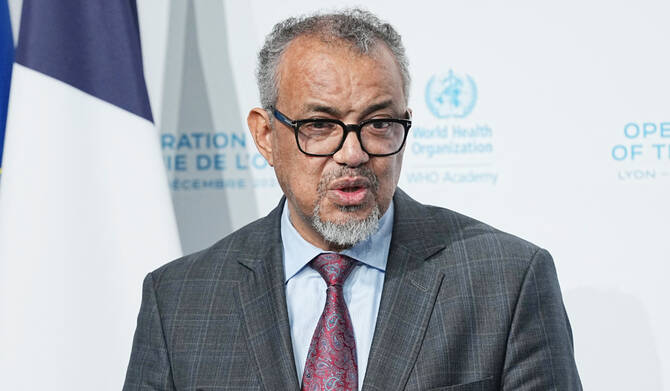
Director General of the World Health Organization (WHO), Tedros Adhanom Ghebreyesus delivers a speech during the inauguration and opening ceremony of the World Health Organization (WHO) academy in Lyon, central eastern France, on December 17, 2024. (AFP)
Short Url
Updated 05 September 2025
Follow

WHO chief urges Israel to stop starvation ‘catastrophe’

  • “People are starving to death while the food that could save them sits on trucks a short distance away,” he lamented
  • “The starvation of the people of Gaza will not make Israel safer, nor will it facilitate the release of the hostages,” he insisted

GENEVA: The World Health Organization chief on Friday urged Israel to stop the “catastrophe” of people starving to death in Gaza, saying at least 370 people have died from malnutrition since the war began.
“This is a catastrophe that Israel could have prevented, and could stop at any time,” said Tedros Adhanom Ghebreyesus.
“Starvation of civilians as a method of war is a war crime that can never be tolerated: doing so in one conflict risks legitimising its use in future conflicts,” he said.
His comments came two weeks after the UN declared a famine in Gaza, blaming the “systematic obstruction” of humanitarian deliveries by Israel.
The Health Ministry in Gaza reported on Friday that 373 people, including 134 children, had died from starvation and malnutrition in the besieged Palestinian territory since the war there erupted in October 2023.
Tedros repeated the number and said that it included “more than 300 just in the past two months.”
“People are starving to death while the food that could save them sits on trucks a short distance away,” he lamented.
“The most intolerable part of this man-made disaster is that it could be stopped right now,” he said, questioning why Israel was allowing the situation to persist.
“The starvation of the people of Gaza will not make Israel safer, nor will it facilitate the release of the hostages,” he insisted.
The WHO chief also stressed that “where hunger goes, disease follows.”
“Lack of food and clean water and cramped living conditions are leaving people with weakened immune systems exposed to more disease,” he said.
He said that in the past month alone, more than 100 cases had been reported of Guillain-Barre Syndrome, which can occur after another infection and lead to paralysis.
He also decried that there are currently more than 15,000 patients in Gaza in need of urgent specialized care who are awaiting evacuation.
“More than 700 people have died while waiting for medical evacuation, including almost 140 children,” he said.
“We call on the government of Israel to end this inhumane war,” Tedros said.
“If it will not, I call on its allies to use their influence to stop it.”


First AI-aided transaction in Dubai promises to change way consumers shop

Updated 15 min 3 sec ago
Follow

First AI-aided transaction in Dubai promises to change way consumers shop

  • Artificial intelligence agent purchases movie tickets for a customer after asking a few questions

DUBAI: CEO of Mastercard Michael Miebach announced on Tuesday that the company, in conjunction with UAE retailer Majid Al-Futtaim, had successfully completed the first transaction by an AI agent in Dubai.

An AI agent purchased movie tickets for a customer after asking a few questions during the transaction.

Speaking at the Dubai Future Forum alongside UAE Minister of State for Artificial Intelligence Omar Al-Olama, Miebach said that in the future “AI agents” would guide most transactions.

Al-Olama hailed the transaction, saying it was part of a future that would streamline the way people consumed online and in person.

“I saw that transaction, I found it extremely seamless,” Olama told the crowd at the Museum of the Future. “It’s very, very convenient, and it’s like having the best personal assistant that will do everything for you, select the movie, get your best seats, find the best timing, the closest location to you, and make a payment without many instructions. And that’s why it stood out.”

While retail chatbots that help customers have been around for some time, Mastercard’s new agentic solution differs in that it is able to make the transaction directly, working like a real-life assistant with access to your finances.

Asked by Al-Olama whether this risked agentic AI going on shopping sprees without consent, likening it to giving away card details to your child, Miebach said that the risk could be mitigated through the right mix of controls and regulation.

“If you think about it from a perspective of powering a digital economy in a country like the UAE, a lot of things need to have (happened) in the background to make it safe, to make it secure, to make it intuitive,” Miebach told the forum.

“When AI starts to make decisions on your behalf for shopping, that can be very scary. So, we (have) got to put in the controls, and all of that is what Mastercard’s Agent Pay has done.”

Miebach said that he envisioned a future where agents would start to understand your preferences for groceries, movies and retail items and make purchases seamlessly when asked, which would substantially streamline the experience of customers.

But he believed that before the technology could really take off, companies and governments would have to gain the trust of individuals and communities.

“What happens if something goes wrong in the world of an AI-generated transaction? And so, what do you do as a consumer? You say, I never intended to do this transaction, and you lose trust,” Miebach said.

“So we have to build in the safeguards. We have to build in the controls. And that is what our business does for a living. That’s what regulators look at. I think it’s really important.”