

WHO chief urges Israel to stop starvation ‘catastrophe’

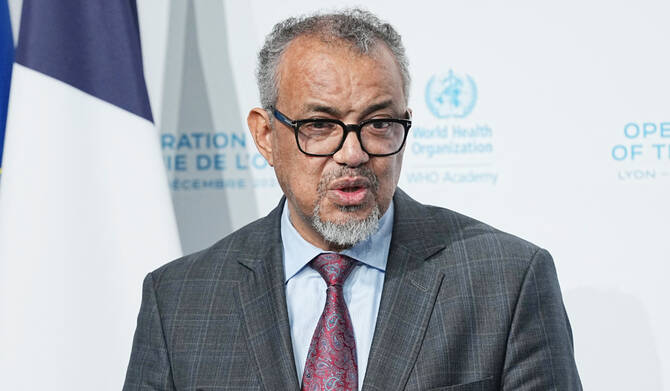
Director General of the World Health Organization (WHO), Tedros Adhanom Ghebreyesus delivers a speech during the inauguration and opening ceremony of the World Health Organization (WHO) academy in Lyon, central eastern France, on December 17, 2024. (AFP)
Short Url
Updated 05 September 2025
Follow

WHO chief urges Israel to stop starvation ‘catastrophe’

  • “People are starving to death while the food that could save them sits on trucks a short distance away,” he lamented
  • “The starvation of the people of Gaza will not make Israel safer, nor will it facilitate the release of the hostages,” he insisted

GENEVA: The World Health Organization chief on Friday urged Israel to stop the “catastrophe” of people starving to death in Gaza, saying at least 370 people have died from malnutrition since the war began.
“This is a catastrophe that Israel could have prevented, and could stop at any time,” said Tedros Adhanom Ghebreyesus.
“Starvation of civilians as a method of war is a war crime that can never be tolerated: doing so in one conflict risks legitimising its use in future conflicts,” he said.
His comments came two weeks after the UN declared a famine in Gaza, blaming the “systematic obstruction” of humanitarian deliveries by Israel.
The Health Ministry in Gaza reported on Friday that 373 people, including 134 children, had died from starvation and malnutrition in the besieged Palestinian territory since the war there erupted in October 2023.
Tedros repeated the number and said that it included “more than 300 just in the past two months.”
“People are starving to death while the food that could save them sits on trucks a short distance away,” he lamented.
“The most intolerable part of this man-made disaster is that it could be stopped right now,” he said, questioning why Israel was allowing the situation to persist.
“The starvation of the people of Gaza will not make Israel safer, nor will it facilitate the release of the hostages,” he insisted.
The WHO chief also stressed that “where hunger goes, disease follows.”
“Lack of food and clean water and cramped living conditions are leaving people with weakened immune systems exposed to more disease,” he said.
He said that in the past month alone, more than 100 cases had been reported of Guillain-Barre Syndrome, which can occur after another infection and lead to paralysis.
He also decried that there are currently more than 15,000 patients in Gaza in need of urgent specialized care who are awaiting evacuation.
“More than 700 people have died while waiting for medical evacuation, including almost 140 children,” he said.
“We call on the government of Israel to end this inhumane war,” Tedros said.
“If it will not, I call on its allies to use their influence to stop it.”


Syria transition ‘fragile’, one year on: UN investigators

Updated 56 min ago
Follow

Syria transition ‘fragile’, one year on: UN investigators

  • The commission said moving beyond the legacy of war and destruction would take “great strength, patience and support”

GENEVA: Syria’s transition is fragile, one year on from the overthrow of ruler Bashar Assad, and the country’s cycles of vengeance and reprisal need to end, United Nations investigators said Sunday.
Syrians have been marking the first anniversary since Islamist-led forces pressed a lightning offensive to topple Assad on December 8, 2024 after nearly 14 years of war.
The UN Independent International Commission of Inquiry on Syria investigates and records all international human rights law violations since March 2011 in the country.
The panel congratulated Syria on the steps it has taken so far to address the crimes and abuses inflicted during previous decades.
But it said violent events since Assad’s downfall had caused renewed displacement and polarization, “raising worries about the future direction of the country.”
The commission said the “horrific catalogue” of abuse inflicted by Assad’s regime “amounted to industrial criminal violence” against Syria’s people.
“The cycles of vengeance and reprisal must be brought to an end, so that Syria can continue to move toward a future as a state that guarantees full respect for the human rights of all its people, with equality, the rule of law, peace and security for all in name and in deed,” the commission said.
“Syria’s transition is fragile. While many across the country will celebrate this anniversary, others are fearing for their present security, and many will sleep in tents again this winter. The unknown fate of many thousands who were forcibly disappeared remains an open wound.”
The commission said moving beyond the legacy of war and destruction would take “great strength, patience and support.”
“The Syrian people deserve to live in peace, with full respect for rights long denied, and we have no doubt they are up to the task,” it said.
The three-person commission is tasked with establishing facts with a view to ensuring that the perpetrators of violations are ultimately held accountable.
The UN Human Rights Council extended its mandate for a further year in April.