At SCO, Pakistan demands Gaza ceasefire, reaffirms support for CPEC expansion

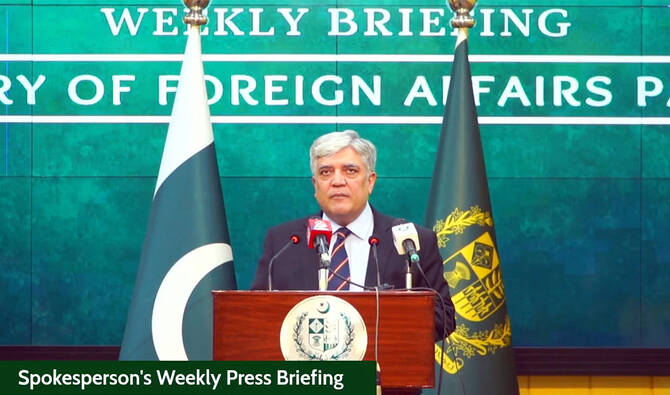
The screengrab taken from the press conference of Pakistan’s Ministry of Foreign Affairs shows the foreign office’s spokesperson Shafqat Ali Khan addressing the weekly media briefing in Islamabad on September 5, 2025. (MOFA)
Short Url
Updated 05 September 2025
Follow

At SCO, Pakistan demands Gaza ceasefire, reaffirms support for CPEC expansion

  • The development comes as Israeli troops operate in parts of Gaza City to take over all of it
  • Sharif, who was in China this week, held talks with Chinese leadership, oversaw several deals

ISLAMABAD: Pakistan condemned Israel’s ongoing military offensive against the Palestinians and called for an immediate ceasefire in Gaza at the Shanghai Cooperation Organization’s (SCO) heads of state meeting in China this week, the Pakistani foreign office said on Friday, with Prime Minister Shehbaz Sharif reaffirming his support for the next phase of the China-Pakistan Economic Corridor (CPEC).

Israeli troops have lately been operating in parts of Gaza City as they plan to take over all of the most populous Palestinian city that is home to around a million people many of whom have already been displaced multiple times.

On Thursday, Israeli strikes killed 28 people as the death toll from Israel’s two-year war rose to 64,000, according to Palestinian health officials. Last month, the Integrated Food Security Phase Classification (IPC) system said Gaza City was officially in famine, with around 514,000 people experiencing it.

Pakistan, which does not have diplomatic relations with Israel, has consistently condemned Israel’s war on Gaza, called for an uninterrupted flow of humanitarian aid into Palestinian territory and the establishment of an independent, sovereign and contiguous

Palestinian state based on pre-1967 borders with East Jerusalem as its capital.

“At the SCO CHS summit, the Prime Minister Sharif presented Pakistan’s perspective on pressing regional and global issues, highlighting strategies to strengthen SCO’s role in fostering regional cooperation and stability,” Shafqat Ali Khan, a Pakistani foreign office spokesman, said at a weekly press briefing in Islamabad.

“The prime minister unequivocally denounced Israel’s inhuman military offensive against Gaza and called for an immediate and unconditional ceasefire.”

The foreign office spokesman said PM Sharif, during his visit to China to attend the SCO summit, held meetings with Chinese President Xi Jinping and Premier Li Qiang, and appreciated Beijing’s support to Pakistan’s socio-economic development.

“He lauded the significance of China-Pakistan Economic Corridor as a flagship project of President Xi Jinping’s Belt and Road Initiative, and reaffirmed the desire to continue working closely with China for the successful implementation of the next phase of upgraded CPEC with its five new corridors,” Khan said.

“This would help both countries to build an even stronger Pakistan-China community with a shared future.”

China is a key strategic ally of Pakistan, with Beijing pouring in tens of billions in energy and infrastructure development projects in the South Asian country under CPEC.

The second phase of CPEC focuses on growth, livelihood and innovation, and reinforcement of Pakistan’s national development framework centered on ‘5 Es,’ representing exports, e-Pakistan, energy, environment and equity.

On Thursday, both countries also signed 21 memorandums of understanding and joint ventures worth $4.2 billion to enhance business-to-business (B2B) cooperation in diverse areas, Pakistani state media reported.



Pakistan joins regional talks on Afghanistan in Iran as Kabul stays away

Updated 6 sec ago
Follow

Pakistan joins regional talks on Afghanistan in Iran as Kabul stays away

  • China, Pakistan, Pakistan, Tajikistan, Uzbekistan, Turkmenistan all joined talks organized by Iran, as did Russia
  • Afghanistan was invited but decided not to attend, Taliban-led government was tight-lipped on the reasons

TEHRAN, Iran: Afghanistan’s neighbors met in Iran and agreed to deepen regional coordination to address political, economic and security challenges, as well as calling for sanctions on Afghanistan to be lifted. 

The only absent party? Afghanistan itself.

China, Pakistan, Pakistan, Tajikistan, Uzbekistan and Turkmenistan all joined the talks organized by Iran, as did Russia, according to a statement released after the meeting on Sunday.

Afghanistan was invited but decided not to attend. Its Taliban-led government was tight-lipped on the reasons, with the foreign ministry saying only that it would not participate because Afghanistan “currently maintains active engagement with regional countries through existing regional organizations and formats, and has made good progress in this regard.”

The statement from the talks in Iran stressed the importance of maintaining economic and trade ties with Afghanistan to improve living conditions and called for the country’s integration into regional political and economic processes.

The Taliban were isolated after they retook power in Afghanistan in August 2021, but in the past year, they have developed diplomatic ties. They now raise several billion dollars every year in tax revenues to keep the lights on.

However, Afghanistan is still struggling economically. Millions rely on aid for survival, and the struggling economy has been further impacted by the international community not recognizing the Taliban government’s seizure of power in the wake of the chaotic withdrawal of US-led troops in 2021. Natural disasters and the flow of Afghans fleeing Pakistan under pressure to return home have underlined Afghanistan’s reliance on foreign aid to meet essential needs.

The countries at the talks also voiced security concerns and pledged cooperation in combating terrorism, drug trafficking and human smuggling, while opposing any foreign military presence in Afghanistan. They underscored the responsibility of the international community to lift sanctions and release Afghanistan’s frozen assets, and urged international organizations to support the dignified return of Afghan refugees from neighboring countries.

The participants backed efforts to reduce tensions between Afghanistan and Pakistan, which have been particularly strained, with border clashes between the two sides killing dozens of civilians, soldiers and suspected militants and wounding hundreds more.

The violence followed explosions in Kabul on Oct. 9 that Afghan authorities blamed on Pakistan. A Qatar-mediated ceasefire has largely held since October, although there have been limited border clashes. The two sides failed to reach an overall agreement in November despite three rounds of peace talks.

Asif Durrani, Pakistan’s former special representative for Afghanistan, said the Taliban government’s decision to skip the meeting reflected a “lack of political maturity.” 

Writing on X, Durrani said the move reinforced concerns that the Taliban were unwilling to negotiate, instead adopting an “I don’t accept” stance that he said would do little to resolve serious regional problems.

Mohammad Sadiq, the current Pakistani special representative for Afghanistan who attended the talks, wrote on X that the Afghan people had already suffered enough and deserved better.

Only an Afghanistan that does not harbor militants would inspire confidence among neighboring and regional countries to engage meaningfully with Kabul and help unlock the country’s economic and connectivity potential, he wrote.

Participants agreed to hold the next meeting of foreign ministers of Afghanistan’s neighboring countries as soon as possible in Ashgabat, Turkmenistan, and welcomed Pakistan’s offer to host the next round of special envoys’ talks in Islamabad in March.

Iran’s foreign ministry spokesman, Esmail Baghaei, on Sunday said that the meeting had not been held for about two years and marked the first such gathering attended by special envoys on Afghanistan from neighboring countries as well as Russia. Russia and Uzbekistan sent the special envoys of their presidents, while Pakistan was represented by a delegate from the prime minister’s office.

Landlocked Afghanistan is sandwiched between the Middle East, Central Asia, and South Asia, making it strategically located for energy-rich and energy-hungry nations.