

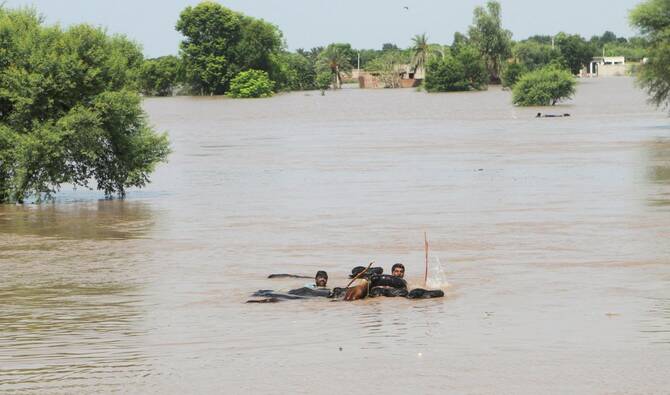

ISLAMABAD/KARACHI: Pakistan on Friday warned of new flood peaks on the Chenab and Indus rivers and possible urban flooding in Sindh, as the monsoon continued to batter Punjab’s agricultural heartland and threaten millions downstream.
Punjab, home to half of Pakistan’s 240 million people and most of its wheat and rice production, has been hit hardest by this year’s monsoon. Provincial officials said 49 people have died in the current Ravi–Sutlej–Chenab flood spell, while the seasonal monsoon death toll for Punjab since mid-June has reached 183.
Nationwide, flooding and rain-related incidents have killed 884 people since June 26 when the monsoon season started, according to the National Disaster Management Authority.
“A total of 3,892,000 people were affected due to the flood situation,” Punjab Relief Commissioner Nabeel Javed said in a statement, adding that 3,900 villages had been inundated.
“Authorities have relocated over 1.8 million people to safer places, while 415 relief camps and 466 medical camps have been established.”
Another 398 veterinary camps were also set up, with 1.34 million animals moved to higher ground.
Punjab PDMA Director General Irfan Ali Kathia said civil administration, the army and other agencies were “on alert” and directed officials to ensure the protection of citizens’ lives and property.
The military said its teams were carrying out extensive rescue and relief work in southern Punjab, including farming districts such as Sahiwal, Khanewal, Muzaffargarh, Toba Tek Singh and Chiniot. At least 30 relief camps were established in Sahiwal after floods swamped 49 villages along the Ravi.
“Army rescue teams are actively engaged in Talamba, Mian Channu and Abdul Hakeem in Khanewal district, relocating thousands of people and livestock to safety,” the army said.
In Muzaffargarh, troops evacuated residents from low-lying localities where floodwaters had breached protective structures.
NEW FLOOD WARNINGS, FOOD SECURITY
The Flood Forecasting Division (FFD) reported an “exceptionally high flood” in the Sutlej at Ganda Singh Wala, a border village opposite India’s Ferozepur district, and “very high” levels at the Ravi (Balloki, Sidhnai) and Chenab (Chiniot).
“Exceptionally high flood level will continue in River Sutlej at Ganda Singh Wala,” the FFD said in its weekly outlook.
At Panjnad and Trimmu headworks, major barrage points in southern Punjab, the Chenab also remained in the “high” category.
The PDMA warned the Chenab at Panjnad was expected to reach “high to very high” flood levels within 24 hours, while flash flooding was likely in the hill torrents of DG Khan and Rajanpur from Sept. 7–9.
The Indus at Guddu could also rise to “high to very high” flood from Sept. 7–8, while authorities cautioned of possible urban flooding in Sindh’s major cities, including Karachi and Hyderabad, during the same period.
Earlier on Friday, the High Commission of India in Islamabad informed Pakistan of “high flood” levels in the Sutlej at Harike and Ferozepur headworks, according to the Pakistan Commissioner for Indus Waters. The advisory warned that excess water releases could intensify the already critical situation downstream at Ganda Singh Wala and beyond.
Separately, the Punjab Home Department imposed Section 144, an emergency law that allows temporary bans, ordering feed mills that produce poultry and livestock feed to stop using wheat for the next 30 days so supplies can be diverted to flour mills for human consumption.
“Wheat is a basic food for human consumption and will now only be supplied to flour mills for production of flour,” the department said in its notification.
Provincial officials said feed mills were holding over 104,000 metric tons of wheat, originally intended for poultry feed. The move is aimed at ensuring uninterrupted supplies of flour as 1.3 million acres of cropland lie inundated across Punjab.
Hydrological reports show Pakistan’s Tarbela Dam has reached 100 percent of its capacity, while Mangla stands at 87 percent. On the Indian side, Bhakra (84 percent), Pong (98 percent) and Thein (92 percent) dams — all major reservoirs on the Sutlej and Ravi rivers — are also nearly full.
Officials warned that further inflows could aggravate downstream flooding if controlled releases become necessary.


