

On Pakistan visit, Palestinian envoy slams US over visa denial for UNGA

Dr. Mahmoud Al-Habbash (2R), Chief Islamic Justice of Palestine and adviser to Abbas on religious affairs, speaks during a conference on Palestine, in Islamabad on September 4, 2025. (AN Photo)
Short Url
Updated 05 September 2025
Follow

On Pakistan visit, Palestinian envoy slams US over visa denial for UNGA

  • Mahmoud Al-Habbash says US move violates international law, vows Palestinian voice “will be heard”
  • Visiting delegation in Islamabad to attend Prophet’s birth anniversary events and deliver Abbas’s message

ISLAMABAD: A senior Palestinian official visiting Pakistan on Thursday condemned the United States for refusing visas to President Mahmoud Abbas and his delegation for this month’s UN General Assembly session and a parallel conference on reviving the two-state solution.

Dr. Mahmoud Al-Habbash, Chief Islamic Justice of Palestine and adviser to Abbas on religious affairs, is in Islamabad with a four-member delegation to attend celebrations of the 1,500th birth anniversary of Prophet Muhammad (PBUH).

Washington said last week it would not allow Palestinian Authority President Mahmoud Abbas and others to travel to New York, where several US allies are set to recognize Palestine as a state.

Al-Habbash told Arab News the US decision was an “unjust, dangerous, and wrong” violation of international law.

“This is a major mistake and will complicate matters, but this will not stop us from continuing our struggle or from raising our voice,” Al-Habbash said.

“The voice of Palestine will be heard, through President Mahmoud Abbas, by the whole world, whether at the international conference on Sept. 22 or at the General Assembly.”
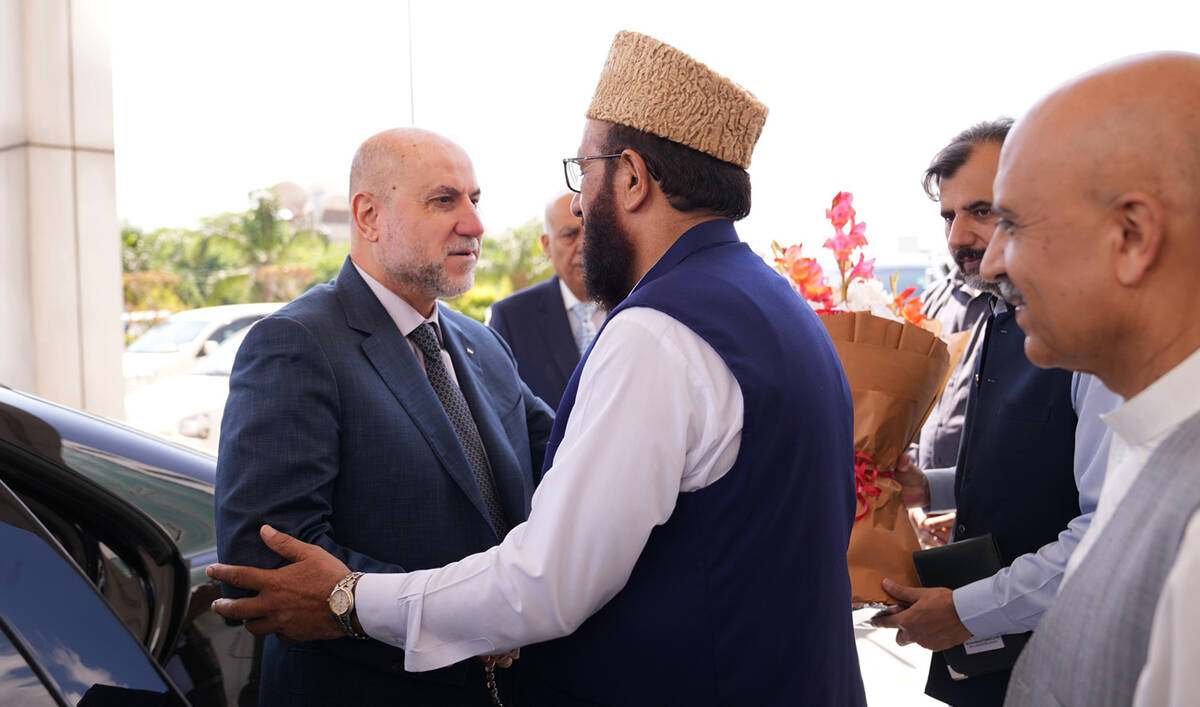


Pakistan Religious Affairs Minister Sardar Muhammad Yousaf welcome Dr. Mahmoud Al-Habbash, Chief Islamic Justice of Palestine and adviser to Abbas on religious affairs, at the Ministry of Religious Affairs in Islamabad on September 5, 2025. (Handout/MoRA)

The United States, as host of the UN in New York, is obligated under its agreement with the world body not to block access for accredited delegations.

The visa refusal also means the Palestinians will miss a high-level meeting on Palestine co-hosted by France and Saudi Arabia.

The US move comes amid growing momentum in Europe to recognize a Palestinian state after the latest Gaza war, which began on Oct. 7, 2023, and has killed more than 63,000 Palestinians according to Gaza health authorities. In May, Ireland, Spain and Norway announced recognition of Palestine, joining over 140 countries worldwide that already extend diplomatic recognition. France has said it is ready to do the same in coordination with EU partners, while Britain has signaled openness.

By contrast, Washington has stood firmly behind Israel, continuing military aid and diplomatic cover despite the mounting death toll in Gaza and expanding Israeli settlement activity in the West Bank. US officials have said they will not recognize Palestine outside of direct negotiations with Israel, a stance Palestinians view as blocking their international legitimacy.

Meanwhile, Israel’s far-right government has openly advanced plans to permanently occupy Gaza while simultaneously moving to entrench control over the occupied West Bank. Senior ministers have called for re-establishing Israeli settlements in Gaza, dismantled in 2005, and for formally annexing key areas of the West Bank such as the Jordan Valley and major settlement blocs including Ma’ale Adumim, Ariel and Gush Etzion. The steps have been widely condemned as violations of international law and seen as undermining any prospect of a two-state solution.

On Israel’s plans to annex parts of the occupied West Bank, Al-Habbash said:

 “This is an illegal action. It contradicts international law and legitimate international resolutions. It will have no legal or political validity.”

He added that Palestine would “continue to exist between the river and the sea,” while the “one who will disappear is the Israeli occupation.”

Al-Habbash also praised Pakistan as a “country of brave people,” describing Pakistanis as “our brothers who always stand by us.” He said his delegation would deliver a message from Abbas to President Asif Ali Zardari and Prime Minister Shehbaz Sharif on bilateral ties and the Palestinian cause.

The Palestinian delegation is scheduled to take part in the Seerat-un-Nabi conference in Islamabad, where Al-Habbash said he felt “the warmth of the hospitality” of Pakistan.


Pakistan, Afghanistan trade heavy casualty claims, battlefield losses as cross-border fighting escalates

Updated 4 sec ago
Follow

Pakistan, Afghanistan trade heavy casualty claims, battlefield losses as cross-border fighting escalates

  • Pakistan says 133 Afghan Taliban killed in counter-strikes, Kabul says 55 Pakistani soldiers dead
  • Both sides report destruction, capture of military posts as escalation deepens, signaling widening conflict

Islamabad/Karachi: Pakistan and Afghanistan traded claims of heavy battlefield losses early Friday as cross-border fighting intensified along their shared frontier, marking the most serious escalation in hostilities between the bitter neighbors in recent months.

The fighting follows Pakistani airstrikes earlier this week targeting what Islamabad said were Tehreek-e-Taliban Pakistan (TTP) and Daesh militant camps inside Afghanistan. Pakistan said those strikes killed more than 100 militants, while Kabul said women and children were killed and condemned the attacks as violations of Afghan sovereignty.

With both governments now announcing retaliatory operations and publishing sharply conflicting casualty figures, the confrontation signals a rapid deterioration in relations between the two countries.

Pakistani officials said the latest strikes were in response to what they described as unprovoked firing by Afghan forces along multiple sectors of the border late Thursday. The Pakistani prime minister’s spokesman Mosharraf Zaidi said at 0345 hours Friday counter-strikes were continuing.

“A total of 133 Afghan Taliban are confirmed killed, more than 200 wounded,” Zaidi said in an X update. “Twenty seven (27) Afghan Taliban posts have been destroyed, and nine (9) have been captured.”

He added that strikes had targeted military positions in Kabul, Paktia and Kandahar, and that corps headquarters, brigade headquarters, ammunition depots, logistics bases and other installations had been destroyed.

Pakistan’s Information Minister Attaullah Tarar described the military action as “Operation Wrath for the Sake of Truth,” saying Pakistan’s “effective counter operations are ongoing.”

Defense Minister Khawaja Asif adopted sharply escalatory language on X, declaring: “Now it is open war between us and you.”

On the Afghan side, Taliban government spokesperson Zabihullah Mujahid accused Pakistan of bombing major cities. 

“The cowardly Pakistani army has bombed some places in Kabul, Kandahar, and Paktia. Praise be to God, no one was harmed,” Mujahid said on X.

In a separate statement, Afghanistan’s Ministry of National Defense said its forces had conducted retaliatory operations along the shared border. 

The ministry claimed 55 Pakistani soldiers were killed, two garrisons and 19 posts captured and military equipment seized. It said eight Afghan fighters were killed and 11 wounded in the clashes, and alleged that 13 civilians were injured in Nangarhar.

Pakistani officials said no Pakistani posts had been damaged or captured. 

None of the casualty figures or battlefield claims from either side could be independently verified.

Cross-border violence has intensified in recent weeks, with Pakistan blaming a surge in suicide bombings and militant attacks on insurgents it says are based in Afghanistan. Kabul denies providing safe havens to anti-Pakistan militant groups.

The latest clashes mark the third major escalation between the neighbors in less than a year. Similar Pakistani strikes last year triggered weeklong fighting before Qatar, Türkiye and other regional actors mediated a ceasefire in October.

The 2,600-kilometer (1,600-mile) frontier, a key trade and transit corridor linking Pakistan to landlocked Afghanistan and onward to Central Asia, has faced repeated closures amid tensions, disrupting commerce and humanitarian movement. Trade and movement of people between the two nations has remained closed since October 2025.

The confrontation also unfolds against a backdrop of growing friction over Afghanistan’s regional alignments. Pakistan has repeatedly accused the Taliban authorities of allowing Indian influence to expand in Afghanistan, an allegation Kabul has rejected.

Pakistan’s defense minister Asif renewed that accusation on Friday, saying the Taliban government had turned Afghanistan into “a colony of India.”

Islamabad has long accused India of using Afghan territory to support anti-Pakistan militant groups, a charge New Delhi denies.