Rain adds to misery of Afghan quake survivors

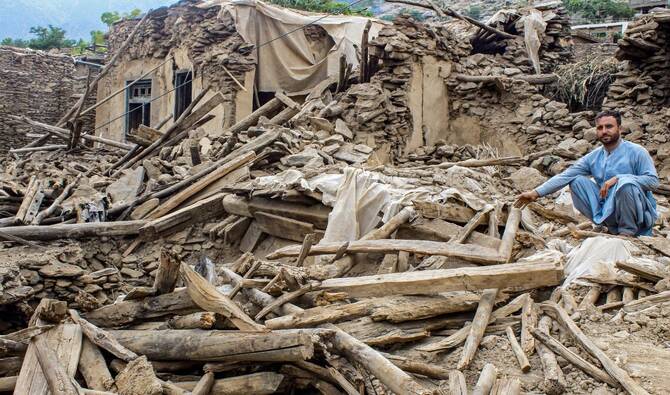
An Afghan man sits amid the remains of a damaged house, in the aftermath of an earthquake at the Dara-i-Nur district of Nangarhar province on September 3, 2025. (AFP)
Short Url
Updated 04 September 2025
Follow

Rain adds to misery of Afghan quake survivors

  • Deadly 6.0 magnitude earthquake struck Afghanistan last Sunday, killing over 2,200 people 
  • UN, NGOs say resources are already overstretched due to sharp drop in international aid 

NURGAL, Afghanistan: Four nights and days since the earth shook and levelled his home in eastern Afghanistan, Khan Zaman Hanafi thought he had endured the worst, until the rain came.

The 35-year-old farmer says his village has “been forgotten by the government and aid groups.”

“It’s raining and we’re being left to live in the open,” he told AFP from a cornfield where he has been sleeping with his family, away from the wreckage of their village, Shelt.

In these valleys — once known as smuggling routes and corridors for fighters moving to and from Pakistan before the Taliban returned to power — mud houses are built into the mountainsides, stacked one above another.

On Sunday night, when the magnitude 6.0 quake struck, the homes collapsed in a giant domino effect.

Kunar province, famous for its forests, was the hardest hit by the quake — one of the deadliest in the country’s history, having already claimed over 2,200 lives.

’IT’S CHAOS’

“In Shelt, there were 350 houses and 300 in Mama Gol, and we heard only 68 tents were distributed,” said Hanafi, adding he has yet to see one.

“This place is unlivable, but we have no choice,” he said. “We are poor. We want the government and aid groups to help us rebuild our homes.”

But the Taliban authorities have already admitted they cannot cope alone.

For their part, the United Nations and NGOs say their resources are already overstretched, as they face a sharp drop in international aid and the return of millions of migrants expelled from neighboring countries.

For now, authorities are sending bulldozers onto Kunar’s steep slopes to clear the few narrow, winding roads as quickly as possible.

Khan Saeed Deshmash was spared from the rough roads, his injuries meaning he was flown by helicopter, along with a dozen injured relatives, from his village of Minjegale, to a hospital in Jalalabad, the capital of neighboring Nangarhar province.

The 47-year-old grain farmer lost six family members in the quake, along with all his cows and sheep.

“Everyone is traumatized, it’s chaos — we can’t even think straight anymore,” he said.

EVERY HOUSE DESTROYED 

Only one thing is certain now, Deshmash said: “It’s no longer possible to live in these villages. There are still aftershocks, every house is destroyed, and we need to be relocated elsewhere.”

But Abdul Alam Nezami, 35, said he wants to stay in his village of Massoud, where he inherited his father’s cornfields.

He would be starting from zero to repair everything that was brought down in the quake or damaged by landslides and rockfall, in a country where around 85 percent of people already live on a dollar a day according to the UN.

Work is underway to clear the blocked roads, but “the irrigation canals and water reservoirs also need to be rebuilt so the harvests are not completely lost,” Nezami said.

For now, he is focused on his immediate living situation.

“There is only one tent for two to three families, and some leak when it rains,” he said.

And the rain has not stopped, with downpours “last night and again this morning.”

In Mazar Dara too, the tarpaulins salvaged from the rubble to create makeshift shelters “have holes” and “don’t protect us from the rain,” said 48-year-old farmer Zahir Khan Safi.

“We keep them for the children,” he told AFP, but they still end up in wet clothes. “And have nothing to change into.”


About 400 immigrant children were detained longer than the recommended limit, ICE admits

Updated 8 sec ago
Follow

About 400 immigrant children were detained longer than the recommended limit, ICE admits

  • A Dec. 1 report from ICE indicated that about 400 immigrant children were held in custody for more than the 20-day limit during the reporting period from August to September
  • Advocates documented injuries suffered by children and a lack of access to sufficient medical care

TEXAS, USA: Hundreds of immigrant children across the nation were detained for longer than the legal limit this summer, US Immigration and Customs Enforcement has admitted in a court filing, alarming legal advocates who say the government is failing to safeguard children.
In a court filing Monday evening, attorneys for detainees highlighted the government’s own admissions to longer custody times for immigrant children, unsanitary conditions reported by families and monitors at federal facilities, and a renewed reliance on hotels for detention.
The reports were filed as part of an ongoing civil lawsuit launched in 1985 that led to the creation of the 1990s cornerstone policy known as the Flores Settlement Agreement, which limits the time children can spend in federal custody and requires them to be kept in safe and sanitary conditions. The Trump administration is attempting to end the agreement.
A Dec. 1 report from ICE indicated that about 400 immigrant children were held in custody for more than the 20-day limit during the reporting period from August to September. They also told the court the problem was widespread and not specific to a region or facility. The primary factors that prolonged their release were categorized into three groups: transportation delays, medical needs, and legal processing.
Legal advocates for the children contended those reasons do not prove lawful justifications for the delays in their release. They also cited examples that far exceeded the 20-day limit, including five children who were held for 168 days earlier this year.
ICE did not immediately respond to a request for comment Tuesday.
Hotel use for temporary detention is allowed by the federal court for up to 72 hours, but attorneys questioned the government’s data, which they believe did not fully explain why children were held longer than three days in hotel rooms.
Conditions at the detention facilities continued to be an ongoing concern since the family detention site in Dilley, Texas, reopened this year.
Advocates documented injuries suffered by children and a lack of access to sufficient medical care. One child bleeding from an eye injury wasn’t seen by medical staff for two days. Another child’s foot was broken when a member of the staff dropped a volleyball net pole, according to the court filing. “Medical staff told one family whose child got food poisoning to only return if the child vomited eight times,” the advocates wrote in their response.
“Children get diarrhea, heartburn, stomach aches, and they give them food that literally has worms in it,” one person with a family staying at the facility in Dilley wrote in a declaration submitted to the court.
Chief US District Judge Dolly Gee of the Central District of California is scheduled to have a hearing on the reports next week, where she could decide if the court needs to intervene.