

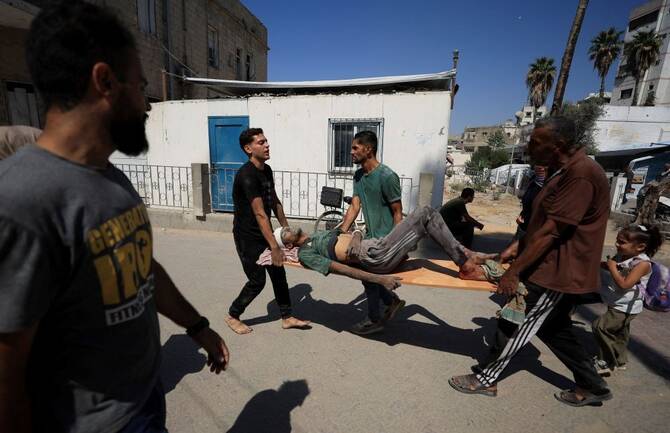

LONDON: Three-quarters of Palestinians arrested in Gaza are civilians, including children, disabled people and healthcare workers, according to classified Israeli data.
The revelation comes after a joint investigation by The Guardian, +972 Magazine and Local Call, which found that among the detained were an 82-year-old woman with Alzheimer’s who was held for six weeks without charge, and a single mother taken for 53 days, forcing her children to beg on the street.
More than 47,000 people have been identified by Israel as militants fighting for Hamas and Islamic Jihad, drawn largely from the groups’ own files seized in Gaza.
Of these, 1,450 were identified in May as being in Israeli captivity, or just under 25 percent of all Palestinians detained in Gaza under Israel’s “unlawful combatants” law since the outbreak of the war in October 2023.
The law allows indefinite detention without charge. An additional 300 people identified by Israel as participants in the Hamas attack of Oct. 7, 2023, are also being held.
No one has been charged in relation to Oct. 7 or the war so far, with Israel allowing a 180-day period before detainees gain access to a lawyer, and 75 days before appearing in front of a judge to confirm the legality of the detention.
However, the large number of civilian prisoners held under the law could be even greater, with Israeli newspaper Haaretz quoting senior officers in late 2023 that “85 to 90 percent” of prisoners taken by Israel were not Hamas members.
Tal Steiner, director of the Public Committee Against Torture, told The Guardian: “As soon as the wave of mass arrests began in Gaza in October 2023, there was serious concern that many uninvolved people were being detained without cause.
“This concern was confirmed when we learned that half of those arrested at the beginning of the war were eventually released, demonstrating that there had been no basis for their detention in the first place.”
The Sde Teiman military base at one point had so many elderly and disabled prisoners that the wing they were kept in was nicknamed “the geriatric pen,” an Israeli soldier who served there told the investigation.
“They brought men in wheelchairs, people without legs,” he said. “I always assumed the supposed excuse for arresting patients was that maybe they had seen the hostages or something.”
Samir Zaqout, deputy director of Al-Mezan Center for Human Rights, which has represented hundreds of civilians imprisoned by Israel, said: “We believe the proportion of civilians among those detained is even higher than Israel’s own figures suggest.”
He added: “At most, perhaps one in six or seven might have any link to Hamas or other militant factions, and even then, not necessarily through their military wings.”
A military medic who treated 82-year-old Alzheimer’s patient Fahamiya Al-Khalidi at Anatot detention center after she was taken from Gaza City in December 2023 told The Guardian: “I remember her limping badly toward the clinic. And she’s classified as an unlawful combatant. The way that label is used is insane.”
He added that he had treated a woman bleeding after suffering a miscarriage, and a breastfeeding mother who had been separated from her infant.
The mother, Abeer Ghaban, knew after she was detained that Israeli authorities had mistaken her estranged husband for a Hamas member with the same name.
Despite proving his identity through comparing photos, she was not released for weeks, leaving her three children to fend for themselves in a war zone. “They were alive, but seeing the state they had been in for 53 days without me broke me,” Ghaban said.
Hassan Jabareen, director of the Palestinian legal rights group Adalah, said the Israeli system “strips detainees of protections guaranteed under international law, including safeguards specifically intended for civilians, using the ‘unlawful combatant’ label to justify the systematic denial of their rights.”
An Israeli source at another military facility said soldiers wanted to hold innocent civilians longer to be used as leverage in hostage negotiations.
A spokesperson for Al-Mezan said: “Even before Oct. 7, Israel withheld the bodies of hundreds of Palestinians, using them as bargaining chips instead of returning them to their families for burial.
“We believe the thousands of civilians from Gaza now in detention are likewise intended to be used as bargaining chips.”


