

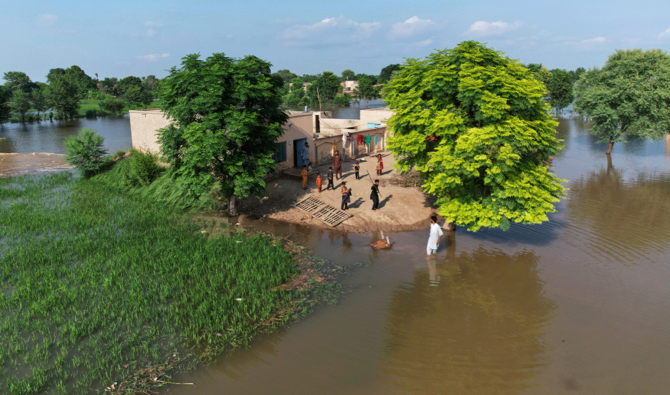

ISLAMABAD: The top Provincial Disaster Management Authority (PDMA) official in Punjab said on Thursday monsoon-swollen rivers in Pakistan’s eastern province have inundated 1.3 million acres of agricultural land, destroying standing crops and raising food security concerns, as the Chenab reached near critical levels overnight according to official data.
Punjab is the country’s most populous and prosperous region, often described as Pakistan’s breadbasket due to its fertile land that contributes significantly to agricultural output and GDP. With the recent floods fueled by days of heavy monsoon rains and dam releases from upstream India, hundreds of relief camps have been set up across inundated districts.
Nationwide, 883 people have died since June 26, according to the National Disaster Management Authority (NDMA), as officials warn of further inundations, reviving memories of the catastrophic 2022 deluges that submerged a third of the country and caused over $35 billion in losses.
“I can roughly tell you that by now, across the three rivers, nearly 1.3 million acres of agricultural land has been inundated inside and outside the floodplains,” PDMA Punjab Chief Irfan Ali Kathia told Geo TV, calling the situation “unprecedented.”
“The Chief Minister of Punjab [Maryam Nawaz] has already issued directions for compensation for the affected land,” he added.
FLOOD THREAT TO MULTAN
Kathia said the next 24 hours were “extremely critical” for Multan, a major urban center and the gateway to southern Punjab, as floodwaters surged toward the city.
“This is a critical time for the city and district of Multan,” he said. “The reason is that the main surge of the Chenab River has already reached Head Muhammad Wala at its peak and is now moving toward Multan.”
“As you are aware, another 575,000 cusecs of water has also entered the Chenab upstream,” he continued, noting that the Ravi’s waters would also merge with the Chenab near Multan, creating yet another challenge.
The PDMA reported in the early hours of Thursday that flows had surged above 550,000 cusecs at Khanki and Qadirabad headworks on the Chenab, among the highest levels in years.
Downstream gauges at Sher Shah and Head Muhammad Wala were also rising, within a few feet of danger marks, while Chiniot Bridge recorded 304,220 cusecs at midnight and climbing.
The Ravi was flowing at elevated levels, with 114,130 cusecs at Balloki and 152,480 cusecs at Sidhnai headworks, though steady for now. The Sutlej was also carrying significant volumes, with 319,295 cusecs at Ganda Singh Wala and 159,662 cusecs at Punjnad, where steady but high flows posed a threat to downstream settlements.
Prime Minister Shehbaz Sharif, currently visiting China, has instructed the NDMA to ensure timely flood alerts and coordinate with provincial authorities to expedite relief operations.
‘SUPER FLOOD’ IN SINDH
Meanwhile, Sindh Chief Minister Syed Murad Ali Shah said in a television interview that the province was preparing for a potential “super flood” scenario of up to 900,000 cusecs, warning that while Punjab bore the brunt of the current disaster, Sindh would face cumulative inflows within days.
“The real danger lies in the possibility of all these rivers’ flood peaks synchronizing at the same time,” Shah said. “We expect this won’t happen and instead the peaks will reach Sindh in phases, reducing pressure.”
He noted that Punjab was experiencing around 160,000 cusecs at Panjnad with the peak expected on Thursday, after which Sindh would have two days to carry out further evacuation and preparations.
Shah said Sindh had drawn up village-level evacuation plans for different flood levels but persuading riverine communities to leave their homes remained the greatest challenge. He stressed that embankments were being closely monitored, provincial ministers deployed at barrages and the irrigation department placed on high alert.
“Our preparations are complete, and we pray this time passes without major damage,” he said.


