

Thousands of Afghans expelled from Pakistan despite quake

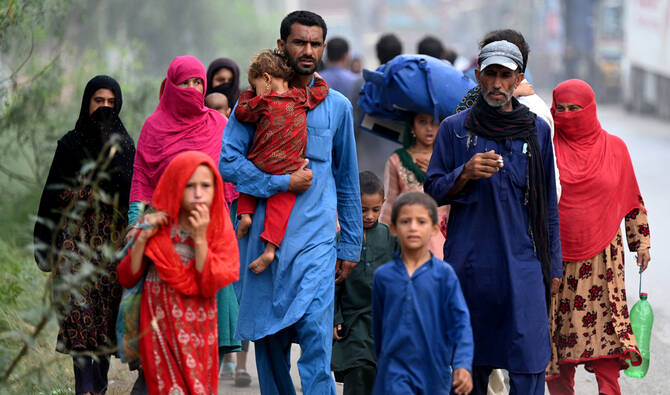
Afghan refugees arrive at the UNHCR repatriation center in Azakhel, Khyber Pakhtunkhwa province on August 23, 2025. (AFP/File)
Short Url
Updated 03 September 2025
Follow

Thousands of Afghans expelled from Pakistan despite quake

  • Pakistan launched deportation drive to expel “illegal” immigrants in 2023, citing uptick in violent attacks
  • More than 1.2 million Afghans have since returned from Pakistan, including over 443,000, according to UN

PESHAWAR: Thousands of Afghans who were registered as refugees have surged over the border from Pakistan in recent days, with officials telling AFP returns have escalated despite the weekend’s deadly earthquake in Afghanistan.

Pakistan has hosted Afghans fleeing violence for more than four decades, from the Soviet invasion to the 2021 Taliban takeover.

Various cohorts of Afghans have found differing degrees of stability, including access to work and education, in neighboring Pakistan. Some were born and raised there, while others transited en route to resettlement in the West.

However, Pakistan’s government, citing an uptick in violent attacks and insurgent campaigns, launched a crackdown in 2023 to evict them, painting the population as “terrorists and criminals.”

More than 1.2 million Afghans have since been forced to return from Pakistan, including more than 443,000 this year alone, according to the United Nations.

The crackdown has most recently targeted an estimated 1.3 million refugees with UNHCR-issued Proof of Registration (PoR) cards, with Islamabad setting a deadline of September 1 for them to leave or face arrest and deportation.

At the Chaman border crossing, “more than 4,000 people have left ever since the deadline ended,” local administrator Habib Bangulzai told AFP.

In Spin Boldak on the Afghan side, migrant registration official Abdul Latif Hakimi estimated that “250 to 300 families are returning” daily since August 31.

At the Torkham crossing further north, more than 6,300 PoR holders returned on Tuesday alone, according to authorities managing the terminal. They estimated that nearly 63,000 PoR cardholders have entered Afghanistan since April.

Afghan refugees, some awaiting relocation overseas, reported police raids as well as extortion and harassment by authorities in the lead-up to the latest deadline.

Convoys of Afghan families, fearing arrest, detention and separation, headed to the border.

The most recent data from the UNHCR shows an uptick of crossings in August, with a surge between August 24 and 30 of 25,490 Afghan returnees, of which 13,525 were PoR holders.

Afghan returnee Khan Wali told AFP he was unable to work in the eastern city of Lahore and faced constant harassment.

“Police used to detain us repeatedly. They seized our belongings,” he said from the Spin Boldak crossing.

An Afghan PoR holder in Peshawar told AFP the situation was easier in that city, which borders Afghanistan and is held by Pakistan’s political opposition.

However, she said “people are facing hell” in the capital Islamabad.

The latest expulsions come as already impoverished Afghanistan responds to a devastating 6.0 earthquake that wiped out villages along the border that were home to many recently expelled migrants.

More than 1,400 people were killed in the disaster.

Analysts say the evictions are designed to pressure neighboring Afghanistan’s Taliban administration, which Islamabad blames for fueling a rise in border attacks.

The Afghan Taliban denies involvement.


Pakistan PM orders accelerated privatization of power sector to tackle losses

Updated 15 December 2025
Follow

Pakistan PM orders accelerated privatization of power sector to tackle losses

  • Tenders to be issued for privatization of three major electricity distribution firms, PMO says
  • Sharif says Pakistan to develop battery energy storage through public-private partnerships

ISLAMABAD: Pakistan’s prime minister on Monday directed the government to speed up privatization of state-owned power companies and improve electricity infrastructure nationwide, as authorities try to address deep-rooted losses and inefficiencies in the energy sector that have weighed on the economy and public finances.

Pakistan’s electricity system has long struggled with financial distress caused by a combination of factors including theft of power, inefficient collection of bills, high costs of generating electricity and a large burden of unpaid obligations known as “circular debt.” In the first quarter of the current financial year, government-owned distribution companies recorded losses of about Rs171 billion ($611 million) due to poor bill recovery and operational inefficiencies, official documents show. Circular debt in the broader power sector stood at around Rs1.66 trillion ($5.9 billion) in mid-2025, a sharp decline from past peaks but still a major fiscal drain. 

Efforts to contain these losses have been a focus of Pakistan’s economic reform program with the International Monetary Fund, which has urged structural changes in the energy sector as part of financing conditions. Previous government initiatives have included signing a $4.5 billion financing facility with local banks to ease power sector debt and reducing retail electricity tariffs to support economic recovery. 

“Electricity sector privatization and market-based competition is the sustainable solution to the country’s energy problems,” Prime Minister Shehbaz Sharif said at a meeting reviewing the roadmap for power sector reforms, according to a statement from the prime minister’s office.

The meeting reviewed progress on privatization and infrastructure projects. Officials said tenders for modernizing one of Pakistan’s oldest operational hubs, Rohri Railway Station, will be issued soon and that the Ghazi Barotha to Faisalabad transmission line, designed to improve long-distance transmission of electricity, is in the initial approval stages. While not all power-sector decisions were detailed publicly, the government emphasized expanding private sector participation and completing priority projects to strengthen the electricity grid.

In another key development, the prime minister endorsed plans to begin work on a battery energy storage system with participation from private investors to help manage fluctuations in supply and demand, particularly as renewable energy sources such as solar and wind take a growing role in generation. Officials said the concept clearance for the storage system has been approved and feasibility studies are underway.

Government briefing documents also outlined steps toward shifting some electricity plants from imported coal to locally mined Thar coal, where a railway line expansion is underway to support transport of fuel, potentially lowering costs and import dependence in the long term.

State authorities also pledged to address safety by converting unmanned railway crossings to staffed ones and to strengthen food safety inspections at stations, underscoring broader infrastructure and service improvements connected to energy and transport priorities.