

Pakistan’s Shariah-compliant real estate trust IMAGE to raise $3.3 million in IPO

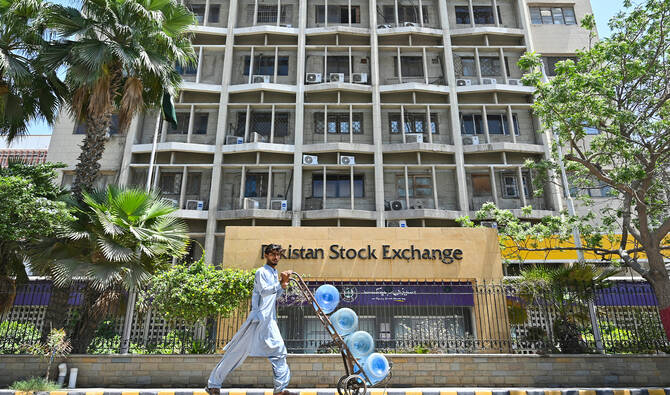
A labour carries water bottles on a hand cart past the Pakistan Stock Exchange (PSX) building as index plummeted amid a global market crash, in Karachi on April 7, 2025. (AFP/File)
Short Url
Updated 03 September 2025
Follow

Pakistan’s Shariah-compliant real estate trust IMAGE to raise $3.3 million in IPO

  • The company says it generates income through two prime real-estate projects in Karachi
  • The IPO, comprising 92,015,467 units, will be conducted through 100% Book Building method

KARACHI: IMAGE, a Pakistani Shariah-compliant real estate trust, is set to raise Rs920 million ($3.3 million) through an initial public offering (IPO) at the Pakistan Stock Exchange (PSX), it said on Tuesday.

The company says it generates income through two prime projects in Karachi: an 8-floor, fully occupied commercial building on Shahrah-e-Faisal and a residential-cum-commercial project, which is expected to generate both sales and rental income.

The IPO, consisting of 92,015,467 units of the Real Estate Investment Trust (REIT) scheme, will be conducted through a 100 percent Book Building method, with a floor price of PKR 10 per unit, and a price band of up to 40 percent (i.e., PKR 14 per unit), according to the firm.

“Proceeds from the IPO will be utilized for the completion and marketing of 11 residential floors of the Developmental REIT project,” IMAGE said in a statement. “The Central Depository Company of Pakistan Limited (CDC) has been appointed as the Trustee of IMAGE REIT.”

The retail portion will comprise 25 percent of the total issue size and will be offered to the general public at the strike price determined post-Book Building, IMAGE said, describing it as an opportunity for investors to capitalize on “recovering” real estate market.

The IMAGE REIT scheme is managed by Sinolink REIT Management Company Limited, a licensed firm dedicated to developing innovative, Shariah-compliant investment opportunities in Pakistan’s real estate sector, providing both institutional and retail investors with access to professionally managed real estate portfolios.

“Topline Securities and Growth Securities are joint Consultants and Book Runner for this IPO,” IMAGE added.


Pakistan reports current account surplus in Jan. owing to improved trade, remittances

Updated 17 February 2026
Follow

Pakistan reports current account surplus in Jan. owing to improved trade, remittances

  • Pakistan’s exports crossed the $3 billion mark in Jan. as the country received $3.5 billion in remittances
  • Last month, IMF urged Pakistan to accelerate pace of structural reforms to strengthen economic growth

ISLAMABAD: Pakistan recorded a current account surplus of more than $120 million in January, the country’s finance adviser said on Tuesday, attributing it to improved trade balance and remittance inflows.

Pakistan’s exports rebounded in January 2026 after five months of weak performance, rising 3.73 percent year on year and surging 34.96 percent month on month, according to data released by the country’s statistics bureau.

Exports crossed the $3 billion mark for the first time in January to reach $3.061 billion, compared to $2.27 billion in Dec. 2025. The country received $3.5 billion in foreign remittances in Jan. 2026.

Khurram Schehzad, an adviser to the finance minister, said Pakistan reported a current account surplus of $121 million in Jan., compared to a current account deficit of $393 million in the same month last year.

“Improved trade balance in January 2026, strong remittance inflows, and sustained momentum in services exports (IT/Tech) continue to reinforce the country’s external account position,” he said on X.

Pakistan has undergone a difficult period of stabilization, marked by inflation, currency depreciation and financing gaps, and international rating agencies have acknowledged improvements after Islamabad began implementing reforms such as privatizing loss-making, state-owned enterprises (SOEs) and ending subsidies as part of a $7 billion International Monetary Fund (IMF) loan program.

Late last month, the IMF urged Pakistan to accelerate the pace of these structural reforms to strengthen economic growth.

Responding to questions from Arab News at a virtual media roundtable on emerging markets’ resilience, IMF’s director of the Middle East and Central Asia Jihad Azour said Islamabad’s implementation of the IMF requirements had been “strong” despite devastating floods that killed more than 1,000 people and devastated farmland, forcing the government to revise its 4.2 percent growth target to 3.9 percent.

“What is important going forward in order to strengthen growth and to maintain the level of macroeconomic stability is to accelerate the structural reforms,” he said at the meeting.

Azour underlined Pakistan’s plans to privatize some of the SOEs and improve financial management of important public entities, particularly power companies, as an important way for the country to boost its capacity to cater to the economy for additional exports.

“This comes in addition to the effort that the authorities have made in order to reform their tariffs, which will allow the private sector of Pakistan to become more competitive,” the IMF official said.