

The changing face of Riyadh summers

Malls and cafes are major social hubs for residents and professionals looking to socialize and network in Riyadh. (Supplied/File photo/SPA)
Short Url
Updated 02 September 2025
Follow

The changing face of Riyadh summers

  • From mall meetups to cafe culture, residents are reinventing socializing in Saudi Arabia

RIYADH: With summer temperatures in Riyadh soaring above 40 C, outdoor gatherings have become rare. While some say the heat makes it impossible to socialize, others believe the right cooling provisions can make any spot appropriate.

And, despite the weather and shifting social norms, some see little change in our socializing habits.

Ali Sowaileh, a visitor from the Eastern Province, said: “The cultural change overall is small. Gatherings were and still are being hosted at homes … with light conversation and Saudi coffee and tea.”


Malls and cafes are major social hubs for residents and professionals looking to socialize and network in Riyadh. (Supplied/File photo/SPA)

But Saudis are increasingly opting for indoor spaces such as malls, cafes, and play areas.

Many working mothers, for example, prefer to meet at play zones and take their children.

“Summer is the most productive time of the year for me. I prefer to spend it developing myself and focusing on work,” said Hanan Al-Harbi, a 30-year-old mother who works in the intellectual property field.

HIGHLIGHTS

• Riyadh’s cafe culture has grown rapidly with establishments boasting stylish interiors and diverse menus.

• Coffee shops have emerged as venues for casual meetups, networking, and professional and creative collaborations.

“I also don’t really enjoy hot weather, so staying indoors feels more comfortable,” she added, saying that she takes her daughter to soft-play locations a few times a week.

Shopping malls have become another major social hub, offering entertainment zones and events that allow families to spend an entire day there.
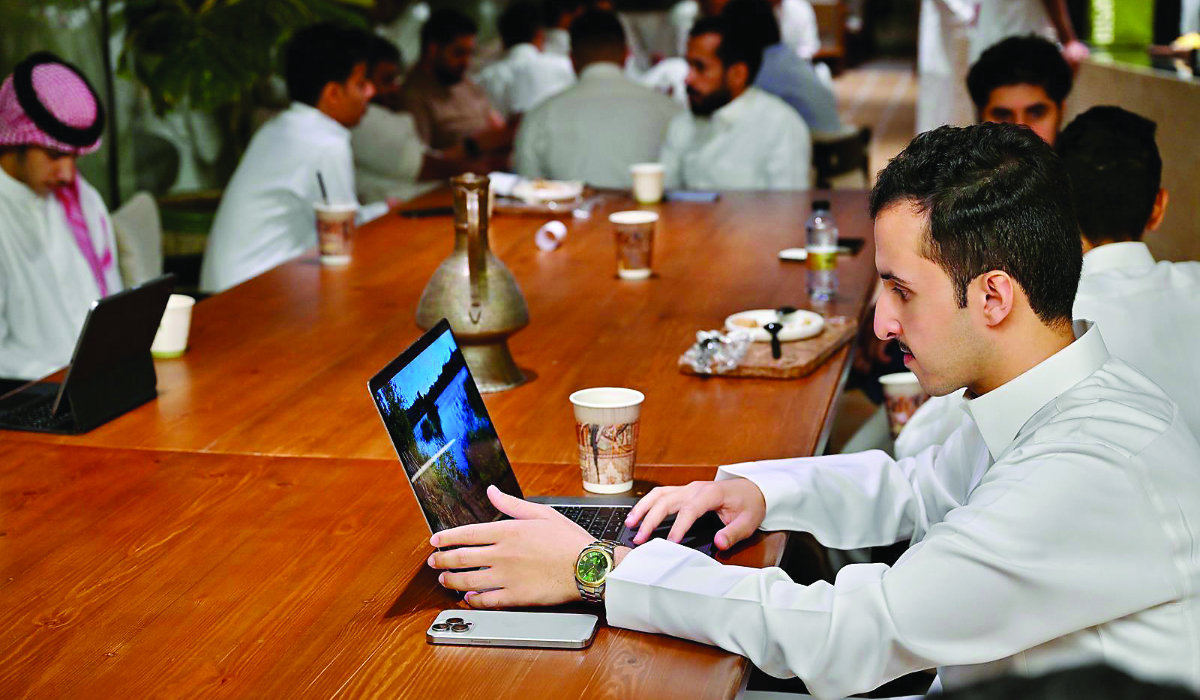


Malls and cafes are major social hubs for residents and professionals looking to socialize and network in Riyadh. (Supplied/File photo/SPA)

“I find it (a mall) a suitable choice given the nature of my work and the limited time I have,” said Tahani Al-Mutairi, a 40-year-old healthcare worker. “My work ends at 4 p.m. and I don’t have enough time to return home and prepare to host guests. So, having meetings here (the mall) is better both emotionally and financially.”

Nawal Mohammad, 24, also finds malls appealing, and the student said: “People are not staying at home all the time. Entertaining areas are now encouraging people to go out and socialize.”

Coffee shops, meanwhile, have emerged as venues for casual meetups, networking, and professional and creative collaborations. Riyadh’s cafe culture has grown rapidly with establishments boasting stylish interiors and diverse menus.

Some trace this development back to the COVID-19 pandemic, and Rawan Alghamdi, 23, said: “People were separated from each other (then). It wasn’t like before when they used to visit neighbors. After COVID-19, people became more isolated.”

However, others still see outdoor options as attractive. Abdulaziz Alotaibi, a telecommunications product manager, said: “If the place is prepared and comfortable and has outdoor seating, I would definitely prefer to sit outside.

“For example, at Sikka, people there sit outside despite the heat because the place is designed well.”

Noura Al-Huqbani, 55, agrees, and enjoys outdoor trips once the seasons shift, saying: “I prefer colder seasons when I go on spring trips, camping and to parks.”

For some, however, heat remains the deciding factor. “I personally enjoy the weather more than the place I am at,” said 19-year-old student Ghanaj Al-Rashid.

Lujain Khalid, her friend visiting from Kuwait, said: “Evenings used to be cooler. It is impossible to see anyone at a park now. It has become mainly (a matter of gathering) in cafes or malls.”

Whether in malls, coffee shops, or play centers, Saudis are reshaping how they gather. Social hubs are no longer just an escape from the heat but new spaces for connection and entertainment.


Absher Hackathon finalists highlight scale of Saudi tech talent

Updated 14 December 2025
Follow

Absher Hackathon finalists highlight scale of Saudi tech talent

  • World’s largest hackathon underscores growing national enthusiasm for tech innovation

RIYADH: Saudi Arabia’s push to position itself as a global hub for digital innovation was on display this weekend as the Absher Tuwaiq Hackathon 2025 — billed as the world’s largest hackathon — concluded with the announcement of finalist teams competing for prizes totaling SR1 million ($266,000). 

The three-day hackathon, organized by the Ministry of Interior in partnership with Tuwaiq Academy, brought together innovators from across the Kingdom to develop digital solutions aligned with the ministry’s digital transformation goals. 

The finalist teams recognized for their projects were: Shadow, Wusool, Watheeq , Tanabbah, HRS, Ikhlaa, Amal, Mustabiq, Al‑Dahna, Inspire, Saqour Al‑Watan, Thaqib, Sawt Al‑Mustaqbal, Manee, and YS Advance International. 

The finalists were announced at the end of the three-day Absher Tuwaiq Hackathon organized by the Ministry of Interior in partnership with Tuwaiq Academy. (AN photo/Supplied)

In addition to cash prizes, the competition offered SR450,000 in support from the National Technology Development Program, along with incubation opportunities at Invi Lab to help teams turn prototypes into market-ready products.   

Tariq Al‑Hamid, official spokesperson for the Absher Conference, told Arab News that the hackathon has generated strong momentum nationwide.  

This year’s event included more than 4,000 participants from all regions of the Kingdom — “a reflection of the growing national enthusiasm for digital innovation,” he said. 

HIGHLIGHT

The Absher Tuwaiq Hackathon brought together innovators from across the Kingdom to develop digital solutions aligned with the ministry’s digital transformation goals. 

According to Al‑Hamid, the 2025 event was structured around four specialized tracks: digital identity and security applications; artificial intelligence for predictive and proactive security; Internet of Things applications supporting field operations; and innovations to enhance or expand services on the Absher Platform. 

Tariq Al-Hamid (center) said that the hackathon’s impact extends beyond prize money. (Supplied)

He added that this focused approach allowed participants “to present high‑quality ideas and advanced prototypes at levels comparable to international competitions.” 

Participants also took part in more than 80 training programs delivered by global partners including Google Cloud, Meta, NVIDIA, and Huawei, an experience Al-Hamid said significantly strengthened both the competition and participants’ skills. 

Al-Hamid said that the hackathon’s impact extends beyond prize money. “More important than the cash reward is the opportunity to turn creative ideas into real products that make an impact on citizens, residents, and visitors.” 

Standout participants often attract the attention of leading national technology companies seeking new talent, he added. 

Participation was open to individuals and teams from across Saudi Arabia, from high school students to industry professionals, highlighting the inclusivity of the event and the breadth of the Kingdom’s innovation ecosystem.  

The hackathon forms part of the wider Absher Tuwaiq initiative, a core pillar of the upcoming Absher Conference 2025, which will empower more than 100,000 participants across seven technical tracks in 16 cities, in partnership with 20 local and international organizations. 

The conference, organized by the Ministry of Interior and Tuwaiq Academy, sponsored by Elm Company and held in strategic partnership with the Saudi Data and Artificial Intelligence Authority, will take place in Riyadh from Dec. 17 -19. 

The event will showcase national digital innovations and reinforce Saudi Arabia’s role in global technology.