

Saudi carrier flynas secures $134m Murabaha facility for fleet expansion

The funding supports flynas’ broader aircraft acquisition program, which includes 195 narrow-body planes — 159 A320neo and 36 A321neo models — under its existing purchase agreements with Airbus. Supplied
Short Url
Updated 02 September 2025
Follow

Saudi carrier flynas secures $134m Murabaha facility for fleet expansion

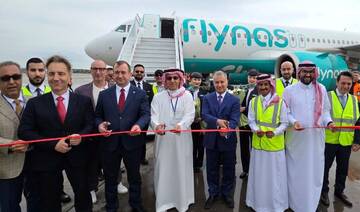
RIYADH: Saudi Arabia’s budget carrier flynas has signed a SR504 million ($134.4 million) Murabaha facility with Saudi Awwal Bank to finance the delivery of new Airbus A320neo aircraft, strengthening its ongoing fleet expansion drive. 

According to a bourse disclosure, the 12-year facility — finalized on Aug. 28 — is secured by promissory notes, aircraft mortgages, and the assignment of insurance, reinsurance, and warranty rights tied to the airframes and engines.  

The funding supports flynas’ broader aircraft acquisition program, which includes 195 narrow-body planes — 159 A320neo and 36 A321neo models — under its existing purchase agreements with Airbus. 

The deal follows another SR495 million Murabaha financing signed in February with Bank AlJazira to fund the acquisition of three Airbus A320neo aircraft. The agreement marked a step toward deepening collaboration between the aviation and financial sectors, while prioritizing Saudi institutions in future growth initiatives. 

In its filing, the airline described the latest facility as a key milestone in advancing its fleet expansion plans, enabling it to meet rising passenger demand, boost operational efficiency, and support broader capital restructuring initiatives. 

“It also reflects flynas’ commitment to aligning with the rapid growth of the aviation sector in the Kingdom, driven by the Saudi Vision 2030 programs, which aim to position the Kingdom as a global hub for travel, tourism, and logistics,” the carrier added. 

This facility aligns with earlier developments in flynas’ ongoing fleet expansion strategy.  

In July 2024, the airline signed a landmark agreement with Airbus for 160 aircraft—comprising 130 A320 family jets and 30 A330neo wide-bodies — bringing its total order book to 280 aircraft.   

It also signed a separate memorandum of understanding for 75 A320neo and 15 A330-900 aircraft.   

In recent months, flynas has taken delivery of several A320neo jets, bringing the total number in its fleet to 57 as of May.   

The airline expects to receive over 100 additional Airbus aircraft by 2030, with wide-body deliveries beginning in 2027.  

These moves support flynas’s ambition to expand its domestic and international network while enhancing service quality and operational efficiency.   

In June, flynas finalized its initial public offering, pricing shares at SR80 apiece, the top of its indicated range, giving the airline a market capitalization of SR13.6 billion.  

The offering — the first airline IPO in the Gulf in nearly two decades — saw heavy demand, with institutional investors oversubscribing by around 100 times and retail investors by 350 percent.

European gas prices soar almost 50% as Iran conflict halts Qatar LNG output

Updated 02 March 2026
Follow

European gas prices soar almost 50% as Iran conflict halts Qatar LNG output

  • Analysts warn prolonged disruption could push prices higher
  • Some shipments of oil, LNG through Strait of Hormuz suspended
  • Benchmark Asian LNG price up almost 39 percent

LONDON: ​Benchmark Dutch and British wholesale gas prices soared by almost 50 percent on Monday, after major liquefied natural gas exporter Qatar Energy said it had halted production due to attacks in the Middle East.

Qatar, soon to cement its role as the world’s second largest LNG exporter after the US, plays a major role in balancing both Asian and European markets’ demand of LNG.

Most tanker owners, oil majors and ‌trading houses ‌have suspended crude oil, fuel and liquefied natural ​gas shipments ‌via ⁠the ​Strait of ⁠Hormuz, trade sources said, after Tehran warned ships against moving through the waterway.

Europe has increased imports of LNG over the past few years as it seeks to phase out Russian gas following Russia’s invasion of Ukraine.

Around 20 percent of the world’s LNG transits through the Strait of Hormuz and a prolonged suspension or full closure would increase global competition for other ⁠sources of the gas, driving up prices internationally.

“Disruptions to ‌LNG flows would reignite competition between ‌Asia and Europe for available cargoes,” said ​Massimo Di Odoardo, vice president, gas ‌and LNG research at Wood Mackenzie.

The Dutch front-month contract at the ‌TTF hub, seen as a benchmark price for Europe, was up €14.56 at €46.52 per megawatt hour, or around $15.92/mmBtu, by 12:55 p.m. GMT, ICE data showed.

Prices were already some 25 percent higher earlier in the day but extended gains ‌after QatarEnergy’s production halt.

Benchmark Asian LNG prices jumped almost 39 percent on Monday morning with the S&P Global ⁠Energy Japan-Korea-Marker, widely used ⁠as an Asian LNG benchmark, at $15.068 per million British thermal units, Platts data showed.

“If LNG/gas markets start to price in an extended period of losses to Qatari LNG supply, TTF could potentially spike to 80-100 euros/MWh ($28-35/mmBtu),” Warren Patterson, head of commodities strategy at ING, said. The British April contract was up 40.83 pence at 119.40 pence per therm, ICE data showed.

Europe is also relying on LNG imports to help fill its gas storage sites which have been depleted over the winter and are currently around 30 percent full, the latest data from Gas Infrastructure ​Europe showed. In the European carbon ​market, the benchmark contract was down €1.10 at €69.17 a tonne