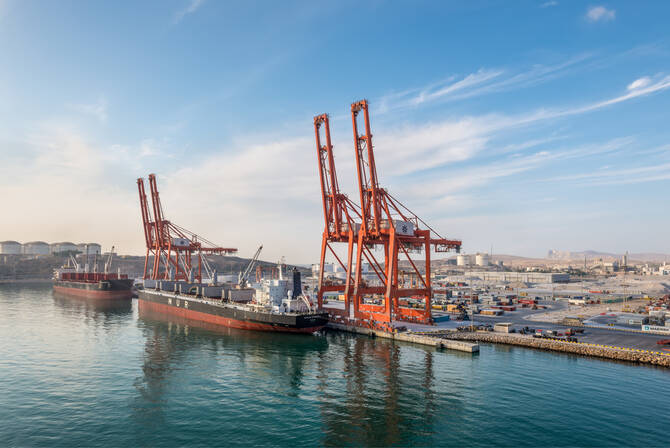
Oman-Iraq trade rises to $622m in H1 2025 

Statistics from the National Center for Statistics and Information showed that bilateral trade increased from 156.5 million rials during the same period in 2024, Oman News Agency reported. Shutterstock
Short Url
Updated 02 September 2025
Follow

Oman-Iraq trade rises to $622m in H1 2025 

RIYADH: Trade exchange between Oman and Iraq grew to 239.2 million Omani rials ($622 million) in the first half of 2025, marking a 1.2 percent rise from a year earlier. 

Statistics from the National Center for Statistics and Information showed that bilateral trade increased from 156.5 million rials during the same period in 2024, Oman News Agency reported. 

Omani exports to Iraq reached 32.8 million rials, while imports from Iraq totaled 206.4 million rials in the first six months of 2025. 

The surge in trade underscores deepening economic ties between Muscat and Baghdad, driven by collaborative agreements on trade, transportation, and investment, as well as efforts to diversify their economies away from oil dependency. 

Commenting on the strengthening ties, Faisal Al-Rawas, chairman of the Oman Chamber of Commerce and Industry, said Iraqi Prime Minister Mohammed Shia Al-Sudani’s recent visit to Oman reflects the depth of bilateral relations and growing economic cooperation. 

“It also demonstrates the two countries’ aspirations to expand the scope of economic cooperation and integration, which enhances the role of the private sectors in both countries in strengthening bridges of partnership,” ONA cited him as saying. 

The figures also showed that 11,558 Iraqi visitors traveled to Oman during the first seven months of 2025, underscoring the growing people-to-people exchange. 

Meanwhile, the Ministry of Commerce, Industry and Investment Promotion revealed that the number of Iraqi companies investing in Oman reached 1,304 in the first half of 2025, with a combined capital of 94.3 million rials. 

Iraqi investment accounted for 68.2 percent of total foreign participation, ONA reported. 

Key Omani exports to Iraq during this period included electrical cables, gold jewelry, and marble, while natural gas, petroleum derivatives, and liquefied propane dominated imports from Iraq. 

Both countries are bound by several agreements, including deals on economic and trade cooperation, air services, and a free trade zone initiative. 

Al-Rawas emphasized that Omani companies benefit from advanced infrastructure, investment incentives, and access to special economic and free zones. Oman’s strategic location, he said, could help Iraqi products reach markets in Asia and Africa. 

Highlighting Iraq’s potential, Al-Rawas said the country represents an attractive investment destination, adding that Iraq’s “Development Road” project offers significant opportunities for international logistical integration, linking the Gulf with Europe. 

He expressed hope for Omani companies to play a role in the project, particularly in the transport and logistics sectors. 

The chamber, he added, is committed to strengthening business partnerships, fostering joint investments, and promoting knowledge exchange to diversify income sources, create jobs, and reinforce the historic and fraternal ties between the two nations. 


Saudi Arabia, WEF launch initiative to reshape global travel landscape

Updated 11 November 2025
Follow

Saudi Arabia, WEF launch initiative to reshape global travel landscape

  • ‘Beyond Tourism’ is global framework advancing sustainability, inclusivity, and resilience in the sector

RIYADH: Saudi Arabia has partnered with the World Economic Forum to launch the “Beyond Tourism” initiative, a global framework designed to drive a more sustainable, inclusive, and resilient future for the travel and tourism sector.

Announcing the initiative on his X account, Saudi Minister of Tourism Ahmed Al-Khateeb said he was “thrilled to announce the launch,” noting that it is “dedicated to shaping the future of travel and tourism and is built around 10 core principles.”

Al-Khateeb emphasized that Beyond Tourism underscores the sector’s vital role as “a bridge between cultures, a means to empower communities, and a source of opportunities for future generations.”

The initiative comes as the global travel and tourism industry undergoes a major structural shift — moving away from fragmented, business-as-usual models toward integrated, ecosystem-based strategies.

According to the World Economic Forum, the sector is projected to reach 30 billion tourist visits and contribute $16 trillion to global gross domestic product by 2034. Yet, it continues to face complex challenges including rising tension between visitors and residents, environmental pressures, workforce shortages, and exposure to geopolitical and climate disruptions.

“The global travel and tourism sector is entering a period of profound transformation, moving decisively from a fragmented, business-as-usual operating model to a holistic, ecosystem-based paradigm,” the WEF said in a statement.

The forum noted that past reliance on siloed policies — a weakness underscored during the COVID-19 pandemic — has proven insufficient to address today’s global challenges.

Its proposed ecosystem approach focuses on five key enablers: infrastructure, finance, technology and innovation, people and skills, and policy and governance. The model aims to convert systemic challenges into opportunities for inclusive and sustainable growth.

Several destinations have already demonstrated the benefits of this approach. Countries such as Portugal, New Zealand, Costa Rica, Singapore, and Indonesia have leveraged it to improve conservation outcomes, diversify economies, and strengthen sustainable tourism development.

By promoting global cooperation among governments, private-sector leaders, and local communities, the Beyond Tourism initiative seeks to unlock the full potential of the industry while safeguarding cultural and natural heritage for generations to come.