

Number of older adults in Sub-Saharan Africa rising rapidly, WHO Says

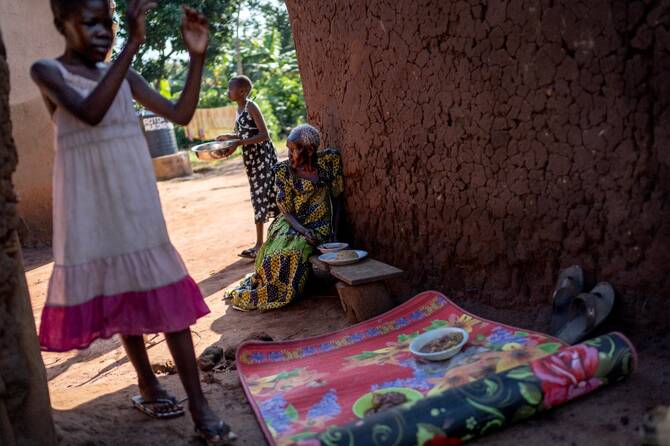
A grandmother sits with her granddaughters in a home they share at Magogo, Uganda. (AP)
Short Url
Updated 02 September 2025
Follow

Number of older adults in Sub-Saharan Africa rising rapidly, WHO Says

  • WHO projects that the number of people aged 60 and older in sub-Saharan Africa will more than double by 2050, highlighting a major demographic shift
  • Older adults in Uganda and across East Africa are living longer but often face limited pensions, scarce healthcare, and poverty, while simultaneously supporting grandchildren and sustaining households

MAGOGO: In rural Uganda, grandparents increasingly walk children to school and tend family gardens, reflecting a broader trend of longer lives across East Africa.

According to WHO projections, the number of people aged 60 and older in sub-Saharan Africa is expected to more than double by 2050. This creates both pressures and opportunities for families, communities, and governments alike.

Yet, amid hardship, older adults continue to play central roles in holding households together, nurturing the young, and passing on cultural knowledge.

“We used to say old age was a blessing,” says Sarah Nansubuga, who runs an elder-care support group in Kampala. “Now we see it’s a blessing and a responsibility. Families, leaders, and all of us must find ways to make those years dignified.”

From Uganda to South Africa, policymakers and communities are debating how to adapt to a growing older population.

Some warn of strain on families and health services, while others point to opportunities for intergenerational care and learning. 

Across Uganda’s villages, children play, climbing jackfruit trees, racing bicycle tires, and laughing through schoolyards. Their presence is a familiar and celebrated sight. Nearby, however, older adults are quietly navigating a new reality. They are living longer, yet many face limited pensions, scarce healthcare, and ongoing poverty.

Dr. Emmanuel Mugerwa, who shifted from pediatrics to geriatric care at a local clinic run by Reach One Touch One (ROTOM), sees the connections between young and old. “Both of them are suffering,” he says. “Both of them don’t have a lot of things that they need.”

Uganda’s demographics reflect this intersection vividly.

Roughly half the population is under 18, while the elderly, though a smaller share, are growing rapidly.

Government statistics show that children and people 75 and older have the highest poverty rates, and households often combine these age groups.

Around one in six households with older adults is “skipped generation,” with grandparents raising grandchildren.

At a ROTOM campus, a school shares its grounds with a home for seniors. Uniformed children pray in an open-air hall just across from a room where staff care for elders. Among them is 94-year-old Rose Liru, who arrived at ROTOM with bruises reportedly inflicted by a family member. Her grandniece and great-granddaughter, 11-year-old Brenda Mungulu and 9-year-old Parvin Nakawesi, have been left in her care after their parents were unable to provide for them.

Liru describes the dual realities of raising children in old age. “I protect them. I defend them,” she says. “Old people, we are the ones who hold families together. We are the ones who pray for you. We are the ones who do good. We are the ones who are next to God.” She acknowledges the weight of responsibility but also the value of companionship and continuity.

Many elders face these responsibilities while struggling to sustain themselves.

Literacy is low among older Ugandans; more than 80% of people over 85 cannot read or write. Yet education remains a priority, with seniors often investing whatever resources they have into supporting young learners.

Felista Kemitaare, 78, cares for her 11-year-old granddaughter along a steep path lined with lush hills. Her own food production is insufficient, and she sells part of her harvest to cover school fees.

On a recent morning, ROTOM field nurse Winnie Katwesigye visits to check on her health and wellbeing. Despite aches and limited resources, Kemitaare heads to her garden with a walking stick, tending anemic potatoes with careful, deliberate movements.

Norah Makubuya, a ROTOM project manager, emphasizes the challenges of older adults assuming parental responsibilities again. “The burden of adult children often becomes their parents’ burden,” she says, underscoring how aging, poverty, and family structures are intertwined.

As Uganda and other sub-Saharan nations confront a rapidly growing elderly population, the stakes are high.

(With AP)


Around the world, refugees are shut out of the US by Trump’s new policies

U.S. Chief Border Patrol Agent, Gregory Bovino talks to a detained migrant on December 5, 2025 in New Orleans, Louisiana. (AFP)
Updated 3 sec ago
Follow

Around the world, refugees are shut out of the US by Trump’s new policies

  • About 600,000 people were being processed to come to the US as refugees around the world when the program was halted, according to the administration

WASHINGTON: When President Donald Trump suspended the refugee program on day one of his current administration, thousands of people around the world who had been so close to a new life in America found themselves abandoned.
Many had already sold possessions or ended leases in preparation for travel. They had submitted reams of documents supporting their cases, been interviewed by US officials and in many cases already had tickets to fly to America.
As part of Trump’s crackdown on both legal and illegal migration, the Republican president has upended the decades-old refugee program that has served as a beacon for those fleeing war and persecution. In October, he resumed the program but set a historic low of refugee admissions at just 7,500 — mostly white South Africans.
A litany of new restrictions was announced after an Afghan national became the suspect in the shooting of two National Guard members last week. The Trump administration also plans a review of refugees let in during the Democratic Biden administration. Trump’s administration has cited economic and national security concerns for its policy changes.
About 600,000 people were being processed to come to the US as refugees around the world when the program was halted, according to the administration. Dozens of white South Africans have been let in this year. But only about 100 others have been admitted as a result of a lawsuit by advocates seeking to restart the refugee program, said Mevlüde Akay Alp, a lawyer arguing the case.
“It’s important that we don’t abandon those families and that we don’t abandon the thousands of people who were relying on the promise of coming here as refugees,” said Akay Alp, with the International Refugee Assistance Project.
The Associated Press spoke to three families whose lives have been thrown into disarray because of the changing policies.
A family separated by tightened restrictions
The Dawoods had waited years for the opportunity to come to the US After fleeing civil war in Syria, they settled in northern Iraq. They hoped to find a home that could provide better medical care for a daughter who had fallen from the fourth floor of the family’s apartment building.
After they were accepted as refugees to the US, son Ibrahim and his sister Ava relocated to New Haven, Connecticut, in November 2024. His parents and one of his brothers were scheduled to fly in January.
But just two days before they were to board their flight, mother Hayat Fatah fainted at a medical check and her departure was postponed. Mohammed, another sibling, didn’t want to leave his parents behind.
“I said: ‘This is it. The chance is gone.’ But I had to stay with my father and mother,” Mohammed said.
Nearly a year later, he and his parents are still waiting. Without a residency card, Mohammed can’t work or travel outside of their home in the city of Irbil. The family gets by on money sent from relatives abroad.
Mohammed had dreams for his hoped-for new life in America: starting a business or finishing his studies to become a petroleum engineer; getting married and building a family.
“Whether it was now, a year from now, two years later or four years, I will wait and hope that I will go,” he said.
In America, Ibrahim often wakes up early to tutor people online before going to his job as a math teacher at a private school, and then he takes care of his sister when he gets home. He said his mother often cries when they talk because she wishes she were in America to help care for her daughter.
Ibrahim said one solace has been the welcome he’s received in the US Volunteers have stepped in to take him and his sister to frequent doctor appointments and helped them adjust to their new lives.
“I really appreciate the kindness of the people here,” he said.
After a decade in limbo, a Chinese pastor wonders when his turn will come
Chinese Christian Lu Taizhi fled to Thailand more than a decade ago, fearing persecution for his beliefs. He’s lived in legal limbo since, waiting to be resettled in the United States.
Lu said he has long admired the US for what he calls its Christian character — a place where he feels he and his family “can seek freedom.” He said he was disappointed that people like him and his family who applied for refugee status legally face so many difficulties in going to the US
“I oppose illegal immigration. Many are fake refugees, or illegal immigrants, they’ve never faced oppression. I’m opposed to this,” Lu said. “But I hope America can accept people like us, real refugees who faced real oppression. … It’s really disappointing.”
Lu comes from a long lineage of dissent: He was born into a family branded as “hostile elements” by the Chinese Communist Party for its land ownership and ties to a competing political party. A teacher and poet, Lu grew interested in history banned by the Chinese state, penning tributes to the bloody 1989 Tiananmen crackdown on pro-democracy protests in Beijing.
In 2004, Lu was arrested after police found poems and essays he secretly published criticizing Chinese politics and the education system. After his release, Lu became a Christian and began preaching, drawing scrutiny from local authorities. Year after year, officers knocked on his door, warning him not to organize protests or publish commentary criticizing the Party.
With Chinese leader Xi Jinping’s rise to power, controls tightened. When Beijing arrested hundreds of rights lawyers in 2015, Lu took his family and fled, worried police would come for him. After traveling across Southeast Asia, Lu and his family settled in Thailand, where they applied for refugee status with the United Nations.
Eight years later, the UN notified Lu the US had accepted his application. But their first flight, in April 2024, was postponed because Lu’s sons’ passports had expired. A second, scheduled for Jan. 22, 2025, was canceled without explanation, and the most recent one, scheduled for Feb. 26, was canceled shortly after Trump’s inauguration. His application has been put on hold indefinitely, Lu said.
Today, Lu is scraping a meager living as a teacher and pastor in Northern Thailand. He’s separated from his wife and children in Bangkok, Thailand’s capital, but says he has no choice if he wants to earn money and support his family.
“I am very supportive of all of Trump’s policies because I think only President Trump can dismantle the CCP,” Lu said, using an acronym referring to the Chinese Communist Party. “So I don’t have any complaints. I just wait silently.”
‘I don’t want to lose her’
Louis arrived in the United States as a refugee in September 2024. He left his wife and two children in East Africa, hoping they could soon be reunited in the US
But that dream faded a few months later with Trump’s return to the presidency.
Louis, who insisted on being identified only by his first name out of concern that speaking publicly could complicate his case, was told in January that a request he had made to bring his family to the US had been frozen due to changes in refugee policies.
Now, the family members live thousands of miles apart without knowing when they will be reunited. His wife, Apolina, and the children, 2 and 3 years old, are in a refugee camp in Uganda. Louis is in Kentucky.
“I don’t want to lose her, and she does not want to lose me,” said Louis, who resettled in Kentucky with the help of the International Rescue Committee. “The hope that I had went slowly down. I thought that we would never meet again,” he said referring to the moment when he received the notice.
Louis and Apolina’s families applied for refugee status after fleeing war in the Democratic Republic of Congo.
Louis’ application, initiated by his parents, was approved, Apolina’s, made separately by her parents, was not. They hoped if Louis applied for family reunification in the US, that would ease the way to bring over Apolina and the two children.
Apolina thought that, as the wife of a refugee, it would take her no more than one year to reunite with her husband, who now works in an appliance factory and has already applied for permanent residency.
The separation hasn’t been easy for her and the children, who live in a tent in the refugee camp. The younger one, who was 7 months old when Louis left, cries every time he sees his father in a video call. The older one keeps asking where Louis is and when he will see him.
Apolina fears that as time drags on, the children will forget their father.
“I feel terrible because I miss my husband very much,” said Apolina in a phone interview from Uganda. “I pray for him that God enables him to be patient until we meet again.”