

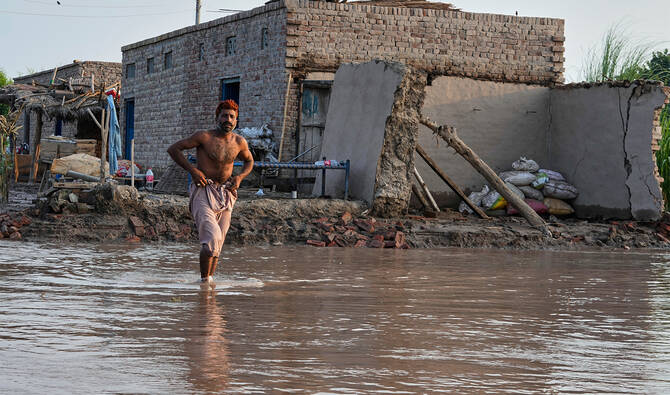

ISLAMABAD: Pakistan’s National Disaster Management Authority (NDMA) on Tuesday widened its flood alert level from the eastern Punjab province to northwestern Khyber Pakhtunkhwa, saying residential areas of the provincial capital were at risk of being inundated.
The warning came as Pakistan struggles with its worst monsoon season in years. At least 41 people have been killed and more than 2.4 million affected in Punjab, the nation’s breadbasket and most properous province, during the last 10 days, according to the Provincial Disaster Management Authority (PDMA). Nationwide, rains and floods have killed 863 people since June 26, reviving memories of the catastrophic 2022 deluge when a third of the country was submerged, more than 1,700 people were killed, 30 million displaced and damages topped $35 billion.
In a fresh alert, the NDMA said the water level at Budhni Nullah on the outskirts of Peshawar city, the capital of KP, had reached 16,142 cusecs, categorizing it as “high-level flooding.” The authority warned that residential areas of Warsak Road, Darmangi and Regi were at risk of being flooded.
“Residents of low-lying areas are advised to take protective measures,” the NDMA said. “Rescue teams and local administration are on high alert.”
The PDMA in Khyber Pakhtunkhwa also warned of heavy to very heavy rainfall with thunderstorms and strong gusty winds across much of the province, including Chitral, Swat, Malakand, Abbottabad, Mansehra, Mardan, Swabi, Peshawar, Nowshera, Kohat, Dera Ismail Khan and Waziristan districts.
According to the Pakistan Meteorological Department, torrential rains could generate flash floods in local streams and rivers, trigger urban flooding in low-lying areas of Peshawar, Nowshera, Tank and D.I. Khan, and cause landslides in vulnerable hilly areas.
Authorities cautioned that windstorms and lightning could damage weak structures, electric poles, billboards, vehicles and solar panels. Farmers were advised to manage agricultural activities accordingly, while residents and tourists were asked to avoid travel in high-risk zones.
Rainfall recorded in the province in the last 24 hours included Kakul 38mm, Ghalanai 33mm, Dir 27mm, Saidu Sharif 20mm, Peshawar Airport 15mm, Peshawar City 9mm, Khaar Bajaur 12mm, Malam Jabba 8mm, and Balakot 4mm. The highest temperature was 36°C in Chitral, Drosh, Mirkhani and D.I. Khan.
RIVERS STEADY OVERALL
The NDMA’s latest update on river flows at 3:30 p.m. Tuesday showed that most river gauges in Punjab have stabilized, but there were fresh rises on the Ravi at Jassar and Sidhnai, continued pressure at Head Muhammad Wala on the Chenab, and falling levels at Trimmu, underscoring the persistent risk of flooding across the basin.
On the Chenab, most gauges were steady, though levels at Trimmu fell to 426,964 cusecs while Head Muhammad Wala continued rising at 409.50 ft, close to its danger mark of 417.50 ft.
On the Ravi, Jassar rose to 54,816 cusecs and Sidhnai to 127,719 cusecs, while other stations held steady.
On the Sutlej, flows remained largely steady, including 167,508 cusecs at Punjnad and 253,068 cusecs at Ganda Singh Wala.
Separately, PDMA Punjab Director General Irfan Ali Kathia warned that a flood wave from the Chenab would reach Multan in southern Punjab via the Trimmu Headworks by Tuesday night.
“The situation in Multan could become critical,” Kathia said in a statement, adding that the next four to six hours were very important. “The total number of villages affected so far is 3,243 and approximately, 2.4 million population have been affected in some form or the other.”
Over one million people had been rescued with both government and private agencies participating in operations, Kathia added.


