North Korea’s Kim in China ahead of massive military parade

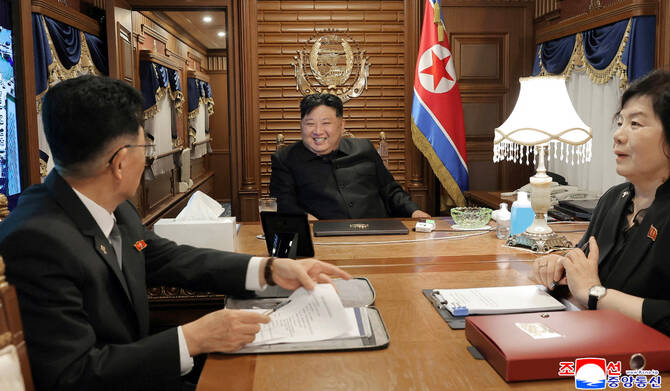
North Korean leader Kim Jong Un travels by train as he leaves Pyongyang to attend China's celebration of the formal surrender of Japan in World War Two, in this picture released by the Korean Central News Agency on September 2, 2025. (REUTERS)
Short Url
Updated 02 September 2025
Follow

North Korea’s Kim in China ahead of massive military parade

  • The North Korean leader's special train passed into China early Tuesday, South Korea's Yonhap news agency reported, citing the North's state-run radio service, KCBC

BEIJING: North Korean leader Kim Jong Un was on his way to Beijing on Tuesday morning, having crossed the border into China aboard an armored train ahead of a massive military parade on Wednesday.
Kim will join Chinese President Xi Jinping and other world leaders including Russia’s Vladimir Putin for a huge spectacle in which China will showcase its military prowess, with troops marching in formation, flypasts and other high-tech fighting gear.
More than 25 leaders will also attend Wednesday’s parade centered on Beijing’s Tiananmen Square to mark 80 years since the end of World War II.
Millions of Chinese people were killed during a prolonged war with imperial Japan in the 1930s and 40s, which became part of a global conflict following Tokyo’s attack on Pearl Harbor in 1941.
China has touted the parade as a show of unity with other countries, and Kim’s attendance will be the first time he has been seen with Xi and Putin at the same event.
The North Korean leader’s special train passed into China early Tuesday, South Korea’s Yonhap news agency reported, citing the North’s state-run radio service, KCBC.
His appearance in China “formalizes the China-Russia-North Korea trilateral (relationship) to the public,” Soo Kim, a geopolitical risk consultant and former CIA analyst, told AFP.
Kim enjoyed a brief bout of high-profile international diplomacy from around 2018, meeting US President Donald Trump and then South Korean president Moon Jae-in multiple times.
But he withdrew from the global scene after the collapse of a summit with Trump in Hanoi, Vietnam, in 2019.
Kim stayed in North Korea throughout the Covid-19 pandemic, but met Putin in Russia’s far east in 2023.

Security around Beijing has tightened in recent days and weeks, with road closures, military personnel stationed on bridges and street corners, and miles upon miles of white barriers lining the capital’s wide boulevards.
Art installations with flowers, doves and an emblem showing the Great Wall of China with “1945-2025” have cropped up around the city, and on Tuesday morning Chinese flags flew in residential neighborhoods.
Officials have been tight-lipped over the list of hardware to be displayed at the parade, but military enthusiasts have already spotted significant new systems, including what is rumored to be a gigantic laser weapon.
Wednesday’s event caps a bumper week of diplomacy for President Xi, who on Sunday and Monday hosted a slew of Eurasian leaders for a summit in the northern port city of Tianjin aimed at putting China front and center of regional relations.
The club of 10 countries — named the Shanghai Cooperation Organization (SCO) — touts itself as a non-Western style of collaboration in the region and seeks to be an alternative to traditional alliances.
During the summit, Xi slammed “bullying behavior” from certain countries — a veiled reference to the United States — while Putin defended Russia’s Ukraine offensive, blaming the West for triggering the conflict.
Many of the guests from the Tianjin gathering, including Putin, Belarusian President Alexander Lukashenko and several other leaders will join Xi and Kim for the parade in Beijing.


Afghanistan launches retaliatory attacks on Pakistan as tensions escalate

Updated 5 sec ago
Follow

Afghanistan launches retaliatory attacks on Pakistan as tensions escalate

  • At least 66 Afghans have been killed by Pakistan’s strikes, Afghan authorities say
  • Afghanistan has called for dialogue while Pakistan ruled out any talks with Kabul 

KABUL: Afghanistan has launched new attacks on Pakistan’s military bases, the Afghan defense ministry said on Saturday, as cross-border clashes escalated between the neighbors after months of tension. 

The latest flare-up erupted after Pakistan’s airstrikes on Afghan territory last weekend triggered a retaliatory offensive from Afghanistan along the border on Thursday. 

The two countries have engaged in tit-for-tat attacks since, marking the most serious development in ongoing tensions between the two countries, which agreed to a ceasefire last October following a week of deadly clashes. 

Afghanistan’s Air Force has “once again launched airstrikes on Pakistani military bases” in Miranshah and Spinwam, the Afghan Ministry of National Defense said on X on Saturday, claiming that the strikes caused “severe damage and heavy casualties.”

“These successful operations were conducted in response to repeated aerial aggressions by the Pakistani military regime,” the ministry said. 

Afghan forces also launched similar strikes against military targets in Islamabad and Abbottabad on Friday, which the ministry said was in retaliation of aerial attacks by Pakistani forces in Kabul, Kandahar and Paktia.

At least 66 Afghan civilians, mostly women and children, have been killed in Pakistani strikes, with another 59 others wounded, according to Hamdullah Fitrat, deputy spokesman for the Afghan government. 

Pakistan has maintained that it is targeting only military targets to avoid any civilian casualties, in compliance with international law. 

Pakistani officials said its forces have killed more than 330 Afghan fighters and targeted 37 military locations across Afghanistan.

Zabihullah Mujahid, chief spokesperson for the Afghan government, earlier called for talks to resolve the crisis. 

“We have always emphasized peaceful resolution, and now too we want the issue to be resolved through dialogue,” he said on Friday. 

However, Pakistan has ruled out any talks with Kabul. 

“There won’t be any talks, there is nothing to talk about. There’s no negotiation. Terrorism from Afghanistan has to end,” Mosharraf Zaidi, spokesperson for Pakistan’s prime minister, said on Friday. 

Pakistan is accusing the Afghan Taliban of sheltering fighters from the banned Tehreek-e-Taliban Pakistan and allowing them to stage cross-border attacks — a charge Afghanistan denies, saying it does not allow its territory to be used against other countries. 

As international calls for mediation grow amid the escalating hostility, Afghans across the country are growing fearful of the violence. 

“Everyone heard the jets. This is the first time since the withdrawal of US invaders that we have heard such a horrible noise and news of damage. It is not good for us,” said Kandahar resident Shahid Zamari. 

“We had forgotten the US war and its bad impact on us, on our families, on our children. And now this has come upon us again — by Pakistan, and in the holy month of Ramadan.” 

When the strikes hit Kabul at around 1:30 a.m. on Friday, Saleema Wardak moved quickly to wake up her six children and escape outside, assuming the strong jolt that shook her house was an earthquake. 

“While standing in the yard, my husband told me it was not an earthquake but an explosion. Then we heard the crazy sounds of planes, and shooting from the mountains against the planes,” she told Arab News. 

“We hid inside, worried another bomb would fall on us. People say Pakistan is targeting civilians on purpose to increase pressure on the Taliban. So we hid … The world is unjust … They do not value the blood of the poor.” 

For Sabawoon, a 23-year-old student from eastern Kunar province’s Asadabad city, the coming days are filled with uncertainties. 

“What to do? Where to go? We have to stay and find our way to survive,” he told Arab News. “God willing, nothing bad will happen to us. If they are bombing us, what can we do?”