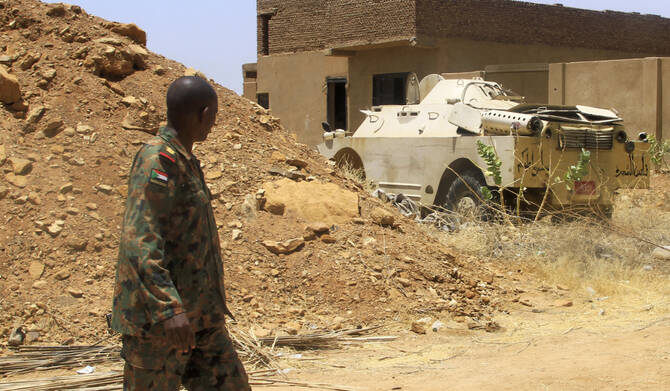

KHARTOUM: The western Sudanese city of El-Fasher has been under siege for more than a year by paramilitary forces seeking to capture it amid a wider war with the army that began in April 2023.
Gripped by brutal violence, the city has become the latest strategic front in the conflict as the paramilitary Rapid Support Forces (RSF) pushes to seize the last major city held by the army in the Darfur region.
The paramilitaries, who lost much of central Sudan including Khartoum earlier this year, are attempting to consolidate power in the west and establish a rival government.
Here are key facts about the situation inside El-Fasher:
The Sudanese army is fighting alongside the Joint Forces, a coalition of former rebel groups led by militia commanders who are part of the army-allied government.
These groups abandoned neutrality in November 2023 following RSF-led ethnic massacres against the Massalit tribe in West Darfur’s El-Geneina, and the RSF’s capture of four Darfur state capitals.
The RSF evolved from the Janjaweed Arab militias, mobilized in the early 2000s by the government to crush a rebellion by non-Arab ethnic groups in Darfur, causing an estimated 300,000 deaths amid accusations of genocide.
The current war erupted after a power struggle between former allies, army chief Abdel Fattah Al-Burhan and RSF commander Mohamed Hamdan Dagalo, over integrating the RSF into the regular army.
The army and its allies now control less than 13 square kilometers (five square miles) of the city’s total of about 80 square kilomtres, primarily clustered around the airport in the city’s west, according to satellite imagery from Yale University’s Humanitarian Research Lab.
Their remaining control areas stretch from the famine-hit Abu Shouk displacement camp in the north to Shalla prison in the south and as far east as the Grand Souk.
The area under army control “is the smallest it has been since the siege began,” Nathaniel Raymond, a war investigator and executive director of Yale’s HRL, told AFP.
The RSF captured much of Abu Shouk camp — which came under repeated attacks over the past weeks — seized the police headquarters in the city center and targeted hospitals and densely populated areas near the airport.
Satellite imagery from Yale’s lab shows extensive damage to the city’s water authority, disrupting access to clean drinking water.
The RSF has constructed over 31 kilometers of dirt berms, encircling El-Fasher to trap its population, “creating a literal kill box,” according to Yale’s latest report.
These earth barriers were started by the army, but completed and fortified by the RSF, Yale’s Raymond said.
The berms form “a half-circle crescent” along the northern side, Raymond said, while the southern side is fully under RSF control after it captured Zamzam camp — also struck by famine — in April.
“There is no way out,” said Raymond.
Those trying to scale the berms face likely death as RSF fighters reportedly demand bribes for passage and execute those suspected of army links, he added.
“We can see the choke points from space that the RSF is using for controlling civilian access.”
Some 300,000 civilians remain trapped inside El-Fasher, cut off from food, water, medicine and humanitarian aid, according to the UN.
Famine was declared last year in Zamzam, Abu Shouk and a nearby camp.
In El-Fasher, nearly 40 percent of children under five suffer acute malnutrition, according to UN data. Civilians eat animal fodder and many who flee into the desert die from starvation, exposure or violence.
Satellite imagery shows expanded cemeteries. Starving civilians report hiding in makeshift bunkers to protect themselves from relentless shelling.
The RSF assault on Zamzam displaced hundreds of thousands. Aid agencies fear another mass exodus if El-Fasher falls.
Capturing El-Fasher would also give the RSF control over all five Darfur state capitals, effectively strengthening its push for a parallel administration in western Sudan.
Experts warn of mass atrocities against El-Fasher’s dominant Zaghawa tribe, similar to the 2023 massacres in El-Geneina, in which up to 15,000 people, mostly from the Massalit tribe, were killed.
Political analyst Kholood Khair called the battle “existential” for both sides: the RSF seeks legitimacy and supply lines with backers in Libya, Chad and the United Arab Emirates, while the Joint Forces, mostly composed of Zaghawa fighters, see the city as their last line of defense.
“El-Fasher has become a siege of attrition much like Stalingrad,” Khair told AFP. “And it is only likely to bring more death and destruction before it ends.”