KHARTOUM: Shelling by Sudan’s Rapid Support Forces killed at least seven people and wounded 71 others in El-Fasher, a medical source said Sunday, as the paramilitary group launched its fiercest offensive yet on the besieged city.
El-Fasher, the last major city in the vast western Darfur region still under army control, has become the most violent front line in the war between the Sudanese army and the RSF, which erupted in April 2023.
In recent weeks, paramilitary forces have escalated their long-running siege, launching fierce artillery barrages and ground incursions into densely populated neighborhoods, the city’s airport and the famine-hit Abu Shouk displacement camp.
The few hospitals still operational have been repeatedly bombarded and the local police headquarters captured by the RSF.
The medical source, who requested anonymity for safety reasons, said the true toll from Saturday’s attack was “likely higher,” as many injured had been unable to reach the hospital due to the intensity of the RSF’s strikes.
Among the wounded, mostly suffering from shrapnel injuries, 22 were reported to be in a critical condition, according to the source, who was reached via satellite Internet to bypass a communications blackout.
Local activists said the attack struck several neighborhoods in the city’s west near the airport, which RSF forces have sought to capture.
The RSF, which evolved from the Janjaweed Arab militias accused of genocide in Darfur in the early 2000s, is seeking to wrest full control of the region from the army after being pushed out of the capital Khartoum earlier this year.
Satellite imagery from Yale University’s Humanitarian Research Lab revealed Thursday that the RSF had constructed more than 31 kilometers of berms — raised earth barriers — “creating a literal kill box” in the city, the report said.
Its imagery also identified munitions impact damage at the city’s water authority, which supplies El-Fasher with fresh drinking water.
Nathaniel Raymond, the lab’s executive director, said the RSF had confined the Sudanese army and its allied militias to less than five square kilometers in the city.
“It’s the smallest it’s been since the siege began,” he told AFP.
The besieged population — estimated by the UN at some 300,000 — has endured severe shortages of water and food for over a year, according to humanitarian workers.
Famine was officially declared in three displacement camps around El-Fasher last year, and the UN warned it could spread to the city itself by last May.
A lack of data has so far prevented an official declaration of famine, but the UN estimates that nearly 40 percent of children under five are acutely malnourished, with 11 percent severely so.
Many have resorted to eating animal fodder, while desperate attempts to escape into the desert often end in death from exposure, starvation or violence.
“The pattern of life is ending,” said Raymond.
“They are dying in poverty, crossfire and bombardment and they’re being killed as they’re trying to leave,” he added.
Yale’s satellite images show that cemeteries had been expanded over the past months.
“The most worrisome part will be when there’s no one left to dig the graves anymore.”
The RSF, which recently announced the formation of a parallel government in the region, would control all five Darfur state capitals if it were to successfully capture El-Fasher.
Experts have warned that the city’s non-Arab Zaghawa tribe may face a similar fate to the non-Arab Massalit tribe in West Darfur’s state capital of El-Geneina, where UN experts found up to 15,000 people, mostly from the tribe, were killed in 2023 massacres blamed on RSF forces.
Both warring sides have been accused of war crimes, but the RSF has, in particular, been accused of genocide, sexual violence and systematic looting.
In the early 2000s, the paramilitary force led a government-orchestrated campaign of ethnic cleansing against non-Arab ethnic groups in Darfur, killing an estimated 300,000 people.
“The Janjaweed are about to win the entire genocide that began in the early 21st century,” Raymond said.
“And the world isn’t going to do anything about it.”

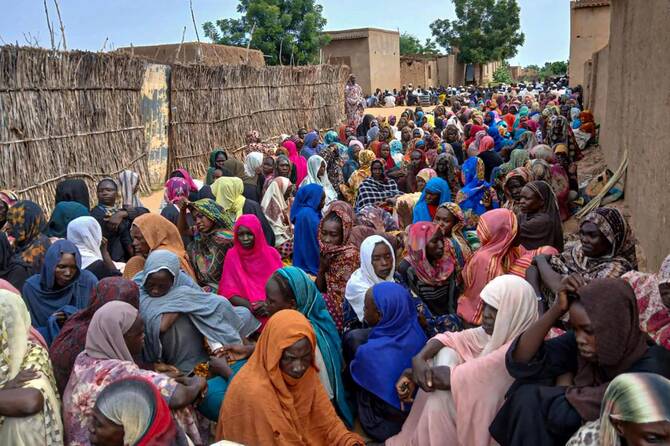
Seven dead, 71 wounded as Sudan’s RSF shells besieged city
https://arab.news/mhxhf
Seven dead, 71 wounded as Sudan’s RSF shells besieged city
- El-Fasher has become the most violent front line in the war between the Sudanese army and the RSF, which erupted in April 2023
Why Gaza aid curbs are deepening children’s health crisis despite ceasefire
- Humanitarian aid deliveries are still restricted, leaving thousands of children without sufficient food, medicine, and basic shelter
- International agencies warn that without urgent, unrestricted aid, child mortality and long-term health crises will escalate sharply
DUBAI: Two months into Gaza’s fragile ceasefire, children in the besieged enclave continue to bear the brunt of a deepening humanitarian crisis, with aid agencies warning that Israel’s continued restrictions on relief supplies are exposing the population to malnutrition and disease.
Despite the Oct. 10 ceasefire, humanitarian groups say convoys carrying much-needed aid remain stuck at border crossings. Meanwhile, thousands of families displaced by two years of war are now enduring heavy rains in overcrowded shelters, heightening the risk of disease.
For displaced children, limited access to medical care and vaccinations could have long-term, irreversible consequences. Without timely medical intervention and proper nutrition, healthcare workers warn that children are far more vulnerable to illness and death.
The UK-based charity Medical Aid for Palestinians has reported a rise in cases of child malnutrition, with medical facilities facing “critical shortages” of supplies needed to treat postwar health complications.
“While the number of severely malnourished patients has decreased compared with the peak of the famine, cases are still regularly presenting to hospital emergency departments and medical points,” Rohan Talbot, MAP’s director of advocacy and campaigns, told Arab News.
In November, the organization’s nutrition cluster identified 575 children with acute malnutrition, including 128 with severe malnutrition, out of 7,930 children screened. The highest rates were in Gaza City, where almost 10 percent of children screened were malnourished.
“We have also seen birth defects attributed to poor nutrition in mothers and lack of access to proper food and medical care,” said Talbot, warning that malnutrition could have long-term effects on children, leaving them at risk of stunting, poor development, and recurrent infections.
Last week, MAP reported that three of Gaza’s largest hospitals — Al-Shifa, Nasser and the Patient’s Friends Benevolent Society — remain overwhelmed with critically injured and malnourished patients.
Staff are unable to provide adequate care or carry out surgeries postponed during the war, with some patients dying as a result.
Medical supplies have not “meaningfully increased” since the ceasefire began, leaving a collapsed healthcare system with little capacity to recover, the organization said.
According to the UN, only half of Gaza’s 36 hospitals are currently partially operational, and not a single hospital in the enclave is fully functional.
The Patient’s Friends Benevolent Society Hospital, the main pediatric facility in northern Gaza, has reported critical shortages of essential drugs, medical supplies, cleaning materials, and sterilization equipment.
On Nov. 14, the hospital — already damaged in the fighting — was flooded by heavy rain, trapping children and their families on the ground floor.
“Medical intervention was not enough to save the lives of children, so we lost a large number of them in the intensive care unit,” Dr. Majd Awadallah, the hospital’s medical director, said in a statement.
“These problems are unsolvable without opening the crossings and allowing the unconditional entry of essential materials, especially medicines. How can a hospital operate in surgical and maternity cases without cleaning materials?”
INNUMBERS
• 600 Aid trucks expected to enter Gaza daily under ceasefire deal.
• 145 Actual average number of aid trucks entering Gaza per day.
(Source: Gaza’s Government Media Office)
On Monday, the UN Relief and Works Agency accused Israel of blocking around 6,000 aid trucks carrying food, medicine, tents and blankets — enough to sustain the enclave for three months.
The organization warned that 1.5 million people urgently need shelter after heavy rains in November flooded displacement camps and damaged at least 13,000 tents.
Israel’s military operation in Gaza, triggered by the Hamas-led Oct. 7, 2023, attack, has displaced about 2.1 million Palestinians — roughly 95 percent of the population — and destroyed nearly 78 percent of the enclave’s 250,000 buildings, according to UN figures.
Most of the displaced now live in makeshift tents, some erected over the rubble of their former homes, without proper sanitation, clean water, insulation or sewage systems, contributing to the spread of infectious diseases.
The World Health Organization has reported a rise in cases of Guillain-Barre Syndrome, acute watery diarrhea, and acute jaundice syndrome, the latter of which can be linked to hepatitis A.
Though more aid has been reaching the devastated enclave since the ceasefire, humanitarian organizations warn this is insufficient to meet the population’s needs.
Under the US-brokered truce, at least 600 aid trucks were expected to enter Gaza daily. However, Gaza’s Government Media Office said the enclave has received an average of just 145 trucks a day since the agreement began.
Of the aid that has entered Gaza, only 5 percent of the trucks contained medical supplies, according to the UN.
“The strain on Palestinians’ lives is only deepening,” said Talbot. “Even the most basic materials needed for shelter continue to be blocked by Israeli authorities.”
Though food availability has slightly improved due to the entry of humanitarian and commercial trucks, aid organizations still report limited quantities and less diverse food in markets.
The World Food Programme said food consumption remained below pre-conflict levels by mid-October, as meat, eggs, vegetables, and fruits remain unaffordable for many families. Talbot said the food shortages are affecting patient recovery and overall public health.
“Local food production has been severely disrupted, and humanitarian access remains extremely constrained by Israeli restrictions, with a severe lack of properly nutritious food entering Gaza,” he said.
The war has eroded purchasing power, leaving 95 percent of the population entirely dependent on aid, UNRWA said, urging Israel to facilitate rapid at-scale and unimpeded humanitarian access.
Although the ceasefire was intended to bring relief, near-daily Israeli strikes have killed 347 Palestinians, including at least 67 children, and injured 889 others, pushing Gaza’s death toll to more than 70,000, according to the Ministry of Health.
Gaza’s Government Media Office has documented 535 Israeli violations since the ceasefire began, while satellite imagery shows more than 1,500 buildings have been destroyed during this period.
In a statement last week, rights monitor Amnesty International accused Israel of continuing to commit genocide in Gaza by severely restricting the entry of aid and blocking the restoration of services essential for civilian survival.
Agnes Callamard, the organization’s secretary-general, said the ceasefire creates “a dangerous illusion that life in Gaza is returning to normal,” warning that the lack of proper food, water and shelter could lead to “slow death” of Palestinians in Gaza.
This includes blocking equipment needed to repair life-sustaining infrastructure and to remove unexploded ordnance, contaminated rubble and sewage — all of which pose serious and potentially irreversible public health and environmental risks, she said.
Israel denies accusations it is deliberately obstructing aid, and accuses Hamas of stealing humanitarian assistance.
COGAT, the Israeli military arm that oversees humanitarian matters, insists that “hundreds of trucks” enter Gaza daily.
In a Nov. 30 statement, the unit said it “approved 100,000 pallet requests submitted by organizations, of winter-related items, shelter equipment, and sanitation supplies.”
“These supplies are ready and waiting for weeks for immediate coordination by the relevant organizations so they can enter Gaza,” the statement read.
Israel and Hamas have continued to trade accusations of ceasefire violations as the first phase nears completion.
Under this initial phase, Israel was required to withdraw its troops behind a temporary boundary known as the yellow line, while Hamas was to release all living and deceased hostages.
The next stage of the Trump 20‑point Gaza peace plan, endorsed by the UN Security Council on Nov. 18, faces major obstacles, including Hamas disarmament, Israel’s full withdrawal from Gaza, governance of the enclave, and international security arrangements.
Despite these obstacles, aid agencies are continuing live-saving work, stepping up efforts to provide essential health services, distribute clean water, support trauma and emergency responses, and offer mental health support.
On Nov. 21, the WHO, UNRWA, and the UN children’s fund UNICEF, announced the completion of the first round of vaccinations, which immunized more than 13,700 children against measles, polio, mumps and rubella, hepatitis B, tuberculosis, rotavirus and pneumonia.
The agencies are now preparing for rounds two and three after 1.6 million syringes procured by UNICEF entered Gaza in mid-November.
The UN also distributed food parcels to more than 264,000 families in the same month.
However, aid workers say that these efforts represent only a fraction of what is needed to mitigate the worsening humanitarian crisis and help the population recover.
“A ceasefire must mean more than this; it must bring an end to Palestinians’ suffering and allow them to regain their dignity and safety,” said Talbot.
“Without a flood of aid and assistance, we will see more avoidable deaths and deprivation.”