RIYADH: Egypt has announced offering 1,386 fully serviced industrial plots across 23 governorates and 35 industrial zones, totaling 6.8 million sq. meters, in a bid to accelerate industrial development and attract local and foreign investment.
The offering, part of the government’s 11th industrial land tender, will be conducted via the country’s digital platform from Sept. 1-11, the Ministry of Industry and Transport said in an official Facebook post.
Plot sizes range from 240 sq. meters to 500,000 sq. meters and cover sectors including food, pharmaceuticals, and chemicals, as well as engineering, medical supplies, building materials, and textiles.
The initiative underscores the state’s commitment to local production and sustainable industrial growth, coinciding with rising confidence in the Egyptian pound, with Standard Chartered noting in August that at least half of $12.5 billion in investment pledges from Qatar and Kuwait is expected to be disbursed by the end of 2025.
“The tender is designed to provide flexible options for investors,” Kamel El-Wazir, deputy prime minister for industrial development and minister of industry and transport, said in the Facebook post. “We continue to create an attractive and transparent environment to support sustainable industrial growth across Egypt.”
He highlighted the diversity of plot sizes to suit projects of all scales — small, medium, and large — ranging from 240 sq. meters to 500,000 sq. meters.
The plots are offered at the actual cost of utilities to facilitate investor access and reduce financial burdens. Annual usufruct fees are set at 5 percent of the ownership price per sq. meter.
Investors may apply for two opportunities, one as a primary choice and another as an alternative, providing flexibility and broader access. Allocation priority will go to applicants who previously submitted valid proposals but were unsuccessful and did not reclaim their deposits.
El-Wazir noted that the offering is supported by unprecedented incentives from previous rounds, including a 50 percent discount on application study fees, removal of bid and financial guarantee charges, a reduced deposit of 10 percent of land value, and a simplified feasibility study form, all designed to encourage broader investor participation.
Following application submission, the Industrial Development Authority will evaluate all entries and announce results within two weeks of the tender’s closing date.


Egypt offers over 1,300 industrial plots to boost economic development

https://arab.news/29a8w
Egypt offers over 1,300 industrial plots to boost economic development


Education spending surges 251% as students return from autumn break: SAMA
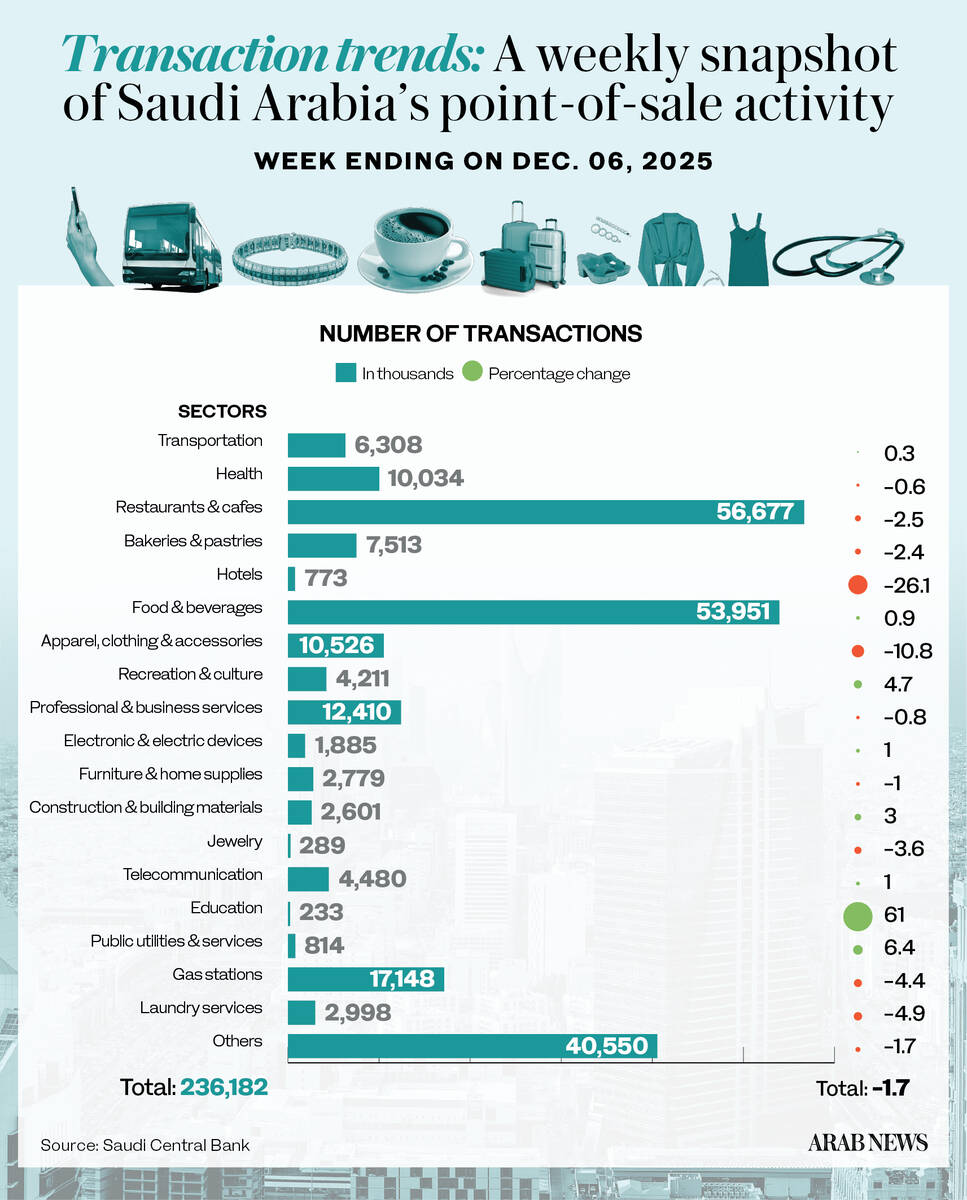
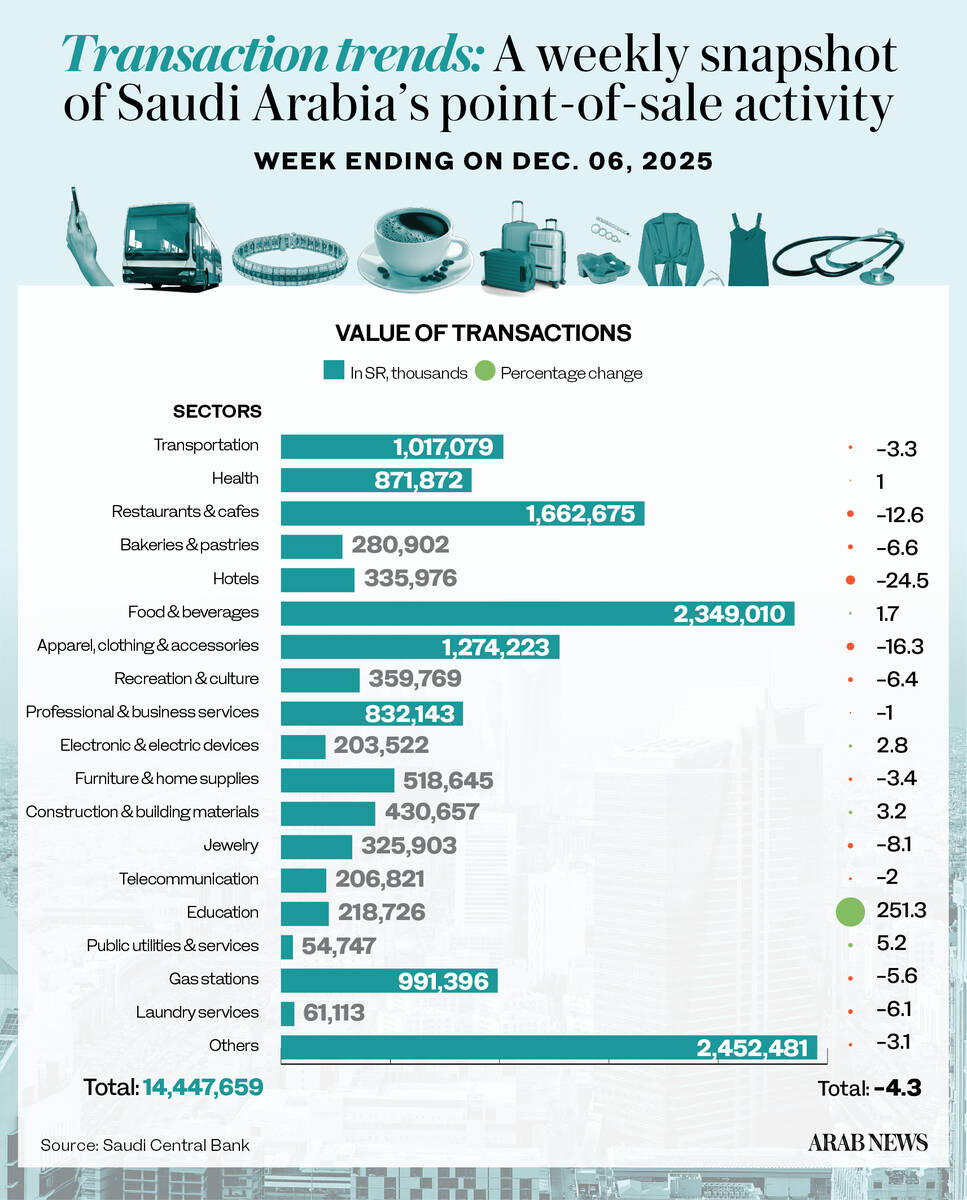
RIYADH: Education spending in Saudi Arabia surged 251.3 percent in the week ending Dec. 6, reflecting the sharp uptick in purchases as students returned from the autumn break.
According to the latest data from the Saudi Central Bank, expenditure in the sector reached SR218.73 million ($58.2 million), with the number of transactions increasing by 61 percent to 233,000.
Despite this surge, overall point-of-sale spending fell 4.3 percent to SR14.45 billion, while the number of transactions dipped 1.7 percent to 236.18 million week on week.
The week saw mixed changes between the sectors. Spending on freight transport, postal and courier services saw the second-biggest uptick at 33.3 percent to SR60.93 million, followed by medical services, which saw an 8.1 percent increase to SR505.35 million.
Expenditure on apparel and clothing saw a decrease of 16.3 percent, followed by a 2 percent reduction in spending on telecommunication.
Jewelry outlays witnessed an 8.1 percent decline to reach SR325.90 million. Data revealed decreases across many other sectors, led by hotels, which saw the largest dip at 24.5 percent to reach SR335.98 million.
Spending on car rentals in the Kingdom fell by 12.6 percent, while airlines saw a 3.7 percent increase to SR46.28 million.
Expenditure on food and beverages saw a 1.7 percent increase to SR2.35 billion, claiming the largest share of the POS. Restaurants and cafes retained the second position despite a 12.6 percent dip to SR1.66 billion.
Saudi Arabia’s key urban centers mirrored the national decline. Riyadh, which accounted for the largest share of total POS spending, saw a 3.9 percent dip to SR4.89 billion, down from SR5.08 billion the previous week.
The number of transactions in the capital settled at 74.16 million, down 1.4 percent week on week.
In Jeddah, transaction values decreased by 5.9 percent to SR1.91 billion, while Dammam reported a 0.8 percent surge to SR713.71 million.
POS data, tracked weekly by SAMA, provides an indicator of consumer spending trends and the ongoing growth of digital payments in Saudi Arabia.
The data also highlights the expanding reach of POS infrastructure, extending beyond major retail hubs to smaller cities and service sectors, supporting broader digital inclusion initiatives.
The growth of digital payment technologies aligns with the Kingdom’s Vision 2030 objectives, promoting electronic transactions and contributing to the nation’s broader digital economy.