

Hundreds of people killed as powerful earthquake devastates eastern Afghanistan

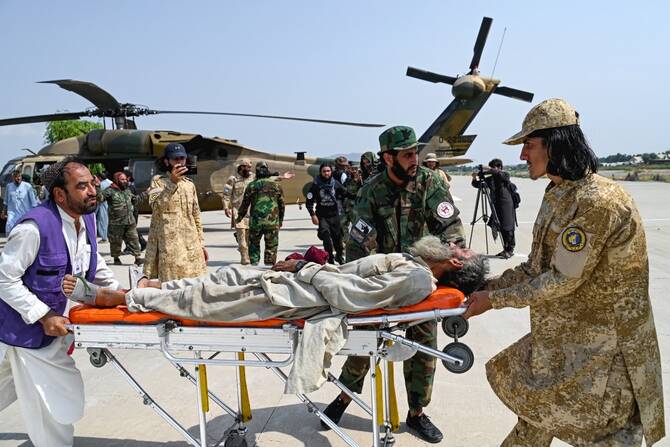
Afghan volunteers and security personnel carry an earthquake victim evacuated by a military helicopter from the Noorgal district of Kunar province, after his arrival for medical assistance in Jalalabad on Sept. 1, 2025. (AFP)
Short Url
Updated 02 September 2025
Follow

Hundreds of people killed as powerful earthquake devastates eastern Afghanistan

  • Death toll from earthquake in Afghanistan rises to 900
  • Rescuers walk for hours to reach the areas as roads are destroyed by landslides

KABUL: The death toll from a strong earthquake in Afghanistan’s east rose to 900, with 3,000 people injured, an official said Tuesday as rescue teams scoured the area for survivors.
The 6.0 magnitude quake struck late Sunday night in a mountainous region, flattening villages and leaving people trapped under rubble for hours.
“The injured are being evacuated, so these figures may change significantly,” Yousaf Hammad, a spokesman for Afghanistan’s National Disaster Management Authority, told The Associated Press. “The earthquake caused landslides in some areas, blocking roads, but they have been reopened, and the remaining roads will be reopened to allow access to areas that were difficult to reach.”

“The situation is dire. In Kunar, entire villages have been completely demolished in at least one district. In Nangarhar’s Dare Noor, people have lost all their family members,” said Faqir Sayed Al-Hashimi from Ehsas Welfare and Social Services Organization, who was helping in rescue efforts on the ground.


“The government is deploying helicopters to reach the wounded, as vehicles can’t access the area. Community members are marching on foot toward Noorgal district, where most of the casualties occurred, but it will take them several hours to get there.”

Since the morning, the Defense Ministry has flown dozens of doctors into Kunar to support hospitals overwhelmed with casualties.

Many of the injured have been transported to Jalalabad, the capital of Nangarhar province.

“Every few minutes, new ambulances are arriving from the Jalalabad airport. Military planes are transferring injured people from Kunar and Dare Noor,” Hazrat Nabi Nabizada, Najm Foundation coordinator, told Arab News from the Nangarhar Regional Hospital.

“Most patients are in critical condition and require orthopedic and neurosurgical care. We’ve lost count, but there are definitely over a thousand wounded at this hospital alone. Many others have been sent to private facilities.”

Casualties have also been reported in Laghman and Nuristan provinces.

“So far, we haven’t recorded any deaths in our province, but the number of injured is steadily rising. More than 60 injured people, including women and children, have already been brought to the provincial hospital,” said Jawhar Niazi, a volunteer with the Najm Foundation in Laghman

“We are mobilizing community members to donate blood to the injured and will be providing food to the family members visiting the hospital.”


Bolivia and Israel to restore ties severed over the war in Gaza

Updated 5 sec ago
Follow

Bolivia and Israel to restore ties severed over the war in Gaza

  • Paz's government eased visa restrictions on American and Israeli travelers last month
  • The Bolivian foreign ministry said its top diplomat would meet his Israeli counterpart in Washington later Tuesday to discuss the revival of bilateral ties

LA PAZ, Bolivia: Bolivia's new right-wing government said Tuesday that it would restore diplomatic relations with Israel, the latest sign of the dramatic geopolitical realignment underway in the South American country that was once among the most vocal critics of Israeli policies toward Palestinians.
The Bolivian foreign ministry said its top diplomat would meet his Israeli counterpart in Washington later Tuesday to discuss the revival of bilateral ties, which Bolivia's previous left-wing government severed two years ago over Israel's devastating campaign against Hamas in Gaza.
Bolivia said the effort came as part of a new foreign policy strategy under conservative President Rodrigo Paz aimed at “rebuilding Bolivia's international prestige, opening new economic opportunities and strengthening alliances that directly benefit the country and our citizens abroad."
Bolivian Foreign Minister Fernando Aramayo is in the midst of a whirlwind trip to Washington for meetings with American officials as his government works to warm long-chilly relations with the United States and unravel nearly two decades of hard-line, anti-Western policies under the Movement Toward Socialism, or MAS, party that left Bolivia economically isolated and diplomatically allied with China, Russia and Venezuela.
Paz's government eased visa restrictions on American and Israeli travelers last month.
In announcing his expected meeting with Aramayo on Monday, Israeli Foreign Minister Gideon Saar thanked Bolivia for scrapping Israeli visa controls and said he spoke to Paz after the center-right senator's Oct. 19 election victory to express “Israel’s desire to open a new chapter” in relations with Bolivia.
Paz entered office last month, ending the dominance of the MAS party founded by Evo Morales, the charismatic former coca-growing union leader who became Bolivia's first Indigenous president in 2006. Not long after taking power, Morales sent Israel's ambassador packing and cozied up to Iran over their shared enmity toward the U.S. and Israel.
When protests over Morales' disputed 2019 reelection prompted him to resign under pressure from the military, a right-wing interim government took over and restored full diplomatic relations with the U.S. and Israel as it sought to undo many of Morales’ popular policies.
But 2020 elections brought the MAS party back to power with the presidency of Luis Arce, who in 2023 once again cut ties with Israel in protest over its military actions in Gaza.
Other left-wing Latin American countries, like Chile and Colombia, soon made similar moves, recalling their ambassadors and joining South Africa’s genocide case against Israel before the United Nations’ highest judicial body.