

Magnitude 6.0 earthquake strikes southeastern Afghanistan, jolts felt in northwestern Pakistan

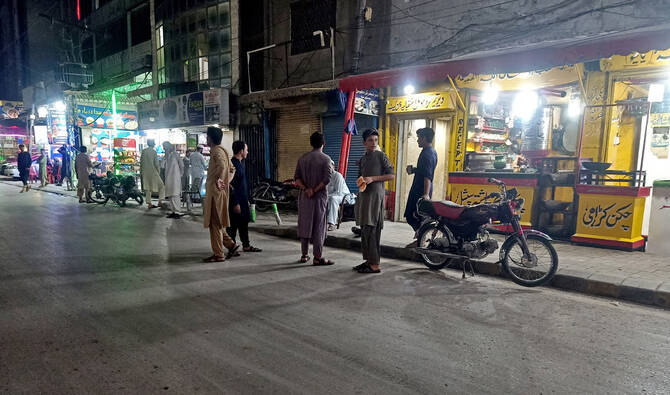
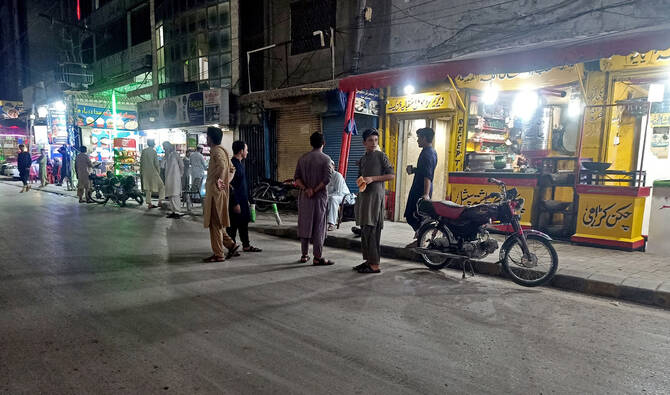
People stand in the street after they vacated eateries following an earthquake in Peshawar, Pakistan, August 5, 2023. (REUTERS/File)
Short Url
Updated 31 August 2025
Follow

Magnitude 6.0 earthquake strikes southeastern Afghanistan, jolts felt in northwestern Pakistan

  • No casualties, damage reported so far, provincial authority says
  • Authorities instruct district administrations to remain on alert

ISLAMABAD: An earthquake of magnitude 6.0 struck southeastern Afghanistan on Monday, Pakistan’s Met Office said, with jolts felt in several districts of Pakistan’s northwestern Khyber Pakhtunkhwa province.

The Provincial Disaster Management Authority (PDMA) said tremors were felt in multiple areas and its emergency operations center had established contact with all district administrations to monitor the situation.

“District administrations have been instructed to remain alert to deal with any possible situation,” the PDMA said in a statement.

The authority added that the process of collecting information about potential damage was underway, but “so far no reports of casualties or property loss have been received at the PDMA control room.”

Citizens were advised to report any untoward incident at the emergency helpline 1700.

Pakistan sits atop the boundary of the Indian and Eurasian tectonic plates and is frequently prone to seismic activity.

In October 2005, a 7.6-magnitude earthquake devastated northern Pakistan and parts of Kashmir, killing more than 73,000 people and leaving around 3.5 million homeless, according to official figures.

More recently, a 7.7-magnitude quake struck Balochistan in September 2013, flattening entire villages and killing at least 825 people.


Pakistan completes first phase of 10-day training for Hajj facilitators in Islamabad

Updated 5 sec ago
Follow

Pakistan completes first phase of 10-day training for Hajj facilitators in Islamabad

  • “Khuddam-ul-Hujjaj” are trained government employees who facilitate Pakistani pilgrims during Hajj pilgrimage in Saudi Arabia 
  • Hajj facilitators equipped with digital maps, life-saving skills and crowd management modules to assist pilgrims, says official 

Islamabad: Pakistan’s Ministry of Religious Affairs (MoRA) has concluded its first phase of a 10-day modern training program for “Khuddam-ul-Hujjaj” or Hajj facilitators in Islamabad, state media reported recently, vowing to provide professional assistance to pilgrims in Saudi Arabia during the annual Islamic pilgrimage. 

Khuddam-ul-Hujjaj are trained government employees who facilitate Pakistani pilgrims during the Hajj pilgrimage in Saudi Arabia. Speaking to the state-run Associated Press of Pakistan (APP), Zulfiqar Khan, Pakistan’s coordinator for Makkah and Khuddam-ul-Hujjaj, said Hajj facilitators have been equipped with digital maps, life-saving skills from the Rescue 1122 emergency services and crowd management modules provided by the Islamabad Police. 

He said the training program marks a shift from traditional briefings to technical training in line with the best practices adopted in Indonesia, Turkiye and Malaysia.

“In a major move to ensure the smoothest Hajj experience in history for Pakistani pilgrims, the Ministry of Religious Affairs and Interfaith Harmony has successfully concluded the first phase of a 10-day modern training program for Khuddam-ul-Hujjaj,” APP reported on Sunday. 

Khan told APP that the Rescue 1122 emergency service conducted “mock exercises” for CPR and emergency medical aid during the first phase of the training. He said the program is divided into two phases: a joint session and the upcoming “Functional Level” specialized training.

“This second phase will prepare food, transport, and building teams for their specific ‘job desks’ to handle any crisis effectively,” the state media reported. 

Khan said the government has included a “significant” number of female assistants for this year’s Hajj to ensure comprehensive support for all pilgrims. He highlighted that assistants have been equipped with a ‘digital view’ of Mina’s roads, bridges and Jamarat routes, making them fully aware of camp locations and zones well in advance.

He said 870 Khuddam-ul-Hujjaj, selected through a competitive process, will serve as the backbone of the transport, food and accommodation sectors.

“This modern training signifies that Hajj 2026 will serve as an administrative role model, ensuring both spiritual peace and logistical excellence for our pilgrims,” he was quoted as saying. 

This year 179,210 pilgrims from Pakistan will perform Hajj, according to MoRA. Of these, 119,210 pilgrims will travel under the government scheme, while 60,000 will go through private tour operators, with applications processed on a first-come, first-served basis.