

Sindh on high alert, 1.6 million at risk as floodwaters from Punjab move south

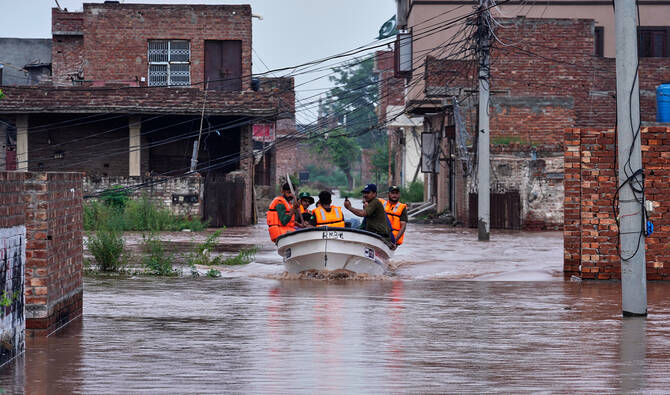
Rescue workers search for trapped people in a flooded area after torrential rains and rising water level in the Ravi river due to sudden water releases from Indian dams, on the outskirts of Lahore, Pakistan, on Aug. 29, 2025. (AP/File)
Short Url
Updated 31 August 2025
Follow

Sindh on high alert, 1.6 million at risk as floodwaters from Punjab move south

  • NDMA warns flood waves of up to 1.2 million cusecs could pass through barrages in Punjab, Sindh in coming days
  • Sindh sets up emergency cell, deploys 192 rescue boats and over 300 livestock camps ahead of expected deluge

KARACHI: Sindh Information Minister Sharjeel Memon on Saturday said the provincial government was “fully mobilized” to deal with the impact of floods in southern Pakistan, where nearly 1.6 million people and over 1,600 villages are at risk.

The deluge, fueled by record monsoon rains and excess water released from upstream India, has created crisis conditions in the country’s most populous Punjab province since Monday, where the trans-boundary Chenab, Ravi and Sutlej rivers have submerged about 2,300 villages and killed at least 30 people.

The National Disaster Management Authority (NDMA) cautioned a day earlier that rising river waters were likely to cause extreme flooding in downstream Sindh, with flood waves of 900,000 to 1.2 million cusecs expected to flow through barrages in Punjab and Sindh in the coming days.

Addressing a news conference in Karachi, Memon said floodwaters were expected to enter the province “on the night of September 2 or 3.”

“A provincial Rain and Flood Emergency Monitoring Cell has been set up to monitor the flood situation, which will remain operational round the clock,” he said.

“At present, 192 rescue boats and mobile health units have been deployed,” he continued. “As many as 1.65 million people, 1,651 villages and 167 union councils could potentially be affected, with an estimated 273,000 families at risk.”

The provincial minister said residents of vulnerable areas were being shifted to safer locations, highlighting that most people have voluntarily evacuated from the riverine areas.

“Three hundred camps have also been set up for livestock,” he added. “Continuous monitoring of water levels is underway.”

Memon noted there was no shortage of funds for flood relief activities, adding that the Punjab government was also providing kits in this regard.

Sindh Chief Minister Syed Murad Ali Shah convened an emergency meeting on Friday after flood forecasts, instructing all relevant departments to stay vigilant.

“In case of a major flood wave, not a single life, human or animal, should be lost,” he told officials, directing the Sindh Provincial Disaster Management Authority (PDMA) to deploy rescue boats, establish over 500 relief camps, and coordinate with the Pakistan Navy, which has 26 boats on standby.

Around 830 people have been killed and 1,121 injured during the monsoon season since June 26, according to official statistics.

Pakistani officials have warned the flood threat could intensify in the coming days, with the current spell expected to last until at least Sept. 10 and potentially rival the 2022 floods, which killed more than 1,700 people and caused over $30 billion in damage.


Pakistan says responding to Afghan ‘offensive operations’ after border fire as tensions escalate

Updated 26 February 2026
Follow

Pakistan says responding to Afghan ‘offensive operations’ after border fire as tensions escalate

  • Afghan Taliban spokesperson says “large-scale offensive operations” launched against Pakistani military bases
  • Pakistan says Afghan forces opened “unprovoked” fire across multiple sectors along shared border

ISLAMABAD: Afghanistan’s Taliban authorities said on Thursday they had launched “large-scale offensive operations” against Pakistani military bases and installations, prompting Pakistan to say its forces were responding to what it described as unprovoked fire along the shared border.

The escalation follows Islamabad’s weekend airstrikes targeting what it said were Tehreek-e-Taliban Pakistan (TTP) and Daesh militant camps inside Afghanistan in response to a wave of recent bombings and attacks in Pakistan. Islamabad said the strikes killed over 100 militants, while Kabul said dozens of civilians were killed and condemned the attacks as a violation of its sovereignty.

In a post on social media platform X, Afghan government spokesperson Zabihullah Mujahid said Afghanistan had launched “large-scale offensive operations” in response to repeated violations by the Pakistani military.


Pakistan’s Ministry of Information said Afghan forces had initiated hostilities along multiple points of the frontier.

“Afghan Taliban regime unprovoked action along the Pakistan–Afghanistan border given an immediate, and effective response,” the ministry said in a statement.

The statement said Pakistani forces were targeting Taliban positions in the Chitral, Khyber, Mohmand, Kurram and Bajaur sectors, claiming heavy Afghan casualties and the destruction of multiple posts and equipment. It added that Pakistan would take all necessary measures to safeguard its territorial integrity and the security of its citizens.


Separately, security officials said Pakistani forces had carried out counterattacks in several border sectors.

“Pakistan’s security forces are giving a befitting reply to the unprovoked Afghan aggression with full force,” a security official said, declining to be named. 

“The Pakistani security forces’ counter-attack destroyed Taliban’s hideouts and the Khawarij fled,” they added, referring to TTP militants. 

The claims from both sides could not be independently verified.

Cross-border violence has intensified in recent weeks, with Pakistan blaming a surge in suicide bombings and militant attacks on militants it says are based in Afghanistan. Kabul denies providing safe havens to anti-Pakistan militant groups.

The clashes mark the third major escalation between the neighbors in less than a year. Similar Pakistani strikes last year triggered weeklong clashes before Qatar, Türkiye and other regional actors mediated a ceasefire in October.

The 2,600-kilometer (1,600-mile) frontier, a key trade and transit corridor linking Pakistan to landlocked Afghanistan and onward to Central Asia, has faced repeated closures amid tensions, disrupting commerce and humanitarian movement. Trade between the two nations has remained closed since October 2025.