SRINAGAR, India: Floods and landslides triggered by record-breaking rain killed at least 11 people, including four children, in India’s Jammu and Kashmir, officials said Saturday.
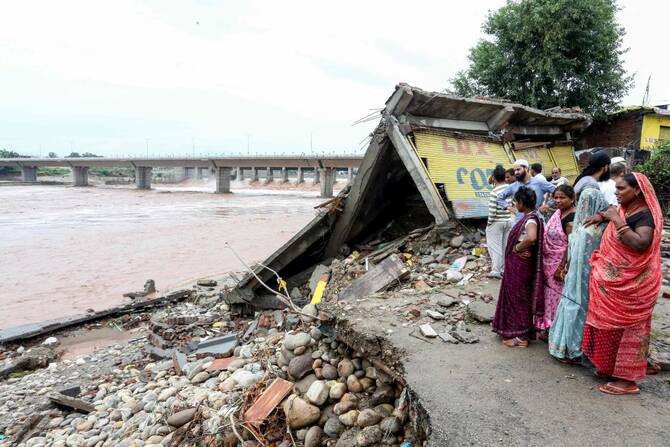
An intense monsoon rainstorm in the Indian-administered territory since Tuesday has caused widespread chaos, with raging water smashing into bridges and swamping homes.
A local disaster official said that Ramban and Reasi districts were hit by heavy rainfall and landslides on Friday night, killing 11 people.
One child aged five was trapped in the debris and still missing, he added.
On Wednesday, a landslide slammed the pilgrimage route to the Hindu shrine of Vaishno Devi in Jammu, killing 41 people.
India’s Meteorological Department said the torrential rain had smashed records at two locations in the region.
Jammu and Udhampur recorded their highest 24-hour rainfall on Wednesday, with 296 millimeters (11.6 inches) in Jammu, nine percent higher than the 1973 record, and 629.4 mm (24.8 inches) in Udhampur – a staggering 84 percent surge over the 2019 mark.
Floods and landslides are common during the June-September monsoon season, but experts say climate change, coupled with poorly planned development, is increasing their frequency, severity and impact.
Climate experts from the Himalayan-focused International Center for Integrated Mountain Development warn that a spate of disasters illustrates the dangers when extreme rain combines with mountain slopes weakened by melting permafrost, as well as building developments in flood-prone valleys.
Powerful torrents driven by intense rain smashed into Chisoti village in Indian-administered Kashmir on August 14, killing at least 65 people and leaving another 33 missing.
Floods on August 5 overwhelmed the Himalayan town of Dharali in India’s Uttarakhand state and buried it in mud. The likely death toll from that disaster is more than 70 but has not been confirmed.

Floods, landslides kill at least 11 in India’s Jammu region
Short Url
https://arab.news/gps2q
Floods, landslides kill at least 11 in India’s Jammu region
- An intense monsoon rainstorm in the Indian-administered territory since Tuesday has caused widespread chaos
- Floods and landslides are common during the June-September monsoon season
Chaos erupts at Indian airports as country’s largest airline cancels flights
NEW DELHI: Chaos gripped major Indian airports Friday as passengers of the country’s biggest airline, IndiGo, scrambled to cope up with widespread flight disruptions and cancelations triggered by newly enforced rules limiting working hours for crew and pilots.
Scenes of frustration played out as passengers slept on airport floors, queued for hours at customer service counters and waited without clear communication from the airline.
Friday was the fourth straight day of disruptions as the low cost carrier struggles with new regulations that mandate longer rest periods and limit night flying hours to address concerns about fatigue and safety.
The first phase of the rules came into effect in July while the second phase kicked in November. IndiGo struggled to adapt its rosters in time, resulting in widespread cancelations and disruptions.
On Thursday, more than 300 IndiGo flights were grounded while several hundreds delayed. A passenger advisory from the Delhi airport Friday stated that all domestic IndiGo flights will remain canceled until midnight. Other major airlines, including Air India, have not faced similar issues so far.
IndiGo operates around 2,300 flights daily and controls nearly 65 percent of India’s domestic aviation market.
Senior citizen Sajal Bose was scheduled to travel with his wife Senjuti Bose early Friday from Kolkata to New Delhi to attend a friend’s silver jubilee celebration. His flight was canceled an hour before the scheduled take off.
Bose told The Associated Press he was now taking a nine-hour train ride to the city Bagdogra, where he plans to get a flight to New Delhi on another airline. “Its very irresponsible and complete negligence. Very difficult for older people like us,” he said.
In an internal email to employees this week, seen by The Associated Press, IndiGo CEO Pieter Elbers apologized, and cited technology glitches, schedule changes, adverse weather conditions, heightened congestion and the implementation of the new rules as the reasons for flight disruptions.
The Civil Aviation Ministry said in a statement that the disruptions arose primarily through misjudgment and planning gaps as the airline implemented phase two of the new rules, and that the airline acknowledged that the effect on crew strength exceeded their expectations.
IndiGo has sought temporary exemptions in implementing the new rules and told the government that corrective measures were underway. It has indicated the operations will be fully restored by Feb. 10.
More cancelations are expected in the next couple of weeks, and the airline said it would reduce its flight operations from Dec. 8 to minimize disruptions.
Scenes of frustration played out as passengers slept on airport floors, queued for hours at customer service counters and waited without clear communication from the airline.
Friday was the fourth straight day of disruptions as the low cost carrier struggles with new regulations that mandate longer rest periods and limit night flying hours to address concerns about fatigue and safety.
The first phase of the rules came into effect in July while the second phase kicked in November. IndiGo struggled to adapt its rosters in time, resulting in widespread cancelations and disruptions.
On Thursday, more than 300 IndiGo flights were grounded while several hundreds delayed. A passenger advisory from the Delhi airport Friday stated that all domestic IndiGo flights will remain canceled until midnight. Other major airlines, including Air India, have not faced similar issues so far.
IndiGo operates around 2,300 flights daily and controls nearly 65 percent of India’s domestic aviation market.
Senior citizen Sajal Bose was scheduled to travel with his wife Senjuti Bose early Friday from Kolkata to New Delhi to attend a friend’s silver jubilee celebration. His flight was canceled an hour before the scheduled take off.
Bose told The Associated Press he was now taking a nine-hour train ride to the city Bagdogra, where he plans to get a flight to New Delhi on another airline. “Its very irresponsible and complete negligence. Very difficult for older people like us,” he said.
In an internal email to employees this week, seen by The Associated Press, IndiGo CEO Pieter Elbers apologized, and cited technology glitches, schedule changes, adverse weather conditions, heightened congestion and the implementation of the new rules as the reasons for flight disruptions.
The Civil Aviation Ministry said in a statement that the disruptions arose primarily through misjudgment and planning gaps as the airline implemented phase two of the new rules, and that the airline acknowledged that the effect on crew strength exceeded their expectations.
IndiGo has sought temporary exemptions in implementing the new rules and told the government that corrective measures were underway. It has indicated the operations will be fully restored by Feb. 10.
More cancelations are expected in the next couple of weeks, and the airline said it would reduce its flight operations from Dec. 8 to minimize disruptions.
© 2025 SAUDI RESEARCH & PUBLISHING COMPANY, All Rights Reserved And subject to Terms of Use Agreement.


