ISTANBUL: For nearly two centuries, the white ferries gliding over the Bosphorus Strait have provided an iconic link for countless passengers traveling between Istanbul’s European shores and its Asian side.
Despite the increasingly congested waters and competition from the Turkish megacity’s bridges and undersea metro line, the ferries remain very popular.
The main operator Sehir Hatlari carries at least 40 million passengers a year.
“Any view of Istanbul must include Maiden’s Tower, a ferry and a seagull,” smiled Adil Bali, a specialist on the history of Istanbul’s ferries, referring to a tiny rocky outcrop at the southern entrance to the Bosphorus.
“It is one of the few cities in the world that can be crossed by sea, so the ferries are indispensable here.”
Their arrival in 1843 transformed the simple fishing villages lining the shores of the Bosphorus into popular holiday destinations where wooden palaces were later built overlooking the water, boosting trade.
Until the first Bosphorus bridge was opened in 1973, the only way to cross between Istanbul’s Asian and European sides was by boat – and today, the experience remains an essential part of the city’s charm.
At the helm of the Pasabahce, the flagship of Sehir Hatlari’s 30 vessels, Captain Ekrem Ozcelik said the waters had become increasingly crowded.
“There’s a lot more traffic on the water,” he said of the tankers, containers and cargo ships that pass through the strait linking the Black Sea to the Aegean via the Sea of Marmara and the Dardanelles.
There are also cruise ships and private yachts navigating what is one of the world’s busiest waterways, where 41,300 vessels passed in 2024, official figures show – an average of 113 per day.
“Navigating the waters of Istanbul requires a certain amount of experience,” Ozcelik said of the strait’s powerful currents, whose waters can get particularly tricky when strong southwesterly winds can whip up three-meter (10-foot) high waves.
Born into a family of sailors and fishermen, Ozcelik said his boyhood dream was to one day don the white cap and uniform of a captain.
Now 52, he enjoys the freedom of sailing and the kudos of his profession.
“Being a captain in the heart of Istanbul is a source of great pride.”
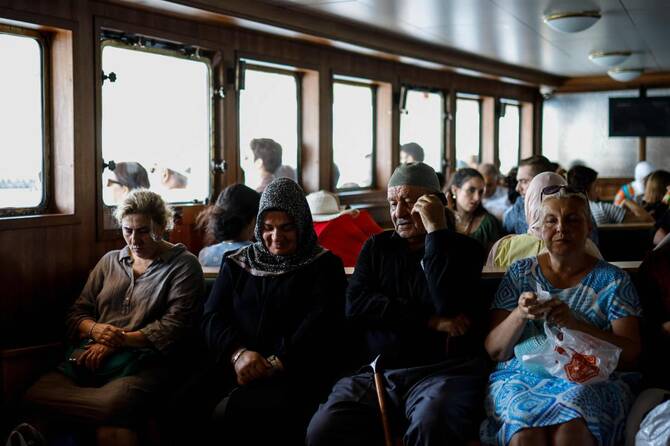
And even more so on the Pasabahce, which recently escaped being decommissioned and instead underwent a two-year restoration, returning to the Bosphorus in 2022 on its 70th birthday.
“It’s harder to maneuver than the others. It’s heavier and turning corners is complicated,” admitted first officer Semih Aksoy, 36.
But he added he wouldn’t change the iconic ferry for the world, with its trademark wooden tables and old-world air of faded luxury.
“This ship has a unique beauty, a special feel to it.”
With its nine-man crew, the Pasabahce mainly sails the 20-minute route between the Asian district of Kadikoy and Besiktas on the European side.
But even that relatively short trip can be tricky, said Burak Temiz, a 24-year-old sailor.
“This summer, people were jumping into the water from Maiden’s Tower for hours.
“And then there are the fishing nets,” he said, adding that the ferry’s bows had even been grazed by jet skis in the crowded waters.
All the other ferries have a six-man crew, and dozens more staff work at the city’s 53 ports, many of whom are known by regulars.
Ibrahim Bayus, a 62-year-old engineer born on Buyukada, the largest of the nearby Princes’ Islands in the Sea of Marmara, recalls the familiarity of the ferries.
“As a boy, I often forgot to bring money but the captain knew me,” he smiled.
With the service only suspended for snow, fog or a violent storm, Captain Ozcelik recalls when three students on Buyukada came to beg for his help.
“Traffic had been suspended but they told me if they couldn’t take their exams, they would fail the entire year. So I took them to Kadikoy. And they all passed,” he smiled.
And they still come to visit him.


![]()

Istanbul’s ferries, a beloved link between two continents
Short Url
https://arab.news/cgvre
Istanbul’s ferries, a beloved link between two continents
- Iconic link for countless passengers traveling between Istanbul’s European shores and its Asian side
- Main operator Sehir Hatlari carries at least 40 million passengers a year

Latest updates


© 2026 SAUDI RESEARCH & PUBLISHING COMPANY, All Rights Reserved And subject to Terms of Use Agreement.