Russia strikes across Ukraine as peace prospects flounder

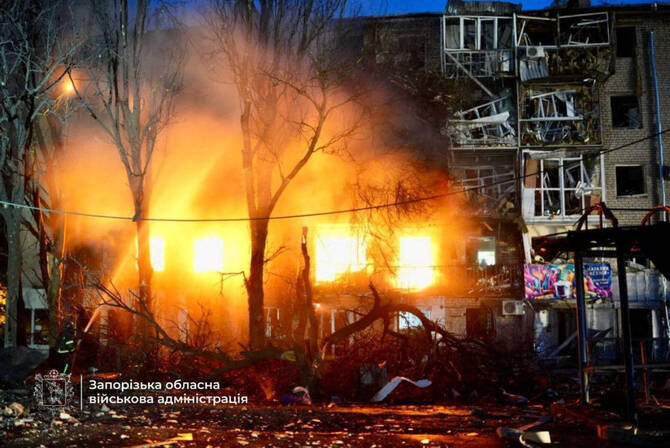
Firefighters work at the site of an apartment building hit during a Russian drone and missile strike in Zaporizhzhia, Ukraine in this handout picture released Aug. 30, 2025. (Zaporizhzhia Regional Military Administration via Telegram/Reuters)
Short Url
Updated 30 August 2025
Follow

Russia strikes across Ukraine as peace prospects flounder

  • Ukrainian rescue services said on Telegram that overnight strikes on the southern city of Zaporizhzhia had killed at least one person and wounded at least 25
  • Russia confirmed it had launched overnight attacks, saying they were against “military” targets

KYIV: Russia launched “massive” strikes across Ukraine overnight, rescue services said on Saturday, a new blow to peace efforts that drew a fresh appeal from President Volodymyr Zelensky for US and European help.

Despite a recent flurry of international efforts to broker a truce in the three-and-a-half-year conflict, led by US President Donald Trump, there have been no signs of a let-up in fighting on the ground.

Ukrainian rescue services said on Telegram that overnight strikes on the southern city of Zaporizhzhia had killed at least one person and wounded at least 25.

Three children aged between nine and 16 were admitted to hospital.

Russia confirmed it had launched overnight attacks, saying they were against “military” targets.

Zaporizhzhia regional governor Ivan Fedorov said residential buildings were hit and scores of homes left without gas or electricity.

The cities of Dnipro and Pavlograd in the central region of Dnipropetrovsk also came under attack early on Saturday, causing fires, regional governor Sergiy Lysak wrote on Telegram, warning residents to take cover.

Since Russia launched its full-scale invasion of Ukraine in February 2022, Dnipropetrovsk had been largely spared from intense fighting.

Ukraine’s air force said the Russian army had launched 582 drones and missiles overnight, most of which it had downed.

Zelensky, who has been pushing for a peace summit with Russian President Vladimir Putin, said a total of 14 regions had been targeted overnight.

He accused the Kremlin of using “the time meant for preparing a leaders’-level (peace) meeting to organize new massive attacks,” and called for more international sanctions on Moscow and its backers.

Ukraine’s army general staff meanwhile said its forces had hit two oil refineries in Russia, which it said were supplying fuel to Russian military units.

It said they had struck the Krasnodarsky refinery in Krasnodar Krai and the Sizransky refinery in Samara, causing a fire near the latter.

Russia for its part said its forces had taken a new village, Komyshuvakha, in the eastern Donetsk region.

The latest strikes by both sides followed a Russian attack on Kyiv on Thursday, in which at least 25 people died, including four children. Around 50 others were wounded.

The assault — the deadliest attack on the capital in months — led the European Union, Britain and Sweden to summon the Russian ambassadors in their capitals to protest.

Zelensky said Ukraine needed more action from the international community.

“This war won’t stop with political statements alone... The only way to reopen a window of opportunity for diplomacy is through tough measures against all those bankrolling the Russian army and effective sanctions against Moscow itself — banking and energy sanctions.”

Defense Minister Denys Shmygal announced the US State Department had approved the sale of Patriot air defense systems for Ukraine for an estimated cost of $179.1 million and satellite communications services worth $150 million.

And following Thursday’s attack on Kyiv, France and Germany said they had agreed to send additional air-defense hardware to Ukraine.

Trump met Putin in Alaska earlier this month to discuss ending the hostilities, and hosted Zelensky and European leaders at the White House last week.

But efforts to end the war appear to have lost steam, and Moscow has played down the likelihood of a Putin-Zelensky summit.

The Kremlin said on Thursday Russia wanted to “achieve our goals through political and diplomatic means” but would continue attacks until then.

Turkiye, which hosted peace talks with Russian and Ukrainian negotiators earlier this year, said on Thursday Moscow had scaled back its previous demands.

It now wanted Ukraine to cede all of its eastern Donbas region, but would be willing to freeze the conflict in the south of the country along current front lines, the Turkish foreign minister said.

Russia occupies around one-fifth of Ukraine’s territory and says it had unilaterally annexed five of the country’s regions — Donetsk, Lugansk, Kherson, Zaporizhzhia and Crimea.


’Only a miracle can end this nightmare’: Eritreans fear new Ethiopia war

Updated 6 sec ago
Follow

’Only a miracle can end this nightmare’: Eritreans fear new Ethiopia war

  • Now the fractious Horn of Africa rivals have begun trading barbs and accusations of war-mongering once more
  • It is extremely difficult to gather testimonies from Eritrea, where dissidents often disappear to prison

ADDIS ABABA: Tewolde has fought multiple times for Eritrea, one of the most closed societies on Earth, and is now praying another war is not about to break out with neighboring Ethiopia.
“If the war starts, many people will go to the front and, as before, many children will lose their fathers, mothers will lose their husbands, parents will lose their children,” said Tewolde, who is in his 40s and lives in the Eritrean capital Asmara.
He fought first in the late 1990s during Eritrea’s horrific border war with Ethiopia, and more recently during clashes against rebels in the Ethiopian region of Tigray.
Now the fractious Horn of Africa rivals have begun trading barbs and accusations of war-mongering once more.
“We’ve already experienced this (before) and we know the losses are severe,” said Tewolde, who gave a false name to protect his identity in a country regularly described by rights groups as the North Korea of Africa.
It is extremely difficult to gather testimonies from Eritrea, where dissidents often disappear to prison. To obtain a few words from Tewolde, AFP had to pass questions and answers through an intermediary.

- ‘Incessant aggression’ -

Eritrea, a country of around 3.5 million, has been ruled by President Isaias Afwerki since independence from Ethiopia in 1993 and ranks near the bottom of every rights indicator.
Civilians are conscripted into the army for life or forced into a national service program that the United Nations has compared to slavery.
Ethiopian Prime Minister Abiy Ahmed won a Nobel Peace Prize in 2019 for signing a long-awaited peace deal with Eritrea shortly after coming to power and, in darkly ironic fashion, the two sides joined forces in the brutal war against the Tigrayans from 2020 to 2022.
Eritrea was not pleased that Ethiopia sued for peace without its input and has accused its landlocked neighbor of planning to seize its port at Assab.
For its part, Ethiopia has lately complained that Eritrea has been “actively preparing” for renewed conflict.
Ethiopian Foreign Minister Gedion Timothewos last month said that “Eritrean aggression and provocation is making further restraint more and more difficult.”

- ‘Fleeing en masse’ -

Mehari, an Eritrean in his 30s, fought in the Tigray war, where his army was accused of horrific war crimes.
“Young people are fleeing en masse to Ethiopia... and to Sudan to avoid a possible war,” he told AFP.
Another Eritrean, Luwan, left the country several years ago and now lives in an east African country, which she did not want to name for fear of reprisals against her family back home.
She says her family are terrified after a relative was summoned to a meeting and told to “prepare herself, her sons and daughters because she was told Abiy will start a war against her and the Eritrean people,” she said.
Some mothers at the meeting “still haven’t been informed about where their children are from the last war in Tigray, but still they are being asked to send their remaining children to the front,” Luwan added.
Eritrean Information Minister Yemane Ghebremeskel did not respond to a request for comment from AFP.
A former independence activist now in exile, researcher Mohamed Kheir Omer, said young people are split between their fear of conflict and of being overrun by Ethiopia, whose wartime atrocities are still in recent memory.
“We are torn between Isaias who does not care about his population, and Abiy who thinks only of his own legacy,” he said.
Luwan said she was desperate.
“Only a miracle can end this nightmare.”