

Punjab farmers left in despair as floods wipe out fields and herds

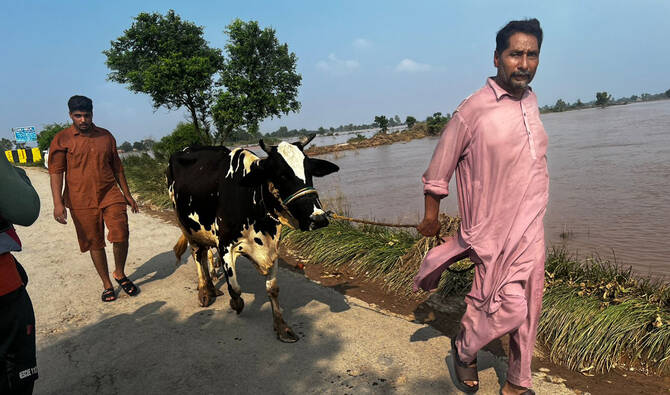
Villagers lead their cattle through a flooded street in Wazirabad, Punjab, on August 29, 2025. (AN Photo)
Short Url
Updated 29 August 2025
Follow

Punjab farmers left in despair as floods wipe out fields and herds

  • Over 25 villages have been submerged in Wazirabad, displacing nearly 8,000 residents
  • Many residents fear more rainfall in northern India could trigger further devastation

WAZIRABAD: The deadly floods that have ravaged Pakistan’s Punjab province have not only claimed about 20 lives but have also devastated the livelihoods of countless others, with families watching helplessly as their crops were swallowed by floodwaters and livestock swept away.

With the lifelines of their survival vanishing in moments, what remains is a haunting landscape of destruction, despair and the silent grief of those left behind.

The floods began in the eastern province of Punjab on Monday when heavy rains triggered sudden water releases from Indian dams on the Sutlej, Chenab and Ravi rivers, making it the worst deluge for the region in about four decades.

In Wazirabad district, heart-wrenching scenes are visible everywhere, with more than 25 villages submerged and nearly 8,000 residents displaced. People mourn the loss of their crops and cattle, and on Friday, two days after the record-breaking flood in the Chenab River, many were still trying to move their animals to safety while watching their submerged rice fields with helpless eyes.

One man, Muhammad Afzal, a resident of the Koth Kahlu area, had been planning to marry one of his two daughters after harvesting his rice crop, but those dreams now lie in ruins.

“Suddenly, so much water came with a great speed that we have never seen in our lives,” he told Arab News. “We got the warning late, and our livestock was swept away. Everyone lost 10, 15, 20 animals.”


A photo taken on August 29, 2025, shows a flood-damaged road in Wazirabad district of Punjab province, Pakistan. (AN Photo)

He added his entire year’s harvest had been destroyed:

“I cultivated rice on 117 acres and corn on 20 acres, but it’s all finished. This is Allah’s will regarding what will happen.”

Punjab is considered the breadbasket of Pakistan due to its significant contribution to the country's agriculture, particularly in staple crops like rice and wheat. The ongoing floods now pose a severe threat to Pakistan’s already struggling economy, with agriculture accounting for 23 percent of the country’s GDP.

Zeeshan Khokhar, a local journalist covering the catastrophe, described the emotional toll on residents.

"I have seen countless people in tears over the past two days," he said. "Many refused to leave their beloved homes and livestock despite repeated pleas from rescue workers."

Another local, Furqan Ahmad, shared his loss, saying he lost his cow and his entire rice crop grown on five acres of land.

“Rescue teams didn’t come in time," he added, his voice heavy with sorrow. "I tried everything, but I couldn’t save my animal.”

Many people have complained that their surviving animals were swept away by the floodwaters into other areas, but there is no way to retrieve them.

Those currently in possession of the animals are making their own claims, and without a proper identification system, it is nearly impossible to prove ownership.

“There’s no way to tell which buffalo belongs to whom,” one of them lamented.

Farmers in the area also expressed frustration over the already low wheat prices this year, saying the floods have completely crippled them financially.

Many have been forced to migrate to urban centers along with their remaining livestock in search of safety and support.

Meanwhile, those who have stayed fear that further rainfall in the upper regions of neighboring India could unleash even more devastation in the coming days.

Although Punjab Chief Minister Maryam Nawaz has promised compensation for farmers affected by the floods, many remain skeptical, pointing out that similar promises in the past were never fulfilled.
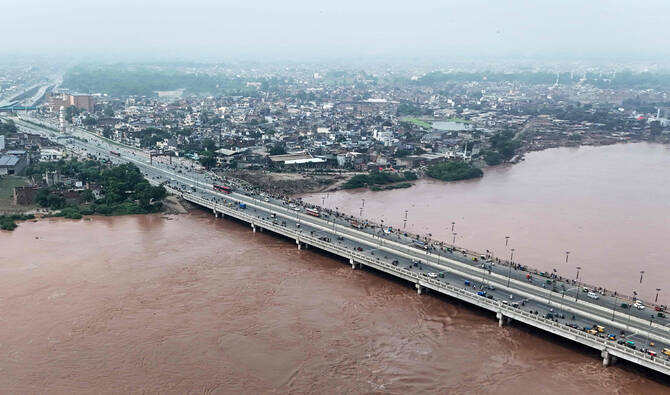


This aerial photograph shows commuters driving on a bridge as floodwaters flow through the Ravi river following a rise in water levels near residential areas in Shahdara, Lahore on August 29, 2025. (AFP)

Authorities are now working to provide relief supplies, medical assistance, and temporary shelters for the affected populations.

Efforts are also underway to prevent the outbreak of diseases — particularly waterborne and skin infections — in the flood-impacted regions.


Pakistan raises fuel prices by Rs55 per liter as Middle East conflict drives oil surge

Updated 06 March 2026
Follow

Pakistan raises fuel prices by Rs55 per liter as Middle East conflict drives oil surge

  • Government says adequate fuel stocks in place despite global energy shock
  • Oil prices jump from about $78 to over $106 per barrel amid regional conflict

ISLAMABAD: Pakistan on Friday increased petrol and diesel prices by Rs55 ($0.20) per liter each as escalating conflict in the Middle East sent global oil prices sharply higher and disrupted energy supply routes, officials said.

Global oil markets have been rattled since coordinated strikes by the United States and Israel against Iran began last week, triggering retaliatory attacks across the region, raising fears of disruption to key energy shipping routes and pushing petroleum prices sharply upward.

The price adjustment in Pakistan was announced after a joint press conference by Finance Minister Muhammad Aurangzeb, Deputy Prime Minister and Foreign Minister Ishaq Dar and Petroleum Minister Ali Pervaiz Malik, who said the government was monitoring international energy markets and domestic supply conditions amid the crisis.

“So, the decision we have made by changing the levy a little bit is that we are going ahead with increasing the price of both fuels, petrol and diesel, by Rs55 ($0.20),” Malik told reporters. 

“And as soon as this matter settles, we will revise the prices downward with the same speed and take steps on how to increase people’s income and purchasing power.”

He said Pakistan entered the crisis with “comfortable energy reserves” due to earlier planning but rising global prices had forced the government to adjust domestic fuel rates to maintain supply continuity.

He said international petrol prices had climbed from roughly $78 per barrel on March 1 to around $106.8 per barrel, while diesel prices had risen to about $150 per barrel.

Malik added that the government had taken steps to minimize the burden on consumers, noting diesel plays a critical role in agriculture, transportation and public mobility.

Malik also warned that authorities would take strict action against anyone attempting to hoard fuel or manipulate supply for profiteering.

The minister said Pakistan was working with international partners to secure additional energy supplies, including arrangements with Saudi Aramco and the use of Pakistan National Shipping Corporation vessels to transport crude oil imports.

Finance Minister Aurangzeb said a high-level government committee formed by Prime Minister Shehbaz Sharif had been meeting daily to review developments in global petroleum markets and their potential impact on Pakistan’s economy.

“Pakistan currently maintains adequate energy stocks and macroeconomic stability,” Aurangzeb said, adding that the government’s response was based on preparedness rather than panic.

He said the committee, which includes senior ministers, the governor of the State Bank of Pakistan and other officials, was assessing short-, medium- and long-term implications of the crisis for inflation, foreign exchange reserves and broader economic indicators.

Deputy PM Dar said the regional conflict had significantly disrupted global energy markets, with international petroleum prices rising by as much as 50–70 percent in recent days.

The deputy prime minister added that Pakistan was also engaged in diplomatic efforts aimed at de-escalating tensions and restoring stability in the region.

Petroleum prices will now be reviewed more frequently, potentially on a weekly basis, and any reduction in global oil prices would be passed on to consumers.

Pakistan, which relies heavily on imported fuel to meet its energy needs, is particularly vulnerable to global oil price shocks that can quickly feed into inflation and pressure the country’s external accounts.