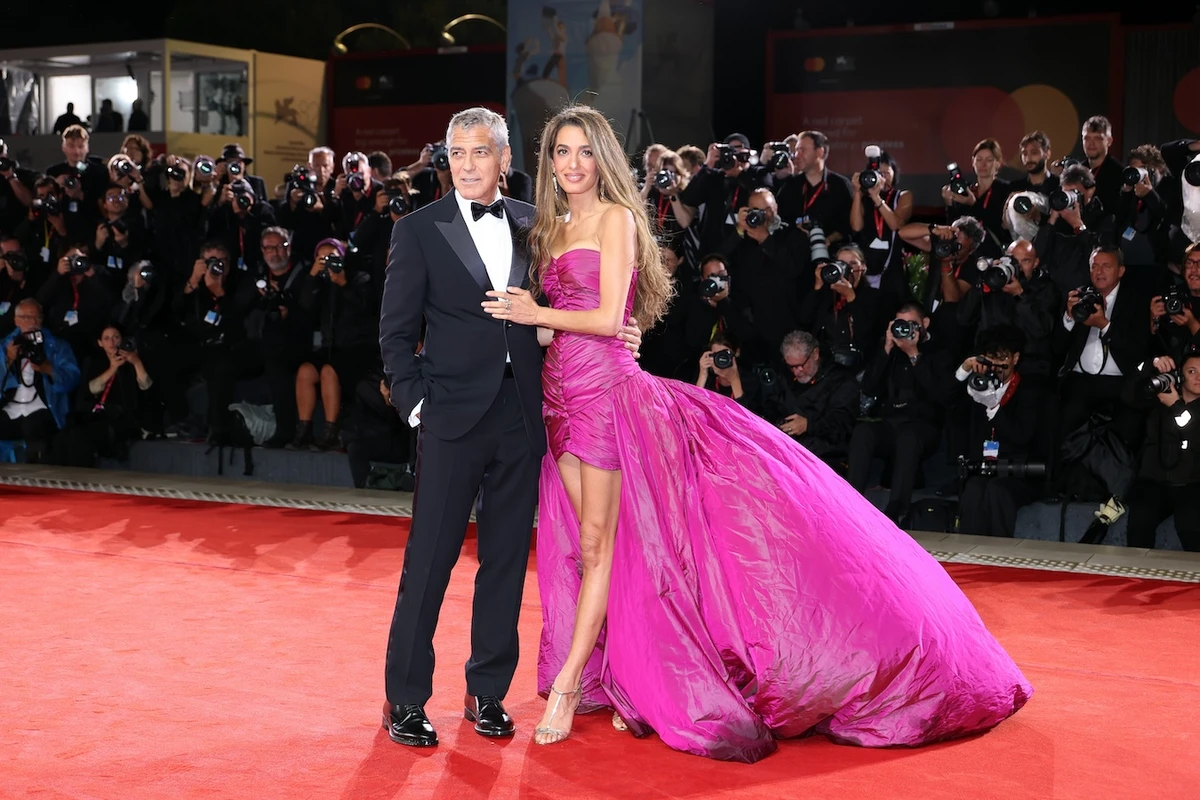
Amal Clooney steps out in vintage look at Venice Film Festival

Amal wore a striking fuchsia vintage Jean-Louis Scherrer gown with a dramatic train. (Getty Images)
Short Url
Updated 29 August 2025
Follow

Amal Clooney steps out in vintage look at Venice Film Festival

  • Praise for George Clooney’s film ‘Jay Kelly,’ competing for top honors

DUBAI: Lebanese British human rights lawyer Amal Clooney and her husband, American George Clooney, made a glamorous appearance at the Venice Film Festival this week for the premiere of the actor’s latest film “Jay Kelly.”

Amal wore a striking fuchsia vintage Jean-Louis Scherrer gown with a dramatic train. The strapless dress featured a ruched bodice and a high slit, and she completed the look with silver Aquazzura heels, a Jimmy Choo bag, and soft, side-swept waves.

George complemented her look in a classic black tuxedo with sharp satin peak lapels, a crisp white dress shirt and a black bow tie.

“Jay Kelly” explores themes of self-discovery while humorously examining celebrity life. The film follows famous movie actor Jay Kelly and his devoted manager Ron, played by Adam Sandler, as they embark on a whirlwind and unexpectedly profound journey through Europe, confronting past choices, relationships and the legacies they will leave behind.

In addition to Clooney and Sandler, the film features a cast including Laura Dern, Billy Crudup, Riley Keough, Grace Edwards, Stacy Keach, Jim Broadbent, Patrick Wilson, Eve Hewson, Greta Gerwig, Alba Rohrwacher, Josh Hamilton, Lenny Henry, Emily Mortimer, Nicole Lecky, Thaddea Graham, and Isla Fisher.

Hours before the premiere, Clooney was reportedly absent from the press conference with a “bad sinus infection.”

His co-star Dern praised his “amazing, raw, true performance” in the film, which is in competition for the festival’s top honors. 

“Jay Kelly” was directed by Noah Baumbach, who co-wrote with Mortimer.

Arab designers and stars also made their mark at the festival.

Saudi fashion influencer Nojoud Al-Rumaihi walked the red carpet for “Bugonia” in a black gown by Lebanese designer Rami Kadi, who noted on Instagram that the look was embellished with cruelty-free feathers, crystals and beads.

“Bugonia” had its world premiere on Thursday evening, and is in competition for the top prize, the Golden Lion. Focus Features is releasing the film in North American theaters on Oct. 24.

The film, which stars Emma Stone, Jesse Plemons, Aidan Delbis, Stavros Halkias, and Alicia Silverstone, is a remake of the 2003 Korean film “Save the Green Planet!” It blends elements of science fiction, horror and comedy.

Al-Rumaihi was not the only one dressed in Kadi’s designs. Italian influencer Beatrice Valli graced the “La Grazia” red carpet at the opening ceremony of the festival in a strapless white pearl gown with a beaded bodice and flowing muslin skirt from the designer’s latest L’Eventail couture collection.

Akio Fujimoto discusses RSIFF Golden Yusr winner ‘Lost Land’ 

Akio Fujimoto at the Red Sea International Film Festival in Jeddah. (Getty Images)
Updated 19 December 2025
Follow

Akio Fujimoto discusses RSIFF Golden Yusr winner ‘Lost Land’ 

  • The Japanese filmmaker on his groundbreaking Rohingya-language feature

JEDDAH: Some stories demand to be told. Not just as narratives, but as acts of witness.  

Japanese filmmaker Akio Fujimoto’s “Lost Land” is one such story. Billed as the first feature film in the Rohingya language, the movie took home the top prize — the Golden Yusr — at this year’s Red Sea International Film Festival. 

“Lost Land” — which premiered in the Horizons section at this year’s Venice Film Festival, where it won the special jury prize — follows two young Rohingya siblings, Somira and Shafi, fleeing persecution in Myanmar as they undertake a perilous journey d to join their uncle in Malaysia. 

Shomira Rias Uddin (R) and Muhammad Shofik Rias Uddin in 'Lost Land.' (Supplied) 

Presenting the Golden Yusr to Fujimoto, RSIFF jury head, the US filmmaker Sean Baker, said the film “confronts the plight of displaced children with unflinching empathy and poetic urgency.” 

Fujimoto’s journey to this film is a profound narrative of personal reckoning. Having worked in Myanmar for more than a decade, he recognized the unspoken tensions surrounding discussions about refugee experiences but never spoke out himself due to fear of persecution. The 2021 military coup in Myanmar, he said, forced him to confront a lingering sense of guilt about his previous silence on the subject. 

“Looking back on my decade of work, I realized I had been avoiding topics I wanted to focus on as a filmmaker,” Fujimoto said in an interview with Arab News at RSIFF. 

That self-reflection became the catalyst for “Lost Land,” transforming personal hesitation into a powerful act of cinematic storytelling. 

Eschewing traditional casting methods, Fujimoto discovered his lead actors through serendipity during community fieldwork. Shomira Rias Uddin and Muhammad Shofik Rias Uddin, real-life siblings who play the film’s young leads, were found walking near interview locations, compelling the filmmaker to reshape the entire script around their natural chemistry. While the original script was written with two teenage brothers in mind, the discovery of the Rias Uddin siblings led Fujimoto to alter the script significantly. 

Communication between the cast and crew became an intricate dance of translation and cultural bridge-building. With Fujimoto speaking primarily Japanese and some Burmese, the team relied on Sujauddin Karimuddin, a Rohingya translator who did far more than linguistic conversion. “He wasn’t just translating words but conveying messages, creating trust, and establishing a collaborative atmosphere,” said Watanabe, Fujimoto’s translator. 

One of the most remarkable aspects of “Lost Land” is its linguistic significance. Beyond being a narrative, the film serves as a critical instrument of cultural preservation. Karimuddin, who is also a producer on the film, approached his role like a linguistic curator. “As a Rohingya myself, I had the privilege of choosing words carefully, trying to instill poetry, capturing linguistic nuances that are slowly disappearing. So, the film is very important when it comes to the preservation of a people’s language. It was a privilege for me to contribute to it,” he said. 

As they were making the first fiction film focused on Rohingya experiences, the team felt an immense responsibility. “Lost Land” aims to humanize a community often reduced to statistics, giving voice and complexity to individual experiences.

Shomira Rias Uddin and Muhammad Shofik Rias Uddin (R) in 'Lost Land.' (Supplied) 

“In our film, we had around 200 people — including extras — who were all part of the Rohingya community. I felt in order to show their feelings and their voice; it was really important to bring in the Rohingya people and tell the story together with them,” said Fujimoto. 

For Fujimoto, whose previous films include “Passage of Life” (2017) and “Along the Sea” (2020), the film represents more than an artistic achievement. It’s a form of personal and collective redemption. “I can now clearly talk about these people without hesitation,” he said. 

The filmmaker’s future ambitions involve expanding on this project. He sees “Lost Land” as a crucial first step, and hopes to support Rohingya filmmakers in telling their own stories directly. 

“The next phase is bringing narratives from the Rohingya perspective, directed by Rohingya filmmakers,” he said.