South Korea’s former first lady and former prime minister indicted by special prosecutors

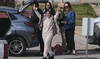
Kim Keon Hee, right, the wife of South Korea’s ousted former President Yoon Suk Yeol, arrives at the special prosecutor’s office in Seoul on Aug. 6, 2025. (AP file photo)
Short Url
Updated 29 August 2025
Follow

South Korea’s former first lady and former prime minister indicted by special prosecutors

  • The wife of jailed former President Yoon Suk Yeol was charged with violating financial market and political funding laws and receiving bribes
  • Three special prosecutor investigations were launched under the government of liberal President Lee Jae Myung that targeted Yoon’s presidency

SEOUL: South Korea’s former first lady Kim Keon Hee and former Prime Minister Han Duck-soo were indicted Friday in special investigations that followed the ousting of the former president for imposing martial law.
The wife of jailed ex-President Yoon Suk Yeol was charged with violating financial market and political funding laws and receiving bribes, about two weeks after a court ordered her arrest.
Han was charged with abetting Yoon’s imposition of martial law imposition, which investigators say amount to a rebellion, and also falsifying and destroying official documents and lying under oath.
Three special prosecutor investigations were launched under the government of liberal President Lee Jae Myung that targeted Yoon’s presidency and the actions taken to impose martial law last December.
Yoon’s defense minister, military commanders and police officers have been arrested for their involvement in imposing martial law.
Yoon was removed from office in April and rearrested last month over his December martial law decree.
Kim and Yoon are suspected of exerting undue influence on the conservative People Power Party to nominate a specific candidate in a 2022 legislative by-election, allegedly at the request of election broker Myung Tae-kyun. Myung faces accusations of conducting free opinion surveys for Yoon using manipulated data that possibly helped him win the party’s presidential primaries before his election as president.
Kim apologized for causing public concern earlier this month but also hinted she would deny the allegations against her, portraying herself as “someone insignificant.”
Assistant special counsel Park Ji-young told a televised briefing that Han was the highest official who could have blocked Yoon’s attempt to impose martial law. Park said Han still played an “active” role in Yoon’s martial law declaration by trying to get Yoon’s decree passed through a Cabinet Council meeting as a way to give “procedural legitimacy” to it.
Han has maintained he conveyed to Yoon that he opposed his martial law plan.
Han, who was appointed prime minister, the country’s No. 2 post, by Yoon, was South Korea’s acting leader after Yoon was impeached in mid-December.
After Yoon was formally dismissed as president in a Constitutional Court decision, Han was supposed to continue to head the caretaker government until the June presidential election. Han resigned to seek the presidential nomination instead, but Yoon’s conservative party chose someone else.


It’s unusual that the Brown campus shooter has evaded identification this long, experts say

Updated 10 sec ago
Follow

It’s unusual that the Brown campus shooter has evaded identification this long, experts say

  • Investigators have released several videos from the hours and minutes before and after the shooting that show a person who, according to police, matches witnesses’ description of the shooter

PROVIDENCE, R.I.: It’s been nearly a week since someone killed two students and wounded nine others inside a Brown University classroom before fleeing, yet investigators on Thursday appeared to still not know the attacker’s name.
There have been other high-profile attacks in which it took days or longer to make an arrest or find those responsible, including in the brazen New York City sidewalk killing of UnitedHealthcare’s CEO last year, which took five days.
But frustration is mounting in Providence that the person behind Saturday’s attack, which killed two students and wounded nine others, managed to get away and that a clear image of their face has yet to emerge.
“There’s no discouragement among people who understand that not every case can be solved quickly,” the state attorney general, Peter Neronha, said at a news conference Wednesday.
How is the investigation going?
Authorities have scoured the area for evidence and pleaded with the public to check any phone or security footage they might have from the week before the attack, believing the shooter might have cased the scene ahead of time. But they have given no sense that they’re close to catching the shooter.
Investigators have released several videos from the hours and minutes before and after the shooting that show a person who, according to police, matches witnesses’ description of the shooter. In the clips, the person is standing, walking and even running along streets just off campus, but always with a mask on or their head turned.
Although Brown officials say there are 1,200 cameras on campus, the attack happened in an older part of the engineering building that has few, if any cameras. And investigators believe the shooter entered and left through a door that faces a residential street bordering campus, which might explain why the cameras Brown does have didn’t capture footage of the person.
Providence Mayor Brett Smiley said Wednesday that the city is doing “everything possible” to keep residents safe. However, he acknowledged that it is “a scary time in the city” and that families likely were having tough conversations about whether to stay in town over the holidays.
“We are doing everything we can to reassure folks, to provide comfort, and that is the best answer I can give to that difficult question,” Smiley said when asked if the city was safe.
Although it’s not unheard of for someone to disappear after carrying out such a high-profile shooting, it is rare.
What can be learned from past investigations?
In such targeted and highly public attacks, the shooters typically kill themselves or are killed or arrested by police, said Katherine Schweit, a retired FBI agent and expert on mass shootings. When they do get away, searches can take time.
“The best they can do is what they do now, which is continue to press together all of the facts they have as fast as they can,” Schweit said. “And, really, the best hope for solutions is going to come from the public.”
In the 2013 Boston Marathon bombing, it took investigators four days to catch up to the two brothers who carried it out. In a 2023 case, Army reservist Robert Card was found dead of an apparent suicide two days after he killed 18 people and wounded 13 others in Lewiston, Maine.
The man accused of killing conservative political figure Charlie Kirk in September turned himself in about a day and a half after the attack on Utah Valley University’s campus. And Luigi Mangione, who has pleaded not guilty to murder charges in the killing of UnitedHealthcare CEO Brian Thompson in Manhattan last year, was arrested five days later at a McDonald’s in Pennsylvania.
Felipe Rodriguez, a retired New York police detective sergeant and adjunct professor at the John Jay College of Criminal Justice, said it’s clear that shooters are learning from others who were caught.
“Most of the time an active shooter is going to go in, and he’s going to try to commit what we call maximum carnage, maximum damage,” Rodriguez said. “And at this point, they’re actually trying to get away. And they’re actually evading police with an effective methodology, which I haven’t seen before.”
Investigators have described the person they are seeking as about 5 feet, 8 inches  tall and stocky. The attacker’s motives remain a mystery, but authorities said Wednesday that none of the evidence suggests a specific person was being targeted.
Meanwhile, Boston-area police are investigating the shooting death of a Massachusetts Institute of Technology professor earlier this week. Nuno F.G. Loureiro was attacked at his home Monday, and no one has been arrested or named as a suspect. The FBI said it had no reason to think his killing was linked to the Brown attack.