

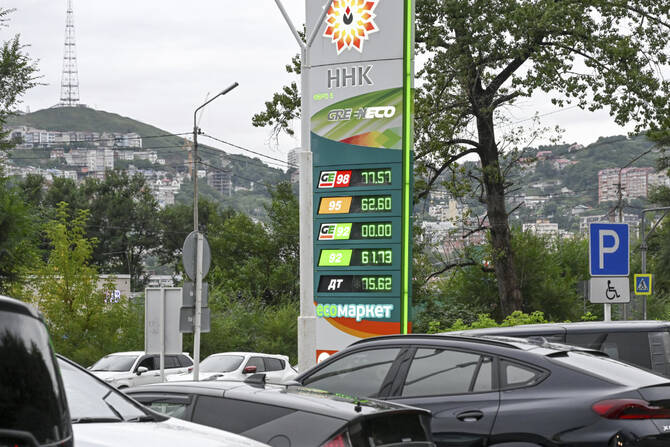

Gas stations have run dry in some regions of Russia after Ukrainian drones struck refineries and other oil infrastructure in recent weeks, with motorists waiting in long lines and officials resorting to rationing or cutting off sales altogether.
Wholesale prices on the St. Petersburg International Mercantile Exchange for A-95 gas — the highest octane — spiked to record highs last week, soaring to about 50 percent higher than in January, as demand soared from farmers seeking to bring in the harvest and Russians hitting the roads for their last big vacation of the summer.
Russian media outlets reported fuel shortages are hitting consumers in several regions in the Far East and on the Crimean Peninsula, which was illegally annexed from Ukraine by Moscow in 2014.
Media outlets in the Primorye region, which borders North Korea, reported long lines and prices of about 78 rubles per liter (approximately $3.58 per gallon) at gas stations in the area, where the average monthly wage is about $1,200. Journalists at local news outlet Primpress found other drivers trying to sell gas online for as much as 220 rubles per liter (about $10.12 per gallon).
In the Kurilsky district of the Kuril Islands north of Japan, shortages of lower octane A-92 gas forced officials to halt public sales outright Monday. In Crimea, a popular resort area, some companies sold fuel only to holders of coupons or special cards.
Normal price increases are aggravated this year
Russia is no stranger to gasoline price increases at the end of summer. But this year’s shortages have been aggravated by Ukraine’s attacks on oil refineries in the 3 1/2-year-old war. Larger, more concentrated attacks are causing more damage and hampering production, all timed to coincide with peak demand.
Ukraine has targeted energy infrastructure before, but the recent strikes have been more successful, with more drones targeting a more concentrated group of facilities.
“The Ukrainians are attacking an arc of refineries, starting from Ryazan, which is south of Moscow, all the way to Volgograd. That region is where people are driving through on their way to (resorts on) the Black Sea. That’s the region where most of the harvest operations are going on. And that’s also a rather densely populated region,” Sergey Vakulenko, a senior fellow at the Carnegie Russia Eurasia Center, told The Associated Press.

A gas station worker refuels a car in Moscow, Russia, on Aug. 25, 2025. (AP)
Between Aug. 2 and Aug. 24, Ukraine attacked oil infrastructure at least 12 times, according to media reports. Of those attacks, at least 10 were targeting sites in the Ryazan-Volgograd arc in southwestern Russia.
These attacks have damaged many oil refineries but have not destroyed them outright, Vakulenko said, adding that most of the facilities are extremely resilient against fires.
But they can slow refinery activity, as shown by a fall in the intake of crude oil to be turned into diesel, gasoline or other products by roughly 200,000 to 250,000 barrels per day, said Gary Peach, oil markets analyst at Energy Intelligence.
“That’s just enough to make their gasoline industry feel some pain, especially during the high consumption months in the summer,” he told AP. Gasoline production fell 8.6 percent in the first 19 days of August, compared with a year earlier, and diesel production was down 10.3 percent.
Other war-related issues have caused even more consumer pain. Ukrainian drone strikes repeatedly have disrupted Russian transportation networks, particularly air traffic, causing more people to travel by car and increasing demand for gas, Vakulenko said.
Inflation also has made it less profitable for suppliers who normally buy gasoline early in the year for sale in the higher-priced summer months, and many entrepreneurs simply decided not to bother this year, he said.
Individually, none of these problems caused lasting or widespread disruption in Russia. But together, they have transformed an expected annual price fluctuation into a problem for the government.
To try to ease the shortage, Russia has paused gasoline exports, with officials Wednesday declaring a full ban until Sept. 30 and a partial ban affecting traders and intermediaries until Oct. 31. Oil company managers have also been summoned to government meetings twice this month to discuss the shortages, Russian media reported.
Moscow is largely spared from shortages
While officials appear to be concerned, the gasoline shortfall “isn’t system critical,” Peach said.
So far, the shortage remains confined to certain areas — the Far East and Crimea — because these regions usually are supplied by fewer refineries and present greater transportation demands.
Moscow has been spared the latest gasoline price spike because it is well-supplied from major refineries in Yaroslavl and Nizhny Novgorod, cities a few hours’ drive away. The capital also has a refinery in the city itself.
Russia is not at immediate risk of grinding to a halt — even in more vulnerable regions, experts say. Although private drivers may feel some pain at the gas pump, most buses and trucks run on diesel, for which Russia has a surplus. The military, which largely uses diesel fuel, also is insulated from any shocks.
Vakulenko wrote in a recent commentary that annual diesel production is “more than double than what is needed.”
That doesn’t mean the situation still couldn’t deteriorate. Refineries that make gasoline for Russia’s domestic market also make diesel and other products for export — a vital source of income amid heavy Western sanctions.
Industry observers say Ukraine’s drones target key refinery equipment, including the distillation column that separates incoming crude oil into other products, including gasoline, diesel, fuel for ships and asphalt. If damaged, it must be repaired or replaced for the refinery to function. Repairs could be difficult if foreign parts are needed.
The gasoline crisis is expected to ease by late September as demand subsides and the annual summer maintenance for many refineries is finished.
Still, the crisis highlights a vulnerability on the home front that has the potential to be exploited further as drone warfare evolves.


