


LONDON: The Committee to Protect Journalists on Thursday called on Israeli authorities to guarantee a “complete” and “independent” investigation into the killing of five journalists in Gaza.
Israel struck Nasser Hospital in the southern Gaza Strip on Monday, killing at least 20 people, including five journalists who worked for Reuters, the Associated Press, Al Jazeera, and others.
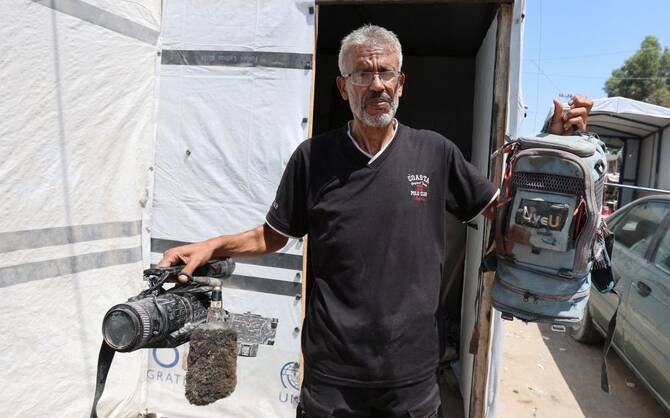
Photojournalists Hossam Al-Masri, Mohammad Salama and Mariam Dagga, along with journalists Moaz Abu Taha and Ahmed Abu Aziz, died after an Israeli explosive drone targeted the medical complex.
“Israel’s initial report leaves many more questions than answers and does not explain why an Israeli tank fired on Reuters camera operator Hossam Al-Masri and the news agency’s visible, live-feed camera that had been filming from that location daily for several weeks,” said CPJ CEO Jodie Ginsberg.
“Nor does it explain why first responders — including other journalists — were targeted in an apparent so-called ‘double tap’ strike on the same location. The indiscriminate and disproportionate nature of the attack demand that this incident be investigated as an apparent war crime.”
A “double tap” is a controversial military tactic designed to maximize casualties by striking first responders such as medical personnel, rescue workers and journalists.
Reconstruction of the incident revealed that what was initially described as a second “tap” was actually two almost simultaneous strikes, both fired nine minutes after the first. These subsequent impacts appear responsible for the majority of fatalities
Following global condemnation, the Israeli military stated the back-to-back strikes were ordered because soldiers believed militants were using the camera to observe Israeli forces. Israel has long asserted that Hamas and other militant groups take shelter in hospitals.
The military’s chief of general staff acknowledged “gaps” in the investigation so far, including questions about the type of ammunition used to disable the camera. Israeli Prime Minister Benjamin Netanyahu described the killing as a “tragic mishap.”
CPJ contested these claims, calling Israel’s explanation “incomplete” and “inadequate” given the scale of the tragedy. The watchdog also highlighted inconsistencies in statements from the Israeli leadership, including those from Netanyahu and the Israel Defense Forces.
The group warned that the lack of transparency “undermines Israel’s moral duty and obligations under international law” to protect journalists, adding that the incident reflected a “wider, deeply troubling pattern of lethal attacks on the media.”
“Our experience over decades is that Israeli-led investigations into killings are neither transparent nor independent — and in not a single case over the past 24 years has anyone in Israel ever been held accountable for the killing of a journalist,” Ginsberg said. “We demand a full, transparent and independent investigation to ensure accountability for this attack and any violations of international humanitarian law.”
The CPJ’s call for accountability comes amid a broader debate over the role of Western media during the Gaza conflict.
Reuters and the Associated Press have faced criticism for distancing themselves from the journalists killed by labeling them as contractors rather than employees — reflecting widespread contractual complexities in the industry. Critics argue this approach undermines the legitimacy of Palestinian journalists, who have endured a prolonged smear campaign by Israel.
Both agencies have also been accused of uncritically repeating Israeli justifications for the strike without sufficient challenge or contextualization. Fellow journalists have criticized the newswires for perceived hypocrisy, opportunism and bias.
Canadian photojournalist Valerie Zink resigned from Reuters after eight years, accusing the agency of “betraying journalists in Gaza” and “enabling the systematic assassination” of media workers. Zink stated she could no longer “wear this press pass with anything but deep shame and grief” as international criticism intensifies over Western media’s perceived failure to hold Israel accountable for atrocities in Gaza.


