

Pakistan’s interior minister, UK envoy discuss counterterrorism, border security

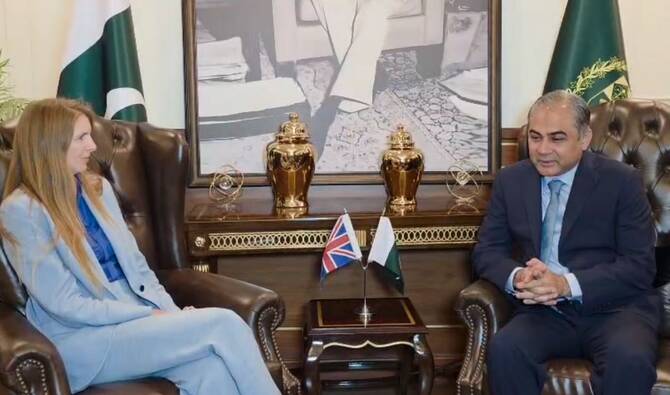
Pakistan’s Interior Minister Mohsin Naqvi and British High Commissioner Jane Marriott in a meeting in Islamabad, Pakistan on August 28, 2025. (GOP)
Short Url
Updated 28 August 2025
Follow

Pakistan’s interior minister, UK envoy discuss counterterrorism, border security

  • Pakistan and the United Kingdom aim to broaden ties through trade and investment
  • British high commissioner voices grief over the loss of lives lost in Pakistan’s floods

ISLAMABAD: Pakistan’s Interior Minister Mohsin Naqvi and British High Commissioner Jane Marriott met on Thursday to discuss enhanced cooperation in counterterrorism, border security and other areas, said an official statement, as the envoy expressed regret over lives lost in the country during the ongoing floods.

The meeting took place as Pakistan and the United Kingdom seek to broaden their relationship through trade and investment. They have also collaborated in the past to fight transnational militant violence and cooperated diplomatically.

“Interior Minister Mohsin Naqvi met British High Commissioner Jane Marriott and discussed strengthening cooperation in counterterrorism, narcotics control, border security and human smuggling,” the statement circulated by his ministry said.

“The high commissioner expressed deep sorrow over the loss of precious lives in floods and rains in Pakistan, offering condolences to the families of the victims.”

Naqvi said Pakistan had always advocated peace and condemned militant violence in all its forms and manifestations.

“Britain is an important partner in Pakistan’s journey of development, and we want to promote bilateral cooperation with the UK in all areas of mutual interest,” he added.

They also discussed the ongoing floods in the country in which over 800 people have been killed since the beginning of monsoon season in late June.


Pakistan opposition to continue protest over ex-PM Khan’s health amid conflicting reports

Updated 16 February 2026
Follow

Pakistan opposition to continue protest over ex-PM Khan’s health amid conflicting reports

  • Pakistan’s government insists that the ex-premier’s eye condition has improved
  • Khan’s personal doctor says briefed on his condition but cannot confirm veracity

ISLAMABAD: Pakistan’s opposition alliance on Monday vowed to continue their protest sit-in at parliament and demanded “clarity” over the health of jailed former prime minister Imran Khan, following conflicting medical reports about his eye condition.

The 73-year-old former cricket star-turned-politician has been held at the high-security Adiala prison in Rawalpindi since 2023. Concerns arose about his health last week when a court-appointed lawyer, Barrister Salman Safdar, was asked to visit Khan at the jail to assess his living conditions. Safdar reported that Khan had suffered “severe vision loss” in his right eye due to central retinal vein occlusion (CRVO), leaving him with just 15 percent sight in the affected eye.

On Sunday, a team of doctors from various hospitals visited the prison to examine Khan’s eye condition, according to the Adiala jail superintendent, who later submitted his report in the court. On Monday, a Supreme Court bench led by Chief Justice Yahya Afridi observed that based on reports from the prison authorities and the amicus curiae, Khan’s “living conditions in jail do not presently exhibit any perverse aspects.” It noted that Khan had “generally expressed satisfaction with the prevailing conditions of his confinement” and had not sought facilities beyond the existing level of care.

Having carefully perused both reports in detail, the bench observed that their general contents and the overall picture emerging therefrom are largely consistent. The opposition alliance, which continued to stage its sit-in for a fourth consecutive day on Monday, held a meeting at the parliament building on Monday evening to deliberate on the emerging situation and discuss their future course of action.

“The sit-in will continue till there is clarity on the matter of [Khan's] health,”  Sher Ali Arbab, a lawmaker from Khan's Pakistan Tehreek-e-Insaf (PTI) party who has been participating in the sit-in, told Arab News, adding that PTI Chairman Gohar Ali Khan and Opposition Leader in Senate Raja Nasir Abbas had briefed them about their meeting with doctors who had visited Khan on Sunday.

Speaking to reporters outside parliament, Gohar said the doctors had informed them that Khan’s condition had improved.

“They said, 'There has been a significant and satisfactory improvement.' With that satisfactory improvement, we also felt satisfied,” he said, noting that the macular thickness in Khan’s eye had reportedly dropped from 550 to 300 microns, a sign of subsiding swelling.

Gohar said the party did not want to politicize Khan’s health.

“We are not doctors, nor is this our field,” he said, noting that Khan’s personal physician in Lahore, Dr. Aasim Yusuf, and his eye specialist Dr. Khurram Mirza had also sought input from the Islamabad-based medical team.

“Our doctors also expressed satisfaction over the report.”

CONFLICTING ACCOUNTS

Despite Gohar’s cautious optimism, Khan’s personal physician, Dr. Yusuf, issued a video message on Monday, saying he could neither “confirm nor deny the veracity” of the government’s claims.

“Because I have not seen him myself and have not been able to participate in his care... I’m unable to confirm what we have been told,” Yusuf said.

He appealed to authorities to grant him or fellow physician, Dr. Faisal Sultan, immediate access to Khan, arguing that the ex-premier should be moved to Shifa International Hospital in Islamabad for specialist care.

Speaking to Arab News, PTI’s central information secretary Sheikh Waqas Akram said Khan’s sister and their cousin, Dr. Nausherwan Burki, will speak to media on Tuesday to express their views about the situation.

The government insists that Khan’s condition has improved.

“His eye [condition] has improved and is better than before,” State Minister Talal Chaudhry told the media in a brief interaction on Monday.

“The Supreme Court of Pakistan is involved, and doctors are involved. What medicine he receives, whether he needs to be hospitalized or sent home, these decisions are made by doctors. Neither lawyers nor any political party will decide this.”