WASHINGTON: President Donald Trump’s administration is taking management of Union Station away from Amtrak in the latest example of the federal government exerting its power over the nation’s capital.
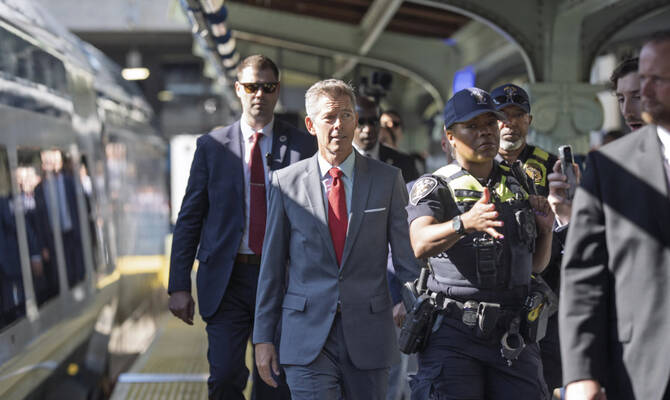
Transportation Secretary Sean Duffy announced the takeover Wednesday alongside Amtrak President Roger Harris at Washington’s main transportation hub during the launch of an updated version of the rail service’s Acela train. The federal government owns Union Station, which is near the Capitol.
Duffy said the station has “fallen into disrepair” when it should be a “point of pride” for the District of Columbia. He said the Republican administration’s move would help beautify the landmark in an economical way and was in line with Trump’s vision.
“He wants Union Station to be beautiful again. He wants transit to be safe again. And he wants our nation’s capital to be great again. And today is part of that,” Duffy said.
It’s Trump’s latest attempt to put the city under his control. In recent weeks, Trump has increased the number of federal law enforcement and immigration agents on city streets while also taking over the Metropolitan Police Department and activating thousands of National Guard members. Last week, Trump said he wants $2 billion from Congress to beautify Washington.
Duffy said the federal government can do a better job managing the train station and attract more shops and restaurants and generate more revenue that will be used to pay for upgrades to the station, which opened in 1907. Since then, the cavernous Roman-columned building has been through multiple management changes and numerous ups and downs regarding its cleanliness, safety and state of repair.
Mayor Muriel Bowser said upgrading the transit hub that serves various rail lines and buses would be an “amazing initiative” for the federal government to take on because the city cannot afford the cost.
“It has suffered from not being able to get the money that it needs for the renovation,” the Democrat said at a separate news conference.
National Guard troops have patrolled in and around Union Station ever since Trump announced the anti-crime effort this month. Vice President JD Vance and Defense Secretary Pete Hegseth were shouted down by opponents of the federal intervention when they visited with troops there last week.
Duffy had pressed Amtrak about crime at the station in a March letter to its chief operating officer and requested an updated plan on how it intended to improve public safety there.
The deputy transportation secretary, Steve Bradbury, cited a new roof and new public restrooms among $170 million in upgrades that he said are needed at the station.
Amtrak’s new high-speed train, the NextGen Acela, will start serving the Northeast Corridor on Thursday, said Harris, Amtrak’s president. The trains can travel at speeds of up to 160 mph, about 10 mph faster than the Acela train it is replacing. Duffy and the officials from the Union Station event boarded one of the new trains afterward for an inaugural ride to New York’s Penn Station.
Union Station has had a history of ups and downs during its nearly 120-year history.
In 1981, after rain started pouring through the ceiling, the National Park Service, which has jurisdiction over some of the area surrounding the station, declared the building unsafe. The station was closed for five years for renovation and President Ronald Reagan signed the Union Station Redevelopment Act to help fund and organize its comeback.
More recently, the building fell on relatively hard times during the COVID pandemic. Foot traffic plummeted after passengers shunned mass transit while multiple shops closed at the station. But the past three years have witnessed a bit of a comeback.
The station has occasionally been a magnet for homeless individuals seeking shelter inside or camping in tents on Columbus Circle in front of the building. The proliferation of tents prompted the Park Service to clear the encampment in front of the station in June 2022.
Control and management of the physical building also have shifted over the years.

Trump extends control over Washington by taking management of Union Station away from Amtrak
Short Url
https://arab.news/m5evz
Trump extends control over Washington by taking management of Union Station away from Amtrak
- Since then, the cavernous Roman-columned building has been through multiple management changes and numerous ups and downs regarding its cleanliness, safety and state of repair
’Made in Europe’ or ‘Made with Europe’? Buy European push splits bloc
- Everyone in Europe agrees the EU needs to rescue its industry but the bloc is split over how far it should push a ‘Buy European’ approach in order to do so
BRUSSELS: Everyone in Europe agrees the EU needs to rescue its industry but the bloc is split over how far it should push a ‘Buy European’ approach in order to do so.
The European Commission, the EU’s executive arm, will next week propose new rules that are expected to include a requirement for companies in strategic sectors to produce in Europe if they want to receive public money.
But the definition of “European preference” has triggered debate, with calls especially from France for more “Made in Europe,” while other EU states such as Germany call for “Made with Europe.”
- Protecting Europe or European protectionism? -
French President Emmanuel Macron insisted the new rules would be about “protecting our industry” without “being protectionist,” by defending “certain strategic sectors, such as cleantech, chemicals, steel, cars or defense.”
Otherwise, he warned, “Europeans will be swept aside.”
But other EU countries, which are proponents of free trade, oppose the plans.
Swedish Prime Minister Ulf Kristersson said Europe should compete based on quality and innovation, not because it wanted to protect European markets.
“We do not want to protect European businesses that are basically not competitive,” Kristersson told the Financial Times newspaper last week.
But EU leaders during talks Thursday appeared to reach a consensus on the issue, pushing for the measure in certain specific sectors since they say Europe faces unfair competition from China and other countries.
“We are in favor of open markets,” German Finance Minister Lars Klingbeil said Monday. “But I also want to be very clear: if China changes the rules of the game, if we are confronted with overcapacity, subsidies, and the fact that markets in Europe are flooded, then Europe must defend itself.”
- In Europe or with Europe? -
Supporters want “Made in Europe” to be strictly defined, and only for industrial goods made from components manufactured in the European Economic Area, made of the EU’s 27 states as well as Iceland, Liechtenstein and Norway.
Critics say this definition would be too restrictive and instead call for a more flexible measure, like Germany’s Merz, who calls for “Made with Europe” not “Made in Europe.”
They also argue it would be difficult to apply in practice and risks destabilising European supply chains.
“Typically, even a vehicle assembled in Europe incorporates hundreds of specialized components sourced from all over the world. Many critical inputs cannot be competitively produced at scale in Europe,” Japanese carmaker Honda said.
Britain and Turkiye, for whom the EU is an important trading partner, have also privately expressed concern to Brussels about keeping their countries out.
Some EU capitals are worried about potential retaliatory measures from supplier countries, which would drag Europe into showdowns at a moment when it needs to strengthen its exports.
- What will the rules look like? -
The EU executive insists it has balanced the need to be open and protect firms.
The measure will be “targeted in three ways,” said the office of EU industry chief Stephane Sejourne — who is spearheading the push.
It will affect:
-- a limited number of critical components
-- a limited number of strategic sectors
-- only when public funding is involved.
The final proposal, which will be announced on February 25, could end up only touching a handful of sectors: the auto industry and those playing an essential role in the green transition and confronted by what the EU says unfair Chinese competition, such as solar panels, wind turbines and batteries.
Sejourne’s office insisted companies producing in the EU would be considered European and there will be “reciprocal commitments” with trusted partners.
A draft document seen by AFP says products made in countries outside the EU with rules similar to the bloc will be treated like those made in Europe.
Non-EU countries however remain watchful until the real proposal lands.
For example, there are still many unknowns including what the percentages of European or equivalent components will be required from manufacturers if they wish to continue accessing public money.
The European Commission, the EU’s executive arm, will next week propose new rules that are expected to include a requirement for companies in strategic sectors to produce in Europe if they want to receive public money.
But the definition of “European preference” has triggered debate, with calls especially from France for more “Made in Europe,” while other EU states such as Germany call for “Made with Europe.”
- Protecting Europe or European protectionism? -
French President Emmanuel Macron insisted the new rules would be about “protecting our industry” without “being protectionist,” by defending “certain strategic sectors, such as cleantech, chemicals, steel, cars or defense.”
Otherwise, he warned, “Europeans will be swept aside.”
But other EU countries, which are proponents of free trade, oppose the plans.
Swedish Prime Minister Ulf Kristersson said Europe should compete based on quality and innovation, not because it wanted to protect European markets.
“We do not want to protect European businesses that are basically not competitive,” Kristersson told the Financial Times newspaper last week.
But EU leaders during talks Thursday appeared to reach a consensus on the issue, pushing for the measure in certain specific sectors since they say Europe faces unfair competition from China and other countries.
“We are in favor of open markets,” German Finance Minister Lars Klingbeil said Monday. “But I also want to be very clear: if China changes the rules of the game, if we are confronted with overcapacity, subsidies, and the fact that markets in Europe are flooded, then Europe must defend itself.”
- In Europe or with Europe? -
Supporters want “Made in Europe” to be strictly defined, and only for industrial goods made from components manufactured in the European Economic Area, made of the EU’s 27 states as well as Iceland, Liechtenstein and Norway.
Critics say this definition would be too restrictive and instead call for a more flexible measure, like Germany’s Merz, who calls for “Made with Europe” not “Made in Europe.”
They also argue it would be difficult to apply in practice and risks destabilising European supply chains.
“Typically, even a vehicle assembled in Europe incorporates hundreds of specialized components sourced from all over the world. Many critical inputs cannot be competitively produced at scale in Europe,” Japanese carmaker Honda said.
Britain and Turkiye, for whom the EU is an important trading partner, have also privately expressed concern to Brussels about keeping their countries out.
Some EU capitals are worried about potential retaliatory measures from supplier countries, which would drag Europe into showdowns at a moment when it needs to strengthen its exports.
- What will the rules look like? -
The EU executive insists it has balanced the need to be open and protect firms.
The measure will be “targeted in three ways,” said the office of EU industry chief Stephane Sejourne — who is spearheading the push.
It will affect:
-- a limited number of critical components
-- a limited number of strategic sectors
-- only when public funding is involved.
The final proposal, which will be announced on February 25, could end up only touching a handful of sectors: the auto industry and those playing an essential role in the green transition and confronted by what the EU says unfair Chinese competition, such as solar panels, wind turbines and batteries.
Sejourne’s office insisted companies producing in the EU would be considered European and there will be “reciprocal commitments” with trusted partners.
A draft document seen by AFP says products made in countries outside the EU with rules similar to the bloc will be treated like those made in Europe.
Non-EU countries however remain watchful until the real proposal lands.
For example, there are still many unknowns including what the percentages of European or equivalent components will be required from manufacturers if they wish to continue accessing public money.
© 2026 SAUDI RESEARCH & PUBLISHING COMPANY, All Rights Reserved And subject to Terms of Use Agreement.


