

Pakistan says efforts underway to power Gwadar port through solar energy

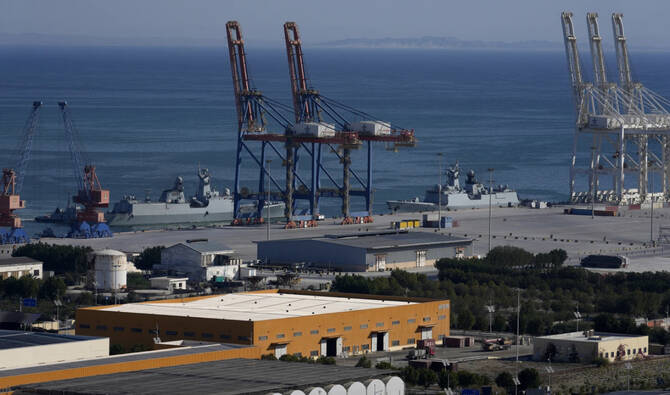
Pakistan Navy ships berth at Gwadar port in the coastal city of Gwadar, Balochistan on January 15, 2025. (AP/File)
Short Url
Updated 27 August 2025
Follow

Pakistan says efforts underway to power Gwadar port through solar energy

  • Pakistan forms sub-committee to review technical aspects of implementing solar power in Gwadar
  • Islamabad, desperate to slash expensive fuel imports, has recently tried to promote solar energy use

ISLAMABAD: Pakistan’s government is working to operationalize Gwadar Port and improve its efficiency by adopting solar-based solutions and cutting its dependence on external energy, state media reported on Wednesday, saying that it has formed a technical sub-committee to review technical aspects of implementing solar power in the port city.

Gwadar city is situated along the Arabian Sea and lies at the heart of the China-Pakistan Economic Corridor (CPEC), under which Beijing has funneled tens of billions of dollars into massive transport, energy and infrastructure projects in Pakistan.

Solar-based solutions use sunlight to provide clean energy, power appliances and water pumps. Pakistan, desperate to cut down on its costly fuel imports, has undertaken efforts in recent years to promote the use of solar energy.

Maritime Affairs Minister Junaid Chaudhry held a meeting on the port’s operationalization with Gwadar Port Chairman Noorul Haque Baloch and China Overseas Ports Holding Company Chairman My Yu Bo, the state-run Associated Press of Pakistan (APP) said in a report. He confirmed that the government has established a sub-committee featuring officials from several ministries to review technical aspects of implementing solar power in Gwadar.

“The minister outlined the sub-committee’s key duties which include devising an efficient solar panel utilization plan, recommending the installation of solar photovoltaic systems and battery storage solutions for Gwadar’s water facilities and proposing measures to enhance the region’s power supply,” APP reported.

“Moreover, the committee will design solar power distribution systems integrated with storage options to ensure a dependable energy supply for critical infrastructure, including the Gwadar Port Authority,” it continued.

“The initiative seeks to significantly reduce Gwadar’s reliance on external energy by making it self-sufficient through local power sources.”

During the meeting, Chaudhry told the participants that solar-based microgrids with sufficient capacity would be set up at strategic locations to supply power to water pumps and the desalination plant.

He said Prime Minister Shehbaz Sharif’s solar initiative for Gwadar would be fully functional to facilitate the establishment of new factories in the Gwadar free zone and provide power to the newly built international airport in the port city.

Chaudhry pointed out that water shortage in Gwadar is acute due to insufficient power, adding that solar energy was vital to protect the industries there.

He also highlighted how the Gwadar fisheries sector saved over a million dollars every year by shifting from diesel to solar power.

Pakistani officials have termed Gwadar’s geostrategic position as the shortest trade route to the Gulf and Central Asia, highlighting its potential to become a regional transshipment hub.


Pakistan, global crypto exchange discuss modernizing digital payments, creating job prospects 

Updated 05 December 2025
Follow

Pakistan, global crypto exchange discuss modernizing digital payments, creating job prospects 

  • Pakistani officials, Binance team discuss coordination between Islamabad, local banks and global exchanges
  • Pakistan has attempted to tap into growing crypto market to curb illicit transactions, improve oversight

ISLAMABAD: Pakistan’s finance officials and the team of a global cryptocurrency exchange on Friday held discussions aimed at modernizing the country’s digital payments system and building local talent pipelines to meet rising demand for blockchain and Web3 skills, the finance ministry said.

The development took place during a high-level meeting between Finance Minister Muhammad Aurangzeb, Pakistan Virtual Assets Regulatory Authority (PVARA) Chairman Bilal bin Saqib, domestic bank presidents and a Binance team led by Global CEO Richard Teng. The meeting was held to advance work on Pakistan’s National Digital Asset Framework, a regulatory setup to govern Pakistan’s digital assets.

Pakistan has been moving to regulate its fast-growing crypto and digital assets market by bringing virtual asset service providers (VASPs) under a formal licensing regime. Officials say the push is aimed at curbing illicit transactions, improving oversight, and encouraging innovation in blockchain-based financial services.

“Participants reviewed opportunities to modernize Pakistan’s digital payments landscape, noting that blockchain-based systems could significantly reduce costs from the country’s $38 billion annual remittance flows,” the finance ministry said in a statement. 

“Discussions also emphasized building local talent pipelines to meet rising global demand for blockchain and Web3 skills, creating high-value employment prospects for Pakistani youth.”

Blockchain is a type of digital database that is shared, transparent and tamper-resistant. Instead of being stored on one computer, the data is kept on a distributed network of computers, making it very hard to alter or hack.

Web3 refers to the next generation of the Internet built using blockchain, focusing on giving users more control over their data, identity and digital assets rather than big tech companies controlling it.

Participants of the meeting also discussed sovereign debt tokenization, which is the process of converting a country’s debt such as government bonds, into digital tokens on a blockchain, the ministry said. 

Aurangzeb called for close coordination between the government, domestic banks and global exchanges to modernize Pakistan’s payment landscape.

Participants of the meeting also discussed considering a “time-bound amnesty” to encourage users to move assets onto regulated platforms, stressing the need for stronger verifications and a risk-mitigation system.

Pakistan has attempted in recent months to tap into the country’s growing crypto market, crack down on money laundering and terror financing, and promote responsible innovation — a move analysts say could bring an estimated $25 billion in virtual assets into the tax net.

In September, Islamabad invited international crypto exchanges and other VASPs to apply for licenses to operate in the country, a step aimed at formalizing and regulating its fast-growing digital market.