Father of slain Colombian candidate Miguel Uribe launches presidential bid

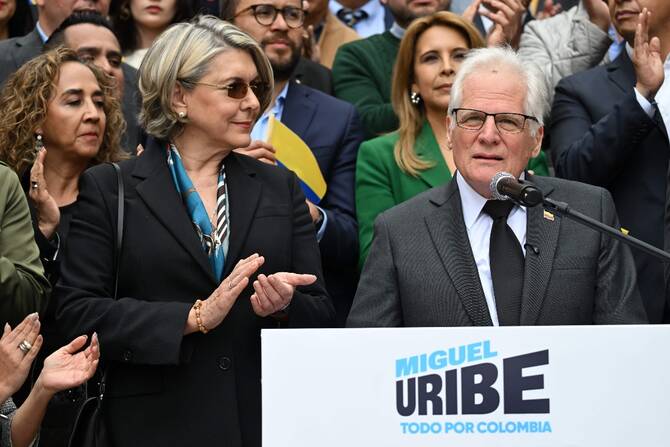
Miguel Uribe Londono, father of slain Colombian presidential candidate Miguel Uribe, announces his presidential pre-candidacy at the Colombian Congress in Bogota. (AFP)
Short Url
Updated 27 August 2025
Follow

Father of slain Colombian candidate Miguel Uribe launches presidential bid

  • Miguel Uribe Londoño, 72, announced his candidacy with a speech outside the congressional building in the capital where his son became a well known senator

BOGOTA: The father of Miguel Uribe, the Colombian presidential candidate fatally shot at a political rally earlier this year, launched a presidential campaign Tuesday in what he called an effort keep his son’s legacy alive and build a safer and more prosperous Colombia.
Miguel Uribe Londoño, 72, announced his candidacy with a speech outside the congressional building in the capital where his son became a well-known senator, and spoke behind a podium fitted with the campaign logo used by his deceased son.
“Together we can build a secure Colombia where people will not fear going out into the streets, and where business owners will not have to make extortion payments” to gangs, Uribe Londoño said in Bogota. “A democratic Colombia, where the government does not foment divisions between the rich and the poor, whites or Blacks, or those who are on the left or on the right.”
Uribe Londoño was a member of Bogota’s city council in the late 80s and a senator for Colombia’s Conservative Party in the early 90s. But he had no plans to run for the presidency before his son’s death, and was not widely known by the public.
He gained new prominence during his son’s nationally televised funeral, when he delivered a speech decrying what he called the country’s descent into “madness” under the administration of left-wing President Gustavo Petro and urging Colombians to vote in next year’s elections.
Uribe Londoño is one of five candidates that are running for the Democratic Center, the conservative party that Miguel Uribe belonged to. The party has said that later this year, it will use opinion polls to decide on its final candidate.
Sergio Guzman, a political analyst in Bogota, said that Uribe Londoño’s decision to enter the presidential race “reinvigorates” the Democratic Center, which has struggled to find a popular candidate while its leader, former President Alvaro Uribe, fights corruption allegations in Colombian courts. The former president is no relation to Uribe Londoño
Guzman said that Uribe Londoño, whose wife was murdered in the 1990s, “symbolizes the pain of many victims, especially those who are conservatives.”
Uribe Londoño’s entry into the presidential race comes as Colombia faces a new wave of violence, caused largely by rebel groups and drug gangs that are trying to take over territory abandoned by the FARC, the guerrilla army that made peace with the government in 2016.
Last week, seven people were killed as a FARC hold-out group set off a car bomb outside a military base in Colombia’s third largest city. While in the province of Antioquia, rebels took down a helicopter that was conducting anti-narcotics operations, killing 13 police officers.
Petro has attempted to broker peace deals with the nation’s remaining rebel groups, and granted many of them ceasefires in an effort to boost negotiations. But these peace talks have yielded few results, and critics of the president say they have helped the rebel groups to become stronger.
“I am not the only father who has lost that which he loved the most” Uribe Londoño said on Tuesday. “But I would like to be voice of the latest father, who has had to accept the cruel destiny that they want to impose on us with violence and terror.”


Poland’s political divide hobbles reform as war rages next door

Updated 1 sec ago
Follow

Poland’s political divide hobbles reform as war rages next door

WARSAW: With war raging in neighboring Ukraine and deep division at home, Poland’s pro-European government has become deadlocked as the country’s nationalist president blocks reforms at an unprecedented scale.
Although he has held office for just four months, President Karol Nawrocki, supported by Poland’s right-wing opposition, has already vetoed 17 laws passed by parliament.
Nawrocki has also refused appointments and promotions for judges, ambassadors and special service agents.
Throughout his short tenure, the head of state has criticized Prime Minister Donald Tusk’s centrist coalition government, positioning himself as the ultimate guardian of national sovereignty.
It is a move that many in the government and opposition have compared to US President Donald Trump, with whom Nawrocki shares ideological similarities.
During the 2023 legislative campaign, Tusk promised to reverse reforms implemented between 2015 and 2023 by the nationalist Law and Justice (PiS) party.
His pro-European stance contrasts sharply with that of the PiS government, which clashed frequently with Brussels, particularly over the rule of law.
In Poland, the head of state, who serves a five-year term, traditionally plays a primarily representative role, while exerting some influence over foreign and defense policy.

- ‘Double discourse’ -

The lack of understanding on domestic affairs also extends to the foreign policy of the EU and NATO member state.
While Tusk’s government “seeks to strengthen the EU... without seeking to limit relations with the US,” Nawrocki serves as a staunch ally of Trump and his camp, Piotr Buras of the European Council of Foreign Relations think tank told AFP.
This has remained consistent “regardless” of US policy toward Europe, he added.
Opposed to Ukraine joining both the EU and NATO, Nawrocki has yet to meet Ukraine’s President Volodymyr Zelensky, despite Warsaw’s key role in delivering military and humanitarian aid against Russia’s invasion.
A staunch critic of the EU, the Polish president has accused Brussels of “depriving member states (apart from Germany and France) of their sovereignty, degrading their national democracies.”
He has also called for major reforms of European treaties.
His remarks were criticized by Foreign Minister Radoslaw Sikorski, who said that Nawrocki’s statements “contradict government policy.”
According to Buras, “this double discourse in Polish foreign policy creates some confusion among (Polish) partners (...) and undoubtedly makes Poland’s policy weaker” than it could have been.

- ‘Legislative sabotage’ -

Nawrocki has used the presidential veto for one in every five pieces of legislation passed by the Polish government, which the latter has described as “legislative sabotage.”
The vetoes range from bills proposing aid extensions for Ukrainian refugees, to green energy bills, regulations of the cryptocurrency market, taxes and the electoral code.
Some vetoes were issued in spite of public support for the laws, notably those on creating a new national park, liberalising the wind energy market, or banning the tethering of dogs.
Proposals to reform Poland’s abortion laws, among the most restrictive in Europe, have also fallen victim to the executive fracture. Under the threat of a presidential veto, the four proposals debated in parliament since 2023 have failed.
Some believe, however, that this could have a positive outcome by pushing parties toward compromise, Piotr Trudnowski of the conservative think tank Klub Jagiellonski told AFP.
“From now on, everyone will have to think three times before undertaking new initiatives if they want to be effective,” he says.