

Israel strikes on Syria kill six: state media, officials

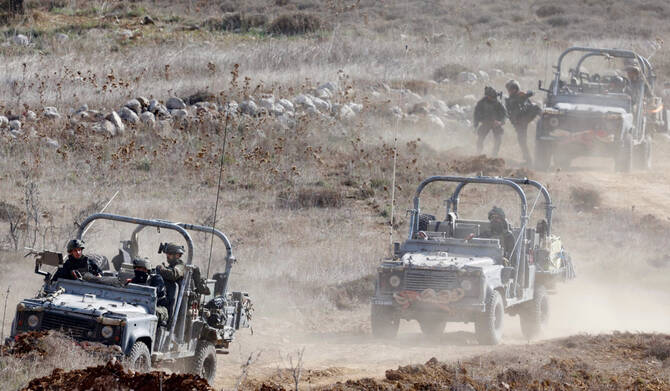
This picture shows Israeli military forces driving in the buffer zone with Syria, near the Druze village of Majdal Shams in the Israel-annexed Golan Heights, on December 11, 2024. (AFP file photo)
Short Url
Updated 27 August 2025
Follow

Israel strikes on Syria kill six: state media, officials

  • Syria condemned “the recent Israeli attacks on its territory, which resulted in the martyrdom of a young man,” the foreign ministry said
  • It also condemned the Israeli forces’ incursion into a town in the Quneitra countryside, their “arrest campaigns against civilians,” and their “announcement of the continuation of their illegal presence on the summit of Mount Hermon and the buffer zone”
  • The Qatari foreign ministry called on “the international community to take decisive action against the Israeli occupation and compel it to halt its repeated attacks on Syrian territory”

DAMASCUS: Israeli strikes killed at least six people across southern Syria, state media and official sources said Tuesday, as Israel continues attacks on the country’s new leaders even as it pursues talks.
Israel has carried out hundreds of strikes in Syria since an Islamist-led alliance toppled longtime ruler Bashar Assad in December.
It has also opened talks with the interim authorities in Damascus.

Drone strikes killed six Syrian soldiers outside Damascus, state television reported Wednesday, updating the toll for attacks the previous day, which also saw a man killed in the south.
Three soldiers were killed in an attack near Damascus, an official at the defense ministry told AFP on Tuesday.
“An Israeli drone targeted one of the military buildings of the 44th division of the Syrian army in Kiswah, west of Damascus, killing three members of the division,” the official said, speaking on the condition of anonymity.
Earlier in the day, the official SANA news agency reported that “a young man was killed in an Israeli strike on a home in the village of Taranja,” on the formerly Syria-controlled side of the armistice line on the Golan Heights.
Syria condemned “the recent Israeli attacks on its territory, which resulted in the martyrdom of a young man,” the foreign ministry said.
It also condemned the Israeli forces’ incursion into a town in the Quneitra countryside, their “arrest campaigns against civilians,” and their “announcement of the continuation of their illegal presence on the summit of Mount Hermon and the buffer zone.”
“These aggressive practices constitute a flagrant violation of the UN Charter, international law, and relevant Security Council resolutions, and constitute a direct threat to peace and security in the region.”
The Israeli military said on Sunday that it had carried out “several activities last week in southern Syria to locate weapons and apprehend suspects.”
The Saudi foreign ministry said the Israeli attacks were a “flagrant violation of the sovereignty of the sisterly Syrian Arab Republic and international law.”
The Qatari foreign ministry called on “the international community to take decisive action against the Israeli occupation and compel it to halt its repeated attacks on Syrian territory.”
Since Assad’s overthrow, Israel has occupied much of a UN-patrolled demilitarised zone on the formerly Syria-controlled side of the armistice line, including the summit of Mount Hermon, the region’s highest peak.
Last week, Syrian Foreign Minister Asaad Al-Shaibani met Israeli Strategic Affairs Minister Ron Dermer in Paris to push for a return to the arrangements that had been in place since a 1974 disengagement agreement.


IMF approves reviews, unlocks $240m in funding for Jordan

Updated 11 sec ago
Follow

IMF approves reviews, unlocks $240m in funding for Jordan

  • The decision allows Jordan to draw about $130 million under the EFF and about $110 million under the RSF

AMMAN: The International Monetary Fund’s executive board has completed the fourth review of Jordan’s Extended Fund Facility and the first review under the Resilience and Sustainability Facility, unlocking immediate access to about $240 million to support the Kingdom’s economic program.

The decision allows Jordan to draw about $130 million under the EFF and about $110 million under the RSF, bringing total disbursements under the IMF arrangement to about $733 million.

In a statement issued on Saturday, the IMF said Jordan’s economy “remains resilient,” supported by sound macroeconomic policies and strong international backing.

Growth accelerated to 2.7 percent in the first half of 2025 and is expected to reach about 3 percent in the coming years, driven by major investment projects, deeper regional integration and continued structural reforms.

Inflation remains anchored at about 2 percent, while the current account deficit is projected to narrow to below 5 percent of GDP over the medium term. The IMF also noted that Jordan’s banking sector is stable and international reserves remain strong.

Fiscal performance continues to align with program targets, underpinned by robust revenue collection and disciplined current spending. The authorities remain committed to reducing public debt to 80 percent of GDP by 2028 through gradual fiscal consolidation, while protecting social and development spending and reducing losses at public utilities.

The IMF said progress under the RSF is ongoing, with reforms addressing vulnerabilities in the water and electricity sectors and strengthening health emergency preparedness. All reform measures scheduled for the current review have been completed.

Commenting after the board discussion, IMF Deputy Managing Director Kenji Okamura said Jordan’s continued macroeconomic stability amid persistent external headwinds reflects the authorities’ commitment to sound policies, supported by strong international assistance.

He said growth continues to recover, inflation remains low and reserve buffers are strong, stressing the importance of maintaining prudent fiscal and monetary policies amid regional tensions and global uncertainty.

Okamura added that accelerated structural reforms are essential to foster job-rich growth, improve the business environment, enhance labour market flexibility, tackle youth unemployment and low female labour force participation, and attract private investment.

He also underlined the importance of sustained donor support to help Jordan manage external challenges and the economic cost of hosting large numbers of refugees, while noting that progress under the RSF would help address long-term vulnerabilities and strengthen balance-of-payments stability.