US judge temporarily blocks deportation of Salvadoran man in immigration row

1 / 2
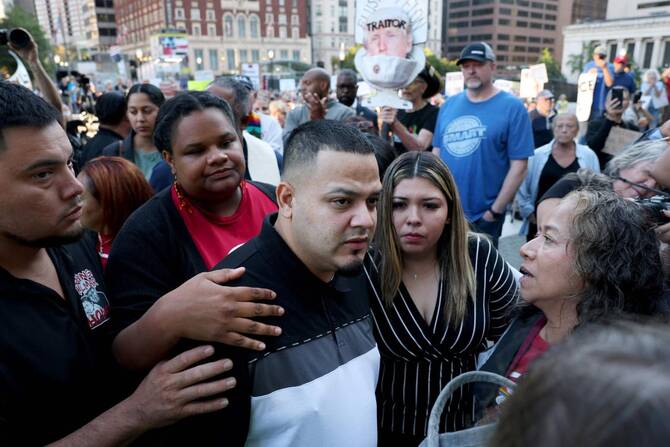
Kilmar Abrego Garcia and his wife Jennifer Vasquez Sura enter a US Immigration and Customs Enforcement (ICE) field office in Baltimore, Maryland, Aug. 25, 2025. (AFP)
2 / 2
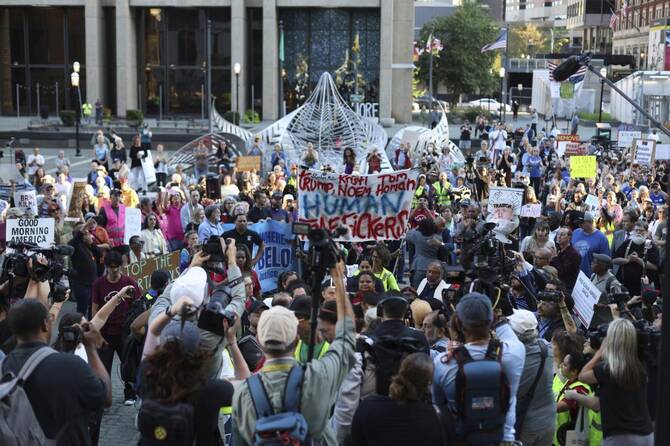
People attend a protest rally in support of Kilmar Abrego Garcia at the Immigration and Customs Enforcement field office in Baltimore, Maryland, Aug. 25, 2025. (AP Photo)
Short Url
Updated 25 August 2025
Follow

US judge temporarily blocks deportation of Salvadoran man in immigration row

  • Lawyers for Abrego Garcia immediately filed a lawsuit contesting his deportation and District Judge Paula Xinis temporarily blocked his removal from the country
  • Attempt to deport Abrego Garcia to Uganda adds a new twist to a saga that became a test case for Trump’s sprawling crackdown on illegal immigration

BALTIMORE: A federal judge on Monday temporarily blocked the deportation to Uganda of a Salvadoran man at the center of a row over US President Donald Trump’s immigration crackdown.
Kilmar Abrego Garcia, who was wrongly deported to El Salvador in March and then sent back to the United States, was arrested in Baltimore on Monday by Immigration and Customs Enforcement (ICE), Homeland Security Secretary Kristi Noem said on X.
Abrego Garcia, 30, who was released last week from a jail in Tennessee, where he is facing human smuggling charges, and allowed to go home to Maryland pending trial, “will be processed for removal to Uganda,” the Department of Homeland Security said.
Lawyers for Abrego Garcia immediately filed a lawsuit contesting his deportation and District Judge Paula Xinis temporarily blocked his removal from the country while she holds further hearings on his case.
Abrego Garcia was required to check in with ICE in Baltimore on Monday as one of the conditions of his release.
Simon Sandoval-Moshenberg, one of Abrego Garcia’s lawyers, told a crowd of supporters outside the ICE field office that his client was immediately taken into custody when he turned up for the appointment.
“Shame, shame,” chanted the protesters, who were holding signs reading “Free Kilmar” and “Remove Trump.”
The attempt to deport Abrego Garcia to Uganda adds a new twist to a saga that became a test case for Trump’s sprawling crackdown on illegal immigration — and, critics say, his trampling of the law.
Abrego Garcia had been living in the United States under protected legal status since 2019, when a judge ruled he should not be deported because he could be harmed in his home country.
Then he became one of more than 200 people sent to El Salvador’s CECOT mega-prison in March as part of Trump’s crackdown on undocumented migrants.
But Justice Department lawyers admitted that the Salvadoran had been wrongly deported due to an “administrative error.”
He was returned to US soil only to be detained again in Tennessee on human smuggling charges.
Abrego Garcia denies any wrongdoing, while the Trump administration alleges he is a violent MS-13 gang member involved in smuggling of other undocumented migrants.
On Thursday, when it became clear that Abrego Garcia would be released the following day, government officials made him a plea offer: remain in custody, plead guilty to human smuggling and be deported to Costa Rica.
He declined the offer.
“That they’re holding Costa Rica as a carrot and using Uganda as a stick to try to coerce him to plead guilty to a crime is such clear evidence that they’re weaponizing the immigration system in a manner that is completely unconstitutional,” Sandoval-Moshenberg said.
The case has become emblematic of Trump’s crackdown on illegal migration.
Right-wing supporters praise the Republican president’s toughness, but legal scholars and human rights advocates have blasted what they say is a haphazard rush to deport people without even a court hearing, in violation of basic US law.


Sarkozy describes his prison stay and advises on appealing to the far right in his new book

Updated 2 sec ago
Follow

Sarkozy describes his prison stay and advises on appealing to the far right in his new book

PARIS: Former French President Nicolas Sarkozy described the prison where he spent 20 days as a noisy, harsh “all-grey” world of “inhuman violence” in a book released Wednesday that also offered political advice about how his conservative party should appeal to far-right voters.
In “Diary of a Prisoner,” the 70-year-old says his own tough-on-crime stance has taken on a new perspective as he recounts the uncommon turn in his life after being found guilty of criminal association in financing his winning 2007 campaign with funds from Libya.
The court sentenced him in September to five years in prison, a ruling he appealed. He was granted release under judicial supervision after 20 days behind bars.
The book provides a rare look inside Paris’ La Santé prison, where Sarkozy was held in solitary confinement and kept strictly away from other inmates for security reasons. His loneliness was broken only by regular visits from his wife, supermodel-turned-singer Carla Bruni-Sarkozy, and his lawyers.
Sarkozy wrote that his cell looked like a “cheap hotel, except for the armored door and the bars,” with a hard mattress, a plastic-like pillow and a shower that produced only a thin stream of water. He described the “deafening noise” of the prison, much of it at night.
Opening the window on his first day behind bars, he heard an inmate who “was relentlessly striking the bars of his cell with a metal object.”
“The atmosphere was threatening. Welcome to hell!”
Sarkozy said he declined the meals served in small plastic trays along with a “mushy, soggy baguette” — their smell, he wrote, made him nauseous. Instead, he ate dairy products and cereal bars. He was allowed one hour a day in a small gym room, where he mostly used a basic treadmill.
Sarkozy says he was informed of several violent incidents that took place during his time behind bars, which he called “a nightmare.”
“The most inhumane violence was the daily reality of this place,” he wrote, raising questions about the prison system’s ability to reintegrate people once their sentences are served.
Sarkozy, known for his touch rhetoric on punishing criminals, said he promised himself that “upon my release, my comments would be more elaborate and nuanced than what I had previously expressed on all these topics.”
Political reflections
Beyond recounting prison life, Sarkozy used the book to offer strategic political advice for his conservative Republicans party and revealed he spoke by phone from prison with far-right leader Marine Le Pen, once a fierce rival.
Le Pen’s National Rally is “not a danger for the Republic,” he wrote. “We do not share the same ideas when it comes to economic policy, we do not share the same history … and I note that there may still be some problematic figures among them. But they represent so many French people, respect the results of the elections and participate in the functioning of our democracy.”
Sarkozy argued that the reconstruction of his weakened Republicans party “can only be achieved through the broadest possible spirit of unity.”
The Republicans party has in recent years been moving away from a position held among parties for decades that any electoral strategy must be aimed at containing the far right, even if it means losing a district to another competitor.
Still, political analyst Roland Cayrol said Sarkozy’s comments came like “a thunderclap” in the decades-long position of French conservatives that the National Rally doesn’t “share the same values” and “no electoral alliance is possible” with the far right.
The former president from 2007 to 2012 has been retired from active politics for years but remains very influential, especially in conservative circles.
In the wake of Sarkozy’s comments, the Republicans’ top officials have stopped short of calling for any actual cooperation deal with the National Rally, but instead indicated they want to focus on ways to get far-right voters to choose conservative candidates.
Strained ties with Macron
Sarkozy also mentioned his former friendship with centrist President Emmanuel Macron. The two men met at the Élysée presidential palace just days before Sarkozy entered prison.
According to Sarkozy, Macron raised security concerns at La Santé prison and offered to transfer him to another facility, which he declined. Instead, two police officers were assigned to the neighboring cell to protect him around the clock.
Sarkozy said he lost trust in Macron after the president did not intervene to prevent him from being stripped of the Legion of Honor, France’s highest distinction, in June.
Last month, Sarkozy was convicted of illegal campaign financing of his 2012 reelection bid, in a major blow to his legacy and reputation. He was sentenced to a year in prison, half of it suspended, which he now will be able to serve at home, monitored with an electronic bracelet or other requirements to be set by a judge.
Last year, France’s top court upheld an appeals court decision that had found Sarkozy guilty of trying to bribe a magistrate in exchange for information about legal proceedings in which he was involved.