UK migrant arrivals on small boats reach new record

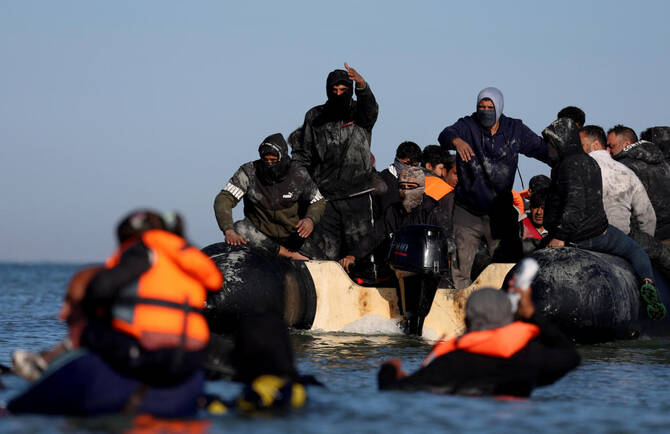
A group of migrants onboard an inflatable dinghy gesture to migrants wading through the sea before leaving the coast of northern France in an attempt to cross the English Channel to reach Britain, from the beach of Petit-Fort-Philippe in Gravelines, near Calais, France, August 25, 2025. (Reuters)
Short Url
Updated 25 August 2025
Follow

UK migrant arrivals on small boats reach new record

  • Record 28,076 migrants reach UK in small boats so far in 2025
  • Labour government pledges asylum system overhaul by 2029
  • Opposition politician Farage proposes mass deportations of migrants

LONDON: A record 28,076 migrants have crossed the Channel to Britain in small boats this year, a 46 percent rise on the same period in 2024, government data showed on Monday, piling pressure on Prime Minister Keir Starmer over his handling of immigration.

The sharp increase comes amid mounting public concern over immigration, which is polling as the public’s top concern, with anti-migrant protests continuing outside hotels housing asylum seekers.

The record was reached on Sunday after 212 migrants arrived in four different boats that day, the data showed.

The Home Office, or interior ministry, did not immediately respond to a request for comment. Demonstrations took place across Britain over the weekend following a court ruling last week that ordered the removal of asylum seekers from a hotel in Epping, north-east of London, the latest flashpoint in the immigration debate.

Starmer’s Labour government has pledged to phase out hotel use by 2029 and to overhaul the asylum system. On Sunday it announced reforms to speed up asylum appeals and reduce a backlog of more than 100,000 cases.

Home Secretary Yvette Cooper, the country’s interior minister, said the changes were aimed at restoring “control and order” to a system she described as “in complete chaos.”

Official data last week showed asylum claims were at a record high, with more migrants being housed in hotels compared with a year ago.

Nigel Farage, leader of the right-wing Reform UK party that has topped recent surveys of voting intentions, outlined plans for “mass deportations” of migrants arriving by small boats.

These would include taking Britain out of the European Convention on Human Rights, barring asylum claims, and building detention centers for 24,000 people.

He told The Times newspaper he would strike repatriation deals with countries such as Afghanistan and Eritrea, and arrange daily deportation flights.


EU leaders gather to discuss a massive loan to Ukraine

Updated 3 sec ago
Follow

EU leaders gather to discuss a massive loan to Ukraine

BRUSSELS: European Union leaders are gathering Thursday for a summit aimed at agreeing on a massive loan to cover Ukraine’s military and other financial needs for the next two years.
The leaders will also discuss migration, the bloc’s enlargement policy, trade and economies, but working out how to fund most of the 137 billion euros ($160 billion) the International Monetary Fund says war-ravaged Ukraine needs is top priority.
“It is up to us to choose how we fund Ukraine’s fight. We know the urgency. It is acute. We all feel it. We all see it,” European Commission President Ursula von der Leyen told EU lawmakers on the eve of the summit.
European Council President António Costa, who is chairing Thursday’s meeting in Brussels, has vowed to keep leaders negotiating until an agreement is reached, even if it takes days.
Many leaders will press for tens of billions of euros in frozen Russian assets held in Europe to be used to meet Ukraine’s economic and military needs.
Such a decision has never been made before, and it comes with risks. The European Central Bank has warned that if Europeans appear willing to grab other countries’ money, it could undermine confidence in the euro. Some member nations are also concerned about inviting retaliation from Russia.
Belgium, where most of the frozen assets are held at a financial clearing house, is the main opponent of the plan. It fears that Russia will strike back and would prefer that the bloc borrow the money on international markets.
Last week, the Russian Central Bank sued the Belgian clearing house Euroclear in a Moscow court, raising pressure on Belgium and its European partners ahead of the summit.
Hungary and Slovakia oppose von der Leyen’s plan for a “reparations loan.” Some 90 billion euros ($105 billion) would be lent to Ukraine until Russia ends its war and pays for the damage it has caused over almost four years. Ukrainian President Volodymyr Zelensky says that totals more than 600 billion euros ($700 billion).
The UK, Canada and Norway would fill the gap beyond the 90 billion euros ($105 billion).
Bulgaria, Italy and Malta also remain to be convinced. In recent weeks, EU envoys have worked to flesh out the details and narrow differences among the 27 member countries. If enough countries object, the plan could be blocked. There is no majority support for a plan B of raising the funds on international markets.