
DEIR AL BALAH/GAZA STRIP: Israeli forces killed four aid seekers traveling on Sunday through a military zone south of Gaza City — an area regularly used by Palestinians trying to reach a food distribution point, a hospital and witnesses said.
The deaths add to the growing toll of Palestinians killed while seeking food, as parts of the Gaza Strip plunge into famine and Israel’s military ramps up activity in northern Gaza ahead of a planned offensive to seize its largest city.
Al-Awda Hospital and two eyewitnesses told The Associated Press that the four Palestinians were killed when troops opened fire on a crowd heading to a site run by the Israeli-backed American contractor Gaza Humanitarian Foundation, or GHF, in the Netzarim corridor area. The incident hundreds of meters (yards) away from the site came as Israel’s military ramps up activity in northern Gaza ahead of a planned offensive to seize its largest city.
“The gunfire was indiscriminate,” Mohamed Abed, a father of two from the Bureij refugee camp, said, adding that while many fled some people fell to the ground after being shot.
Abed and Aymed Sayyad, another aid seeker among the crowd, said troops opened fire when a group near the front of the crowd pushed forward toward a distribution site before its scheduled opening.
Sayyad said he and others helped two people who were wounded by gunshots, one in his shoulder and the leg in his leg.
The Israeli military and GHF did not immediately respond to requests for comment.
Malnutrition-related deaths
The four deaths are the latest in areas where UN convoys have been overwhelmed by looters and desperate crowds, and where people have been shot and killed while heading to sites run by the GHF.
More than 2,000 Palestinians have been killed and more than 13,500 wounded while seeking aid at distribution points or along convoy routes used by the United Nations and other aid groups, according to Gaza’s Health Ministry.
The ministry said on Saturday that at least 62,622 Palestinians have been killed in the war, including missing people now confirmed dead by a special ministry judicial committee.
It said the number of malnutrition-related deaths rose by eight to 281. The deaths include a child, bringing the death toll among children to 115 since the war between Israel and Hamas began in 2023. A total of 174 adults have died of malnutrition-related causes since late June, it added.
The health ministry does not say how many of those killed have been fighters or civilians but says around half have been women and children. It is part of the Hamas-run government and staffed by medical professionals. The UN and independent experts consider it the most reliable source on war casualties. Israel disputes its figures but has not provided its own.
The Integrated Food Security Phase Classification — the world’s leading authority on food crises — said Friday that famine is happening in Gaza City, home to hundreds of thousands of Palestinians, and could spread south to Deir Al-Balah and Khan Younis by the end of next month.
Israel has denied there’s hunger in Gaza, calling reports of starvation “lies” promoted by Hamas.
‘Non-stop explosions’
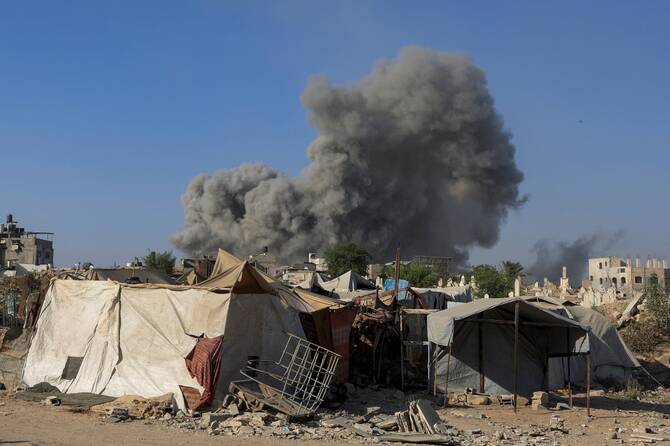
In Jabaliya, the densely populated refugee camp just north of Gaza City, residents said they endured heavy explosions overnight. Days after Israel’s military announced it was intensifying its operations in the area and mobilizing tens of thousands of reservists to take the city, they said they were living in constant fear.
In the part of Gaza City where he and his family have sheltered since being displaced from a neighborhood on the city’s southern edge, Ossama Matter said he had seen houses reduced to rubble and neighborhoods razed beyond recognition.
“They want it like Rafah,” he said, referring to a town in southern Gaza destroyed earlier in the war. “There have been non-stop explosions and strikes in the past days.”
While fleeing westward from Jabaliya, schoolteacher Salim Dhaher said he saw weaponized robots planting explosives as troops advanced from the opposite direction. As they set the stage for Israel’s push to seize the city, Dhaher said he feared it was part of a larger effort to forcibly remove Palestinians from the north.
The aim is clear, he said: “To destroy everything above the ground, and force the transfer.”
There has been little sign of the hundreds of thousands of Palestinians evacuating south ahead of Israel’s invasion of Gaza City, which Israel says is still a Hamas stronghold. Many are exhausted by repeated displacements and unconvinced that any area— including so-called humanitarian zones — offers safety.
The military operation could begin within days in a region that threatens the lives of hundreds of thousands of civilians, who are sheltering above an area Israel has invaded multiple times but still believes harbors a network of militant tunnels underground.
Hamas-led militants abducted 251 people and killed around 1,200 people, mostly civilians, in the Oct. 7, 2023, attack that triggered the war. Most of the hostages have been released in ceasefires or other deals but 50 remain inside Gaza, around 20 of them believed by Israel to be alive.