

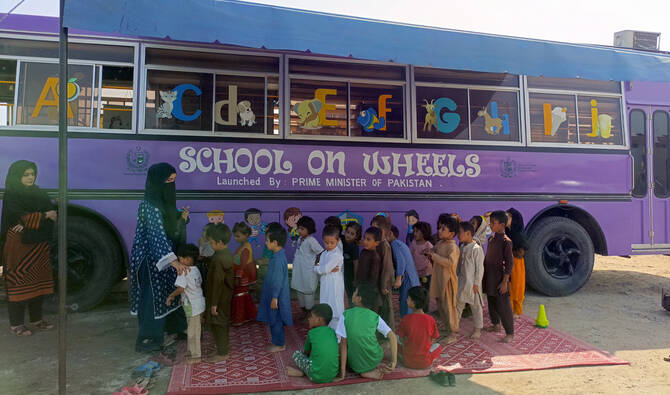

ISLAMABAD: The eyes of Mukhtiyar Ahmed shine bright as soon as he sees a colorful bus pulling over near his village, Thalla Saiyidan, on the outskirts of the Pakistani capital of Islamabad. The 62-year-old walks his grandson, Muhammad Hamza, to the vehicle where he attends a two-hour Montessori class along with other out-of-school children in their locality.
The bus, adorned with smart screens, chairs, desks, whiteboards and air conditioners, offers a ray of hope to Ahmed. For Hamza and other children, it provides a rich, interactive learning experience that is both fun and foundational, bringing primary education to rural and underserved communities in Islamabad.
Pakistan has an estimated 22.8 million children aged 5-16 not attending school, representing 44 percent of the total population in this age group, according to United Nations Children’s Fund (UNICEF). In the 5-9 age group, 5 million children are not enrolled in schools and after primary-school age, the number more than doubles to 11.4 million adolescents.
To promote education in underserved communities in Islamabad, the Pakistan government launched the “School on Wheels” initiative in 2023 , which aims to offer primary-level education to children who’ve never had a chance to attend school, especially those whose parents cannot afford to send them to formal institutions.
“He is my grandson. I leave him here in the morning and take him back at this time [noon],” Ahmed told Arab News as he came to pick Hamza after the class. “I want him to have an education so he can have a good future.”
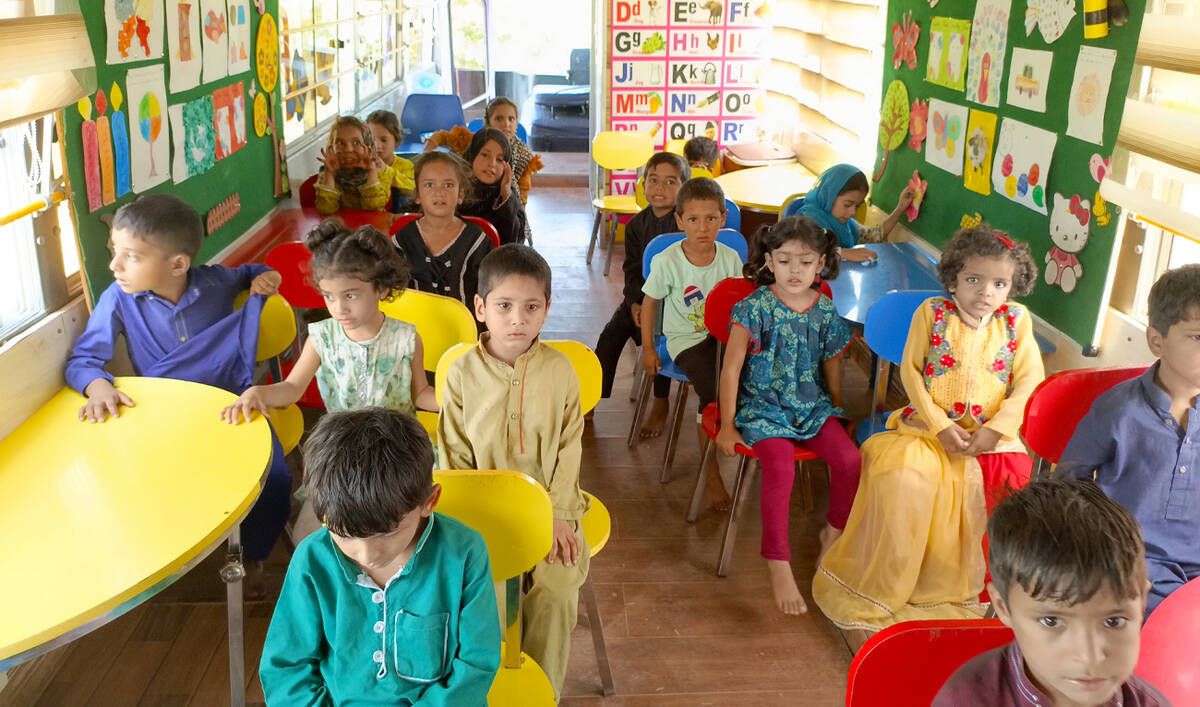
Montessori students attend a class inside bus, under the “School on Wheels” initiative in Thalla Saiyidan village, on the outskirts of Islamabad, Pakistan, on August 20, 2025. (AN)
Currently, only two operational buses travel to various informal settlements and slums in Islamabad as part of the pilot project, with officials hoping to scale it up as they describe their experimental journey as “incredible.”
“When we started, we had just 30 to 35 children across both buses,” Riffat Jabeen, the Federal Directorate of Education’s (FDE) director of academics and quality assurance, said.
“Now, in just two years, over 250 children have graduated from these mobile classrooms, many of them had never even held a pencil before stepping onto the bus.”
Jabeen stressed the critical role of School on Wheels in disaster-affected areas, especially in light of Pakistan’s recurring climate emergencies, including the recent flash floods.
“Many schools have been damaged or rendered non-functional,” she said, referring to the devastation caused by the ongoing monsoon. “According to the Pakistan School Safety Framework, aligned with international standards, education must resume within 72 hours of any disaster.”
“If we can’t rebuild schools immediately,” she continued, “mobile classrooms like School on Wheels can ensure that learning continues.”

Montessori students take part in a morning assembly under the “School on Wheels” initiative in Thalla Saiyidan village, on the outskirts of Islamabad, Pakistan, on August 20, 2025. (AN)
The government launched the initiative in Tarnol and Nilore, situated on Islamabad’s peripheries, with the aim to provide education to underprivileged children at their doorstep.
Both buses are staffed by a dedicated trio: a Montessori head teacher, a trained instructor and a sports coach, all working together to make learning hands-on, engaging and joyful for children.
“Step inside one of our School on Wheels buses, and you’ll see it’s not just a vehicle, it’s a fully equipped, air-conditioned Montessori classroom,” Dr. Ehsaan Mahmood, the area education officer of the Tarnol sector, said.
“The walls are lined with bright, level-based charts and everything the children need, from stationery to sports equipment, is already on-board,” he added. “They don’t have to bring a thing from home.”
Shadab Khan, the head teacher, said the goal is not just to teach ‘ABC’ or ‘123,’ but to foster a love for reading and learning while motivating the children to continue their education long after the bus rolls away.
“When children first step onto this bus, many of them don’t even know how to speak properly,” she said. “There’s a real language barrier, English sentences are especially tough for them to grasp.”
“They start picking up not just language, but manners, classroom etiquette and social skills such as how to sit, how to interact, how to live in a community,” she added. “These changes don’t happen overnight. It’s the result of consistent, patient work by our teachers.”

Montessori students attend a class inside bus, under the “School on Wheels” initiative in Thalla Saiyidan village, on the outskirts of Islamabad, Pakistan, on August 20, 2025. (AN)
For families like Ahmed’s, the arrival of School on Wheels isn’t just a convenience, it’s a lifeline. In places where traditional classrooms remain out of reach, this mobile initiative brings dignity, structure and the promise of a better tomorrow right to their doorstep.
“He speaks well at home, with mother, father, with us,” Ahmed said of his grandson, Hamza. “He is getting a very good upbringing.”
These brightly colored buses have become more than just vehicles for children: they’re spaces of joy, discovery and transformation.
“The kids absolutely love it,” Khan, the head teacher, told Arab News. “They’re excited to learn, they participate in every activity, and they’re developing a real passion for reading.”
“It’s heartwarming to see how motivated they’ve become,” she added.


