Pakistan urges immediate action on UN humanitarian plan for Syria

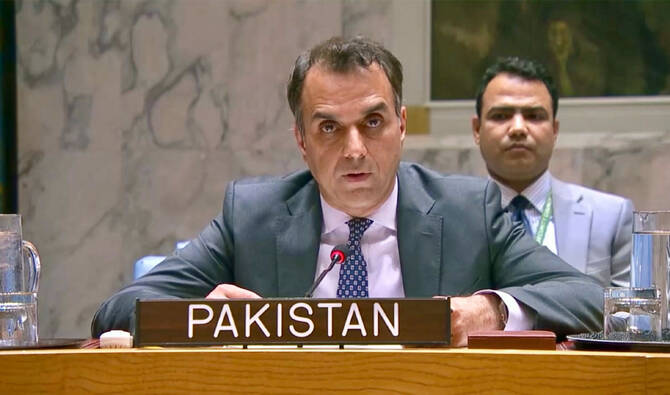
Pakistan’s Deputy Permanent Representative to the UN Ambassador, Usman Jadoon, speaks at the Security Council Briefing on UN Support Mission in Libya (UNSMIL) in New York on August 21, 2025. (@PakistanUN_NY)
Short Url
Updated 22 August 2025
Follow

Pakistan urges immediate action on UN humanitarian plan for Syria

  • Syria has been grappling with deep ethnic and religious divisions following the ouster of President Bashar Assad in December
  • Islamabad says over 16 million Syrians remain in need of assistance, deploring children continuing to face hunger, malnutrition

ISLAMABAD: Pakistan’s envoy to the United Nations (UN) has stressed urgent action to ensure adequate resources for the UN response plan to meet humanitarian needs in Syria, Pakistani state media reported on Friday.

UN humanitarian chief Tom Fletcher this week called the humanitarian situation in Syria “dire” and said aid workers need protection and safety, noting that humanitarian convoys came under fire this month.

He said money for food and other assistance is desperately needed, pointing to the UN humanitarian appeal for $3.19 billion for 2025 being only 14 percent funded.

Speaking at a UN Security Council briefing on Syria, Pakistan’s Deputy Permanent Representative to the UN Ambassador, Usman Jadoon, called for immediate humanitarian support, political inclusivity and respect for the sovereignty of Syria, the Radio Pakistan broadcaster reported.

“Over 16 million Syrians remain in need of humanitarian assistance,” he was quoted as saying. “It is deplorable that children continue to face hunger and malnutrition on a staggering scale, with access to safe water, health care and education collapsing.”

Syria is also grappling with deep ethnic and religious divisions following the ouster of President Bashar Assad in December, which brought an end to decades of Assad family rule. The transition has proven fragile, with renewed violence erupting in March along the coast and in July in Sweida, a city with a significant Druze population, highlighting the continued threat to peace after years of civil war.

Clashes erupted in Sweida on July 13 between Druze militias and local Bedouin tribes, and government forces intervened, nominally to restore order. Israel intervened in defense of the Druze, launching dozens of airstrikes on convoys of government fighters.

UN envoy for Syria Geir Pedersen warned on Thursday that while violence in Sweida has largely subsided following a ceasefire, “the threat of renewed conflict is ever-present — as are the political centrifugal forces that threaten Syria’s sovereignty, unity, independence and territorial integrity.”

“We are still seeing dangerous hostilities and skirmishes on the margins of Sweida. And violence could resume at any moment,” he said, expressing concern that “a month of relative military calm belies a worsening political climate, with escalatory and zero-sum rhetoric hardening among many.”

Pakistan’s Ambassador Jadoon strongly condemned repeated Israeli violations of Syrian sovereignty in Sweida, Daraa, Damascus and the occupied Syrian Golan.

“Such acts are in clear violation of international law, the UN Charter and Security Council’s resolutions,” he added.


Pakistan’s president defends ongoing strikes in Afghanistan, urges Kabul to dismantle militants

Updated 02 March 2026
Follow

Pakistan’s president defends ongoing strikes in Afghanistan, urges Kabul to dismantle militants

  • Afghanistan on Thursday launched attacks in retaliation for Pakistani airstrikes the previous Sunday
  • Pakistan’s military says it is only targeting Afghan military installations to avoid civilian casualties

ISLAMABAD: Pakistan’s president on Monday defended his country’s ongoing military strikes in neighboring Afghanistan, saying Islamabad tried all forms of diplomacy before targeting militants operating from Afghan territory, and called on the Taliban government in Kabul to disarm groups responsible for attacks in Pakistan.

Pakistan earlier said it is in “open war” with Afghanistan, alarming the international community. The border area remains a stronghold for militant organizations including Al-Qaeda and the Daesh (Islamic State) group.

“(The Afghan Taliban) must choose to dismantle the terror groups that survive on conflict and its war economy,” Asif Ali Zardari said during a speech to lawmakers, adding that “no state accepts serial attacks on its soil.”

Afghanistan on Thursday launched attacks in retaliation for Pakistani airstrikes the previous Sunday. Since then, Pakistan has carried out operations along the border, with Information Minister Attaullah Tarar claiming the killing of 435 Afghan forces and the capture of 31 Afghan positions.

Kabul has denied such claims.

In Afghanistan, the deputy government spokesman Hamdullah Fitrat said Pakistan’s military fired mortar shells at a refugee camp in eastern Kunar province, killing three children and injuring three others.

Afghanistan’s defense ministry said Afghan forces carried out strikes targeting a Pakistani military facility near Paktia province, causing “substantial losses and heavy casualties.”

Pakistan’s military did not respond to questions. It has said Pakistan is only targeting Afghan military installations to avoid civilian casualties.

Pakistan has witnessed a surge of violence in recent months and blames it on the outlawed Pakistani Taliban, known as Tehreek-e-Taliban Pakistan or TTP. It operates both inside Pakistan and from Afghan territory.
Islamabad accuses Afghanistan’s Taliban government of providing safe havens for the TTP, which Kabul denies.

The latest cross-border fighting ended a ceasefire brokered by Qatar and Turkiye in October. The two sides failed to reach a permanent agreement during talks in Istanbul.

Zardari reiterated Pakistan’s call for talks, saying, “We have never walked away from dialogue.”

The Pakistani leader again accused Afghanistan of acting as a proxy for India by sheltering militant groups.

“Stop being used by another country as a battlefield for their ambitions,” he said.

Zardari cited a recent report from the United Nations Security Council’s monitoring team that described the presence of militant groups in Afghanistan as an extra-regional threat.